


Agriculture in 2025: Current Trends and Future Outlook

Cho Chung-hui
Ph.D. in North Korean Studies
Director, Good Farmers (a non-profit organization)
With the first half of 2025 behind us, early assessments suggest that crop yields and farm incomes will likely keep falling. Key staple crops like rice, corn, wheat, and barley are expected to produce less than they did last year. Wheat and barley yields, in particular, are projected to drop in most regions, having no effect on the ever-rising grain prices. Additionally, delayed rice transplanting, caused by various issues—has cast a shadow over the outlook for this year’s harvest.
1. Wheat and Barley Production in the First Half of 2025
In June, as wheat harvesting began, a critical part of North Korea’s food production, TV broadcasts showed golden wheat fields across South Phyongan Province, a major grain area. Yet, once harvesting got underway, reports emerged that the actual yield was lower than it appeared, falling short of last year's already poor levels.
An official from South Phyongan cited a confidential report from the province’s Rural Management Committee, revealing that this year’s wheat and barley yield came to roughly 51,300 tons.
According to that report, the province has around 269,000 jeongbo (approximately 267,000 hectares) of farmland, with about 27,000 jeongbo used for wheat and barley. The average yield per jeongbo was 1.9 tons, ranging from 1.5 to 2.3 tons, outpacing yields in regions like North Pyongan and both South and North Hwanghae Provinces.
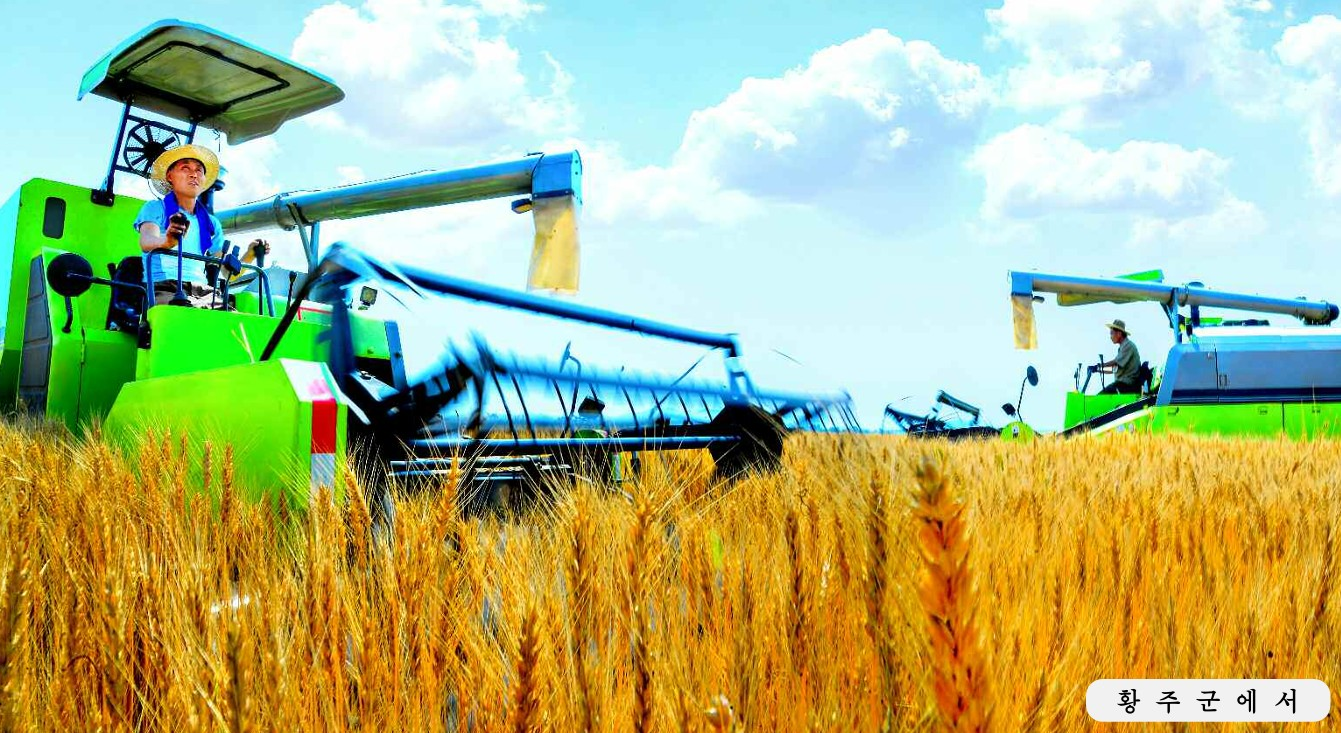
To compare, South Korea’s wheat yield averages 5.3 tons per hectare, while leading European producers report between 7 and 9 tons. Some British farms have even achieved yields as high as 16 tons per hectare.
Based on South Phyongan Province, nationwide wheat and barley output for the first half can be estimated as follows: Of the 159,000 jeongbo sown, about 40% is from South Phyongan, North Pyongan, South and North Hwanghae, Gangwon, and parts of South Hamgyong—excluding Ryanggang (wheat 55.06%, barley 31.79%), North Hamgyong (wheat 15.5%), and Jagang (wheat and barley 16.44%).
Assuming 40% of the national wheat and barley area—about 63,600 jeongbo—yields 1.9 tons per jeongbo, first-half production totals an estimated 120,840 tons. At 500 grams per person daily, this would feed the entire North Korean population for roughly 12 days.
Despite the harvest being over, market grain prices remain high: rice at 13,000 won/kg and corn at 4,500 won/kg—double the 2023 rates and still climbing. This underscores how the small wheat and barley output has done little to stabilize grain prices or ease food shortages.
What caused the production decline in early 2025? The main issues were a lack of high-quality seeds, nutrient-depleted soils, and poor weather. This March, colder temperatures and low rainfall during the tillering stage reduced the number of stalks per plant. Barley typically sprouts 6–7 stems, but this year only produced 3–4, resulting in fewer grain heads and lower overall yields.
2. Delayed Rice Transplanting and Grain Production Outlook
This year, rice transplanting across North Korea’s countryside fell behind schedule by about 20 days. Though officials claim most transplanting finished around June 15, field reports suggest it actually wrapped up closer to the end of June.
Timing is critical for rice planting. Transplanting at the right moment boosts plant growth and final yields. Delays, or even early planting, can reduce harvests. When seedlings go into the ground too late, the shortened growing period prevents the rice from maturing fully, leading to reduced yields.
This year’s delay was mainly due to weather. Spring temperatures were low, and there was a lack of protective materials like plastic covers and windbreaks. These shortages caused cold damage to seedlings. On top of that, limited supplies of fertilizer and pesticides hindered seedling growth, adding to the delays.
Normally, a transplanting delay of 10 days cuts yields by about 20%. With delays closer to 20 days this year, a 40% drop in output is possible.
Despite the government’s nationwide mobilization orders, trying to recover through sheer manpower, reminiscent of 1970s tactics—won’t solve today’s agricultural problems or food shortages.
If North Korea hopes to avoid further losses in the second half of 2025, immediate investments are essential. Crop management must improve, including proper drainage to prevent flooding and timely topdressing with nitrogen.
As climate disasters like droughts, floods, and heatwaves grow more frequent, relying on slogans and mass mobilization without external support is risky. Lacking fertilizers and pesticides hampers nutrient management and weed control, increasing the risk of severe crop failure and famine.
-
PREV [Feature Article]
-
NEXT [Feature Article]