

Assessing North Korea’s Nuclear Submarine Threat and South Korea’s Strategic Response

Cheong Seong-chang
Acting Vice President, The Sejong Institute
North Korea’s Accelerating Strategic Submarine Program
At the 8th Congress of the Workers' Party of Korea in January 2021, North Korea officially committed to developing strategic ballistic missile submarines (SSBNs). By March 2025, the country unveiled footage showing the hull of an SSBN under construction—signaling a notably rapid advancement in its submarine program.
During the 2021 congress, Kim Jong-un announced that the design of a new nuclear-powered submarine had been finalized and was undergoing a comprehensive review. He emphasized the acquisition of nuclear submarines and underwater-launched strategic weapons as one of five core priorities for strengthening national defense.
This commitment was reaffirmed in December 2023 at a plenary session of the Party Central Committee, where Kim called for a “second shipbuilding revolution” to expand naval power—both underwater and surface-based—and expedite outstanding defense modernization goals.
Until recently, many outside observers believed that North Korea’s nuclear submarine program was experiencing setbacks. That perception shifted in March 2025, when the Rodong Sinmun released images of a “nuclear-powered strategic guided missile submarine” (commonly referred to as an SSBN) under construction.
This development strongly indicates that North Korea may be nearing the capability to conduct sea-based second-strike nuclear operations.
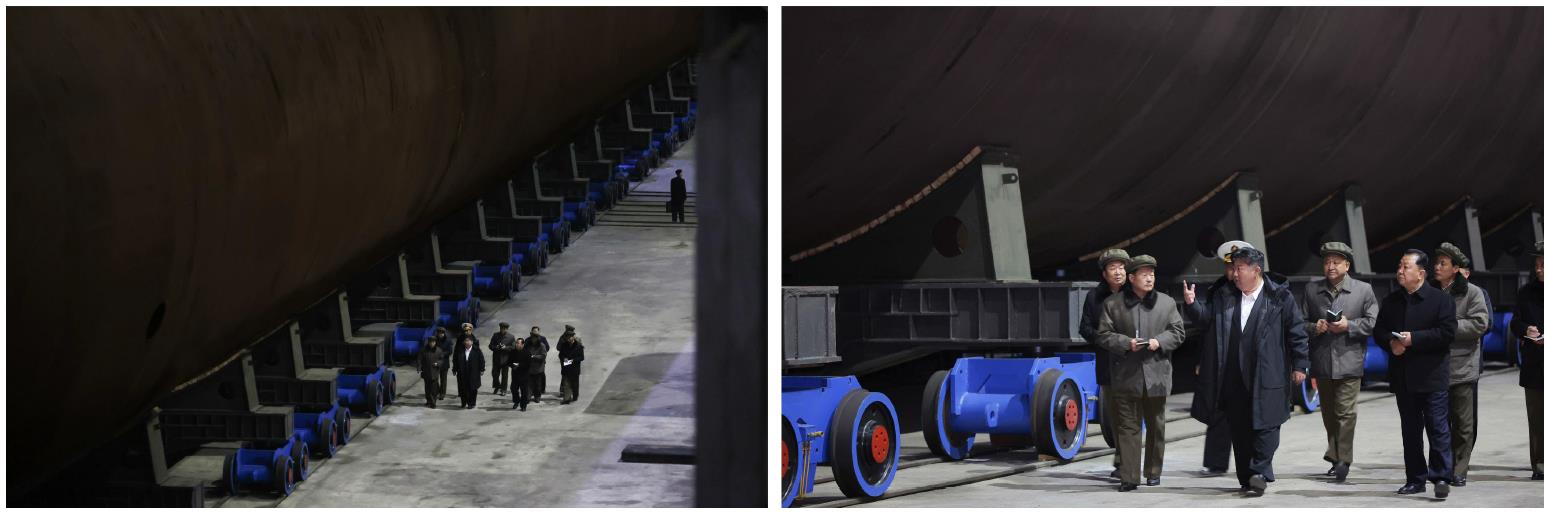
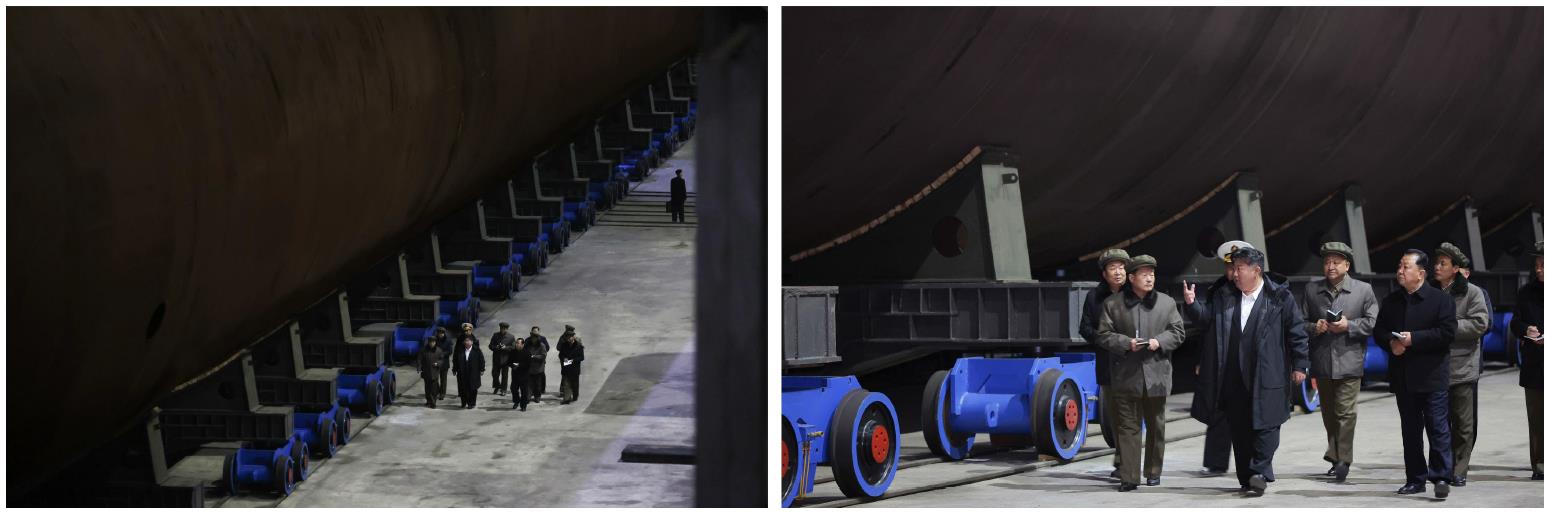
Hull of North Korea’s Strategic Nuclear Submarine Under Construction / Source: Rodong Sinmun, March 8, 2025
Though SSBN development is a highly complex endeavor, North Korea’s progress could accelerate if it receives small reactor technology from Russia, possibly in exchange for sending troops to assist in the Russia-Ukraine war.
While some analysts argue that Moscow is unlikely to share such sensitive technology, it’s worth noting that Russia previously offered related expertise to South Korea in the 1990s and supported India’s SSBN program by leasing a nuclear submarine to New Delhi.
Based on the images of a strategic nuclear submarine under construction released by North Korea in March 2025—considering factors like the hull size relative to nearby personnel and the number of support blocks—the vessel is estimated to have a displacement of around 5,000 to 10,000 tons. To operate a submarine of this size reliably, its propulsion system would need to be powered by nuclear fuel.
Given that strategic nuclear submarines are capable of covert, long-duration missions, it appears that North Korea intends to equip its submarine with at least the minimum capabilities comparable to the U.S. Navy’s Ohio-class SSBNs, in pursuit of a mutual assured destruction (MAD) deterrence posture.
Although its shipbuilding technology lags behind South Korea's, North Korea leads the world in the number of submarines it operates and has extensive construction experience. With Kim Jong-un’s strong political will and the mobilization of state resources, North Korea seems poised to complete an operational SSBN in the near future. Should this happen, it could significantly shift the strategic balance and threaten nuclear stability for both the U.S.–ROK alliance and Japan.
If North Korea complements its intercontinental ballistic missile (ICBM) capability with SSBNs able to approach the U.S. mainland undetected, it could seriously complicate Washington’s response to a nuclear or electromagnetic pulse (EMP) attack on South Korea. With stealthy submarines in play, North Korea would gain a far more credible and survivable platform for nuclear coercion, making its overall deterrent more effective than its current land-based arsenal.
The Need for South Korea to Acquire Nuclear-Powered Submarines
Should South Korea acquire nuclear-powered submarines, it would greatly enhance its ability to track and deter both North Korea’s current diesel-powered submarines carrying diesel-powered nukes and any future SSBNs. Nuclear submarines offer unmatched stealth, speed, and underwater endurance.
With top speeds reaching 46 km/h—over three times faster than diesel subs—and the capacity to carry a greater payload, their advantages are clear. These benefits led the U.S. to retire all of its diesel submarines in the 1990s and switch entirely to nuclear-powered fleets.
South Korea already has the technological capacity to design and build submarines on its own, even exporting them to other nations. The development of the 3,000-ton Jang Bogo-III-class submarine placed South Korea among the few nations capable of independently designing and constructing mid-sized submarines.
This advanced diesel sub integrates cutting-edge features such as lithium-ion batteries, air-independent propulsion (AIP), and vertical launch systems, with a localization rate of about 80%. It has earned praise for its weapons systems, submerged endurance, and automation capabilities.
A major sticking point in the debate over nuclear-powered submarines is cost. Some experts argue that constructing such vessels would be prohibitively expensive. However, according to Professor Moon Keun-sik of Hanyang University, a leading expert in the field, each South Korean nuclear-powered submarine would cost around 2.5 trillion KRW (approximately USD 2.5 billion).
In comparison, a 3,000-ton diesel-electric submarine costs about 1 trillion KRW (roughly USD 845 million). While nuclear submarines are indeed more costly, the strategic advantages they offer—such as extended underwater endurance and enhanced stealth—far outweigh the additional expense.
Furthermore, South Korea benefits from lower labor costs than the United States and boasts a highly efficient shipbuilding industry, which would significantly reduce overall construction costs compared to American programs.
Trilateral (South Korea, the U.S., and Japan) and International Cooperation
If North Korea launches an SSBN capable of stealthy operations near U.S. territory, it would secure a robust second-strike capability—intensifying the threat to the U.S., South Korea, and Japan. In light of this development, it is critical for both Seoul and Tokyo to pursue their own nuclear submarine programs.
Joint development and operation among the U.S., South Korea, and Japan would align well with U.S. strategic interests in the region. Additionally, if a Taiwan crisis were to erupt, Washington could count on the support of allied nuclear submarines from Seoul and Tokyo.
South Korea should also consider forming a broader consortium with the U.S., Japan, the UK, and Australia for nuclear submarine cooperation. However, if the Trump administration refuses to work with South Korea in this area, Seoul would be wise to look toward France—much like Brazil has.
Since South Korea is aiming to build nuclear-powered submarines using low-enriched uranium (LEU), similar to France’s approach, it could learn more from France’s operational experience than from the U.S. model.
-
PREV [Feature Article Series]
-
NEXT [Feature Article]