

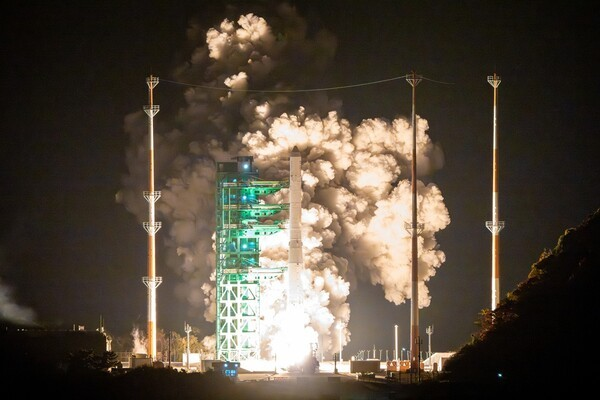
Fourth Successful Launch and the Future of Nuri Rocket

Chae Yeon-seok
Former Director
Korea Aerospace Research Institute
South Korea overcame numerous technical and operational challenges to develop its own space launch vehicle, an achievement essential for independent access to space. This capability enables the nation to place satellites into Earth orbit on demand or send probes to the Moon and asteroids.
The launch vehicle is also critical for transporting cargo to and from space stations. Moreover, successful satellite launches serve as a demonstration of the country’s scientific and technological capabilities, enhance its international standing, and inspire young people to pursue careers in science and engineering.
When the Korea Aerospace Research Institute (KARI) was established in 1989, I was assigned to lead the Space Propulsion Systems Laboratory. Its mission was to research and develop propulsion systems for space launch vehicles and satellites. Developing a space launch vehicle requires either liquid-propellant rocket engines or solid-propellant motors. At that time, South Korea could only produce small solid-propellant rockets capable of flights under 180 kilometers.
These small rockets were insufficient for a space launch vehicle, necessitating the development of liquid-propellant engines. Liquid engines are highly sensitive to unstable combustion in the chamber, which can trigger sudden pressure surges and catastrophic failure, particularly in large-diameter, high-pressure chambers.
Resolving these challenges is time-intensive, making liquid rocket engine development a lengthy and demanding process. KARI began researching liquid-propellant engines in 1991, initially focusing on small-scale systems for future space launch vehicles.
The first liquid-propellant engine, rated at 186kgf of thrust, successfully completed ground combustion tests in September 1995. Building on this achievement, South Korea’s first liquid-propellant scientific rocket, KSR-3, was developed in December 1997, for which I served as project manager.
KSR-3, funded with 80 billion won, measured 14 meters in length, one meter in diameter, and weighed six tons. It used a pressurized system to deliver liquid oxygen (LOX) and kerosene to the combustion chamber, generating 13 tons of thrust. KSR-3 was launched on November 28, 2002, reaching an altitude of 43 kilometers and a flight distance of 80 kilometers.
In 2003, construction of the Naro Space Center commenced to enable space launches, and development of a 30-ton thrust engine with a turbopump and large oxidizer tank began. Development of a 75-ton thrust engine for next-generation launch vehicles started in 2008. The Naro rocket, using a Russian-supplied first-stage engine, was successfully launched on January 30, 2013, with South Korea producing the second-stage solid-propellant rocket and the 100kg Naro Science Satellite.
The Nuri project, employing a 75-ton thrust liquid engine as the main propulsion system, began in 2010. The vehicle stands 47.2 meters tall, with first- and second-stage diameters of 3.5 meters and 2.6 meters, respectively, and a launch weight of 200 tons. The first stage combines four engines, each producing 75 tons of thrust, for a total of 300 tons.
The second stage utilizes a single 75-ton engine, while the third stage employs a seven-ton engine. The 75-ton engines generate thrust by combusting kerosene and liquid oxygen at 60 atmospheres and 3,500 degrees Celsius, effectively functioning as high-pressure furnaces in space.
The technical complexity and extreme operational conditions make these engines exceptionally difficult to develop. Furthermore, many liquid rocket components, including engines and guidance systems, are restricted under the Missile Technology Control Regime (MTCR), preventing their acquisition or technical support from other nations.
Consequently, independent development was the only viable path. South Korea independently designed all systems, producing 370,000 components from KSR-3 to Nuri. Engineers and scientists with KSR-3 experience played a central role in Nuri’s development.
Stable liquid engine performance requires extensive ground testing. For Nuri’s first-stage 75-ton engine, 33 units were built and tested 184 times, totaling 18,290 seconds of combustion. Twelve third-stage engines, rated at seven tons, underwent 16,925 seconds of testing. These extensive tests account for the reliable engine performance observed in all five launches to date.
Nuri uses kerosene and liquid oxygen, the most widely adopted propellant combination in modern launch vehicles, including SpaceX’s Falcon 9, due to its performance and cost-effectiveness. Liquid oxygen and liquid hydrogen provide higher efficiency but lower ground thrust and require booster systems, as seen in the U.S. Space Shuttle, Japan’s H-3, and Europe’s Ariane V.
Launch vehicle structures must be both lightweight and robust. Nuri’s propellant tanks, the largest-volume components, carry 182.5 tons of the 200-ton liftoff weight, or 91.25 percent of the total mass. The tanks are specially constructed to store cryogenic liquid oxygen at −183°C while withstanding launch velocities of up to 7.5 km/s.
Nuri was initially designed to place a 1.5-ton satellite into a 700km circular orbit. Through four iterative improvements, it now supports payloads of up to 1.9 tons. In November 2018, a test launch of a 26-meter vehicle weighing 53 tons and equipped with a single 75-ton engine reached 230km, validating engine performance and guidance systems. The first Nuri launch, on October 21, 2021, failed to reach orbit due to a 46-second shortfall in third-stage burn time.
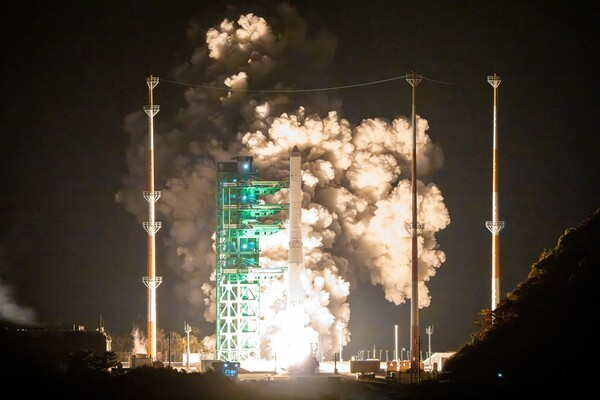
The second launch, on June 21, 2022, successfully deployed a 180kg verification satellite into a 700km orbit. Nuri No. 3, launched on May 24, 2023, placed a 180kg Next-Generation Small Satellite No. 2 along with seven CubeSats into a 550km orbit. Nuri-4, launched at 1:13 a.m. on November 27, 2025, completed the first night launch, achieving precise stage separations, placing the Next-Generation Medium Satellite No. 3 into a 600km orbit, and deploying twelve CubeSats at 20-second intervals. Launches five and six are scheduled for 2026 and 2027, respectively.
Nuri’s development, involving 370,000 parts and over 3 trillion won in funding over three decades, represents the largest R&D program in South Korea’s history. Its successful, independent development demonstrates South Korea’s high level of scientific and technological capability as well as its economic strength. Globally, only six entities operate Nuri-class vehicles: the United States, Russia, China, Japan, India, and the European Space Agency.
Future Challenges
To sustain and enhance the competitiveness of South Korea’s space launch industry, KARI and its domestic sector must continue collaborative R&D on advanced technologies, including reusable first-stage rockets and high-performance engines using liquid oxygen an liquid methane.
The government must also ensure at least one to two launches per year to provide continuous testing and operational experience. These steps are critical to the development of a sustainable domestic space industry.
-
PREV [Feature Article]
-
NEXT [Feature Article]