

President Lee Jae-myung’s Visit to China: Strategic Significance and Policy Implications
- Ending a Nine-Year Hiatus and Reanchoring Practical Diplomacy in South Korea–China Relations -

Sang-man Lee
Institute of Far Eastern Studies, Kyungnam University
(Visiting Professor, Shandong University)
1. A Visit After Nine Years: Resuming Shuttle Diplomacy and Restoring a “Manageable Relationship”
As the international system increasingly enters an era of managed strategic competition, both South Korea and China appear to be recalibrating their bilateral relationship on the basis of converging interests and pragmatic considerations.
President Lee Jae-myung’s official visit to China from January 4 to 7, 2026, carries notable symbolic weight as the first such visit by a South Korean president in nine years, following President Moon Jae-in’s trip in December 2017. Yet the significance of the visit extends well beyond the mere resumption of long-suspended diplomatic engagements.
At its core, the visit represents an effort to normalize summit-level diplomacy between Seoul and Beijing after years of stagnation. It signals a shift in South Korean foreign policy toward a more pragmatic and balanced trajectory amid rapid changes in the Northeast Asian strategic environment.
Particularly significant is the fact that the summit took place only two months after the South Korea–China leaders’ meeting held in Gyeongju in November 2025. This rapid succession suggests that top-level shuttle diplomacy—effectively dormant for several years—has entered a renewed and operational phase.
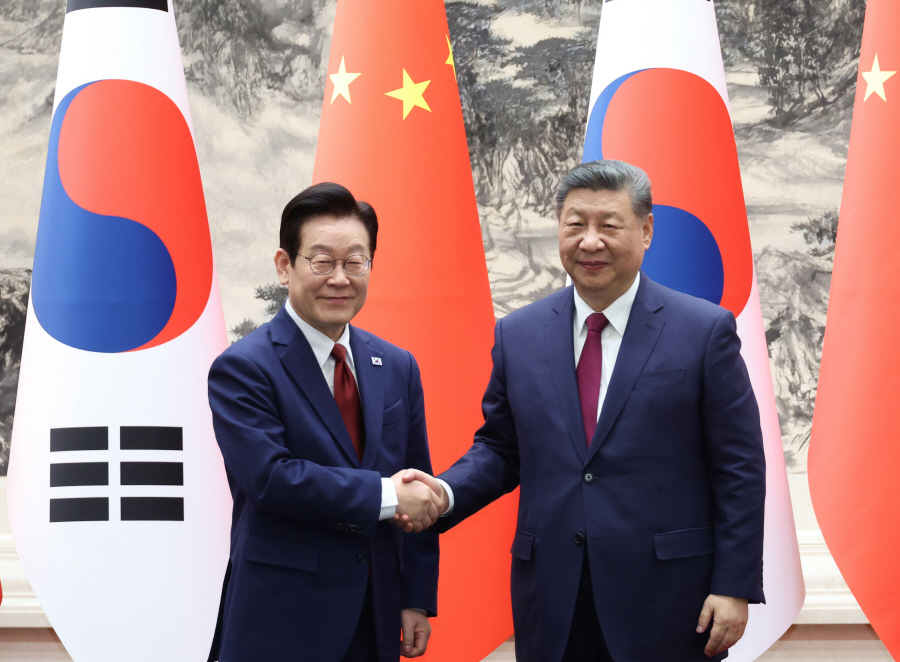
Regularized communication at the summit level is widely regarded as a key indicator of mutual trust and of a state’s capacity to manage bilateral relations. The reestablishment of an ongoing dialogue mechanism, rather than a one-off engagement, indicates that South Korea–China relations may be transitioning toward what can be characterized as a “manageable relationship.” In this sense, the meeting marked an important inflection point by restoring top-down communication channels and reinforcing institutionalized top-level engagement.
Historically, shuttle diplomacy between South Korea and China showed signs of stabilization following President Park Geun-hye’s participation in China’s Victory Day commemorations in September 2015 and President Xi Jinping’s visit to South Korea in July 2014.
However, this momentum dissipated rapidly after Seoul’s decision to deploy the THAAD missile defense system in July 2016, leading to a prolonged suspension of high-level exchanges. Against this backdrop, President Lee’s visit can be understood as an effort to restart summit-level communication and reconstruct the basic framework necessary for effective bilateral management.
Accordingly, the central objective of the summit was not a wholesale “reset” of relations but their “normalization.” This entails institutionalizing shuttle diplomacy, restoring high-level strategic dialogues across the foreign policy, security, and economic domains, and establishing mechanisms to prevent issue-specific disputes from escalating into broader political or security confrontations. In effect, the visit marked a structural revival of Korea–China summit diplomacy that had remained largely dormant since 2017.
2. Korea’s Pragmatic Position in U.S.–China Strategic Competition: Conditional Strategic Flexibility
Since assuming office, the Lee Jae-myung administration has consistently emphasized a pragmatic, national-interest–driven approach to diplomacy, grounded in an acknowledgment of the dual realities of global competition and cooperation. The visit to China should be understood within this broader effort to expand South Korea’s diplomatic autonomy and strategic space, rather than as a policy shift directed against any specific country or aligned with bloc-based logic.
The summit agenda reflected this orientation. Discussions extended beyond economic and industrial cooperation to address several long-standing issues that have weighed on bilateral relations. The participation of approximately 400 business leaders from both countries in the South Korea–China Business Forum—resumed after a nine-year hiatus—was particularly noteworthy. It underscored strong private-sector demand for renewed economic engagement, suggesting that, despite political frictions, market-driven incentives for cooperation remain substantial.
Key areas highlighted included supply chain stabilization for strategic industries such as semiconductors, batteries, and rare earth elements; improvements to the operating environment for South Korean firms in China and the mitigation of regulatory risks; and follow-up discussions on expanding the South Korea–China FTA to cover services, digital trade, and environmental sectors.
Notably, economic cooperation was placed at the forefront of the summit agenda, while political and security issues were relatively de-emphasized. This sequencing suggests South Korea’s deliberate strategy aimed at managing interdependence rather than pursuing economic decoupling from China.
In an environment where U.S.–China strategic competition is increasingly prolonged and structural, South Korea faces the challenge of managing complex relationships while minimizing exposure to strategic risk. Rather than being compelled into binary choices, Seoul appears intent on positioning itself as an actor focused on risk management and diplomatic flexibility.
From this perspective, maintaining stable relations with China is not optional but a structural necessity, and the summit can be interpreted as an effort to reframe Korea–China relations from a source of strategic volatility into an object of active management.
Cultural and people-to-people exchanges were also addressed, particularly the long-standing restrictions on Korean cultural content in China (commonly referred to as Hanhanryeong). While these measures have constrained the global expansion of the Korean Wave, such exchanges have historically functioned less as direct instruments of political pressure and more as buffers that mitigate tensions and foster mutual understanding.
Rather than framing the issue in confrontational or demands-based terms, the Lee administration has pursued incremental progress through confidence-building measures and the normalization of exchanges. The leaders’ agreement to gradually expand cultural and people-to-people interactions should be viewed positively in this context.
On the Taiwan issue—one of Beijing’s core interests—the South Korean government clarified its position by treating the matter as an internal issue for China and reaffirming respect for the One China principle. This represents a departure from the previous administration’s indirect references to opposing unilateral changes to the status quo by force. The adjustment reflects a realist recalibration, undertaken within the framework of the ROK–U.S. alliance, aimed at avoiding unnecessary entanglement in U.S.–China strategic competition over Taiwan.
Regarding China’s installation of structures in the West Sea, the two leaders agreed to pursue constructive consultations aimed at transforming the area into a zone of peace and shared prosperity. Rather than framing the issue as a sovereignty dispute, both sides emphasized stable maritime management and the prevention of accidental clashes. This approach reinforces their shared intent to address sensitive issues through practical and managerial mechanisms rather than escalation.
3. China’s Role in Inter-Korean Affairs and the Limits of Recognizing the Changed Reality on the Korean Peninsula
The Lee Jae-myung administration views China’s role as increasingly consequential amid recent shifts on the Korean Peninsula. North Korea has explicitly redefined inter-Korean relations as those between “two hostile states,” while continuing to advance its nuclear and missile programs. These developments risk entrenching structural tensions and underscore the limits of managing the situation through existing policy frameworks alone.
At the same time, the effectiveness of the international sanctions regime against North Korea has eroded over time. Prolonged reliance on sanctions and pressure has revealed clear constraints in shaping Pyongyang’s strategic behavior. Under these conditions, the task of managing tensions and creating conditions for renewed dialogue inevitably places greater emphasis on the role of neighboring states—most notably China.
Against this backdrop, it is notable that the summit’s outcome merely reaffirmed general commitments to peace and stability in Northeast Asia, without explicit reference to North Korea or the denuclearization of the Korean Peninsula. This omission underscores both the continued resilience of China–North Korea ties and the inherent limits of China’s role as a “stability manager” vis-à-vis Pyongyang. While Beijing remains a critical actor, the summit highlighted the constraints it faces in reshaping North Korea’s strategic trajectory.