

An Analysis of North Korea’s Foreign Strategy and Policy Proposals for Improving Inter-Korean Relations

Yong-hwan Choi
Institute for National Security Strategy
North Korea recently convened its Party Congress and the Supreme People’s Assembly (SPA). The Ninth Party Congress—its first in five years—reviewed achievements since the Eighth Congress and set forth a national governance strategy for the next five years. Subsequently, the 15th SPA, North Korea’s highest legislative body and the functional equivalent of South Korea’s National Assembly, was constituted and convened.
These domestic political developments unfolded amid a period of significant international turbulence, including the outbreak of conflict involving the United States, Israel, and Iran in the Middle East. Against this backdrop, this paper examines the foreign policy orientations articulated at North Korea’s most consequential political gatherings, assesses the implications of recent geopolitical developments, and identifies policy considerations for advancing peace on the Korean Peninsula and improving inter-Korean relations.
Recent Trends and Changes in North Korea’s Foreign and Inter-Korean Strategies
Since the Eighth Party Congress in 2021, North Korea has pursued a foreign policy strategy that leverages what it characterizes as a “new Cold War structure.” At its core, this strategy seeks to deepen ties with China and Russia in order to offset pressure from the United States and its allies, capitalizing on the deterioration of U.S.-China and Russia-West relations amid intensifying strategic competition and the Russia-Ukraine war.
In effect, Pyongyang assesses that shifts in the international system are creating expanded strategic space beyond the reach of the United States and the broader Western coalition, and it has actively sought to exploit these conditions.
This assessment is reinforced by the erosion of great-power consensus within the United Nations Security Council, which has significantly constrained the body’s capacity to respond to international crises. Even in instances of clear violations of UN Security Council resolutions by North Korea, additional sanctions have not been adopted because of opposition from China and Russia.
Moreover, the Russia-Ukraine war has provided a particularly favorable geopolitical environment for North Korea’s strategy. Notably, the U.S. Defense Intelligence Agency assessed in its 2025 Worldwide Threat Assessment that North Korea currently occupies its most advantageous strategic position in decades.
Several defining characteristics of North Korea’s evolving foreign strategy can be identified. First, the center of gravity in Pyongyang’s diplomacy has shifted from the United States toward China and Russia. Whereas North Korea previously operated under the assumption of a U.S.-led unipolar order, it now perceives the international system as transitioning toward a multipolar—or “new Cold War”—configuration.
As a result, relations with Beijing and Moscow have assumed parity with, if not greater importance than, relations with Washington. This shift has also altered the traditional pattern of North Korean diplomacy, which typically oscillated between crisis escalation and negotiation with the United States. With alternative strategic partners available, Pyongyang faces reduced pressure to enter negotiations with Washington on an expedited timeline.
Second, North Korea’s approach extends beyond passive alignment within a bloc structure; it reflects a willingness to actively shape and, if necessary, reinforce Cold War–style confrontation dynamics. Pyongyang appears to calculate that a polarized alignment—pitting the United States, South Korea, and Japan against North Korea, China, and Russia—does not disadvantage its strategic position.
Indeed, it has signaled its readiness to help construct such a configuration. This orientation was reflected in statements by Kim Jong-un during the 11th Plenary Meeting of the 8th Central Committee in late 2024, where he emphasized the need to create a “favorable external environment through proactive and offensive foreign activities.”
Third, North Korea’s growing confidence in its nuclear capabilities underpins its more assertive foreign policy posture. Nuclear weapons have become central to its national strategy, significantly diminishing the likelihood of denuclearization through negotiations. In a September 2025 address to the SPA, Kim Jong-un asserted that “the balance of power in the region is guaranteed by our physical deterrent,” signaling North Korea’s self-identification as a “strategic state” capable of shaping regional dynamics.
Fourth, Pyongyang’s exploitation of the “new Cold War structure” is closely linked to its “two hostile states” framework for inter-Korean relations. If North Korea seeks to sustain and benefit from bloc-based confrontation, maintaining a state of hostility toward South Korea becomes strategically consistent with that objective.
At the Ninth Party Congress, North Korea emphasized that the current international environment differs fundamentally from that of five years earlier, highlighting heightened instability and unpredictability. It attributed this turbulence to the actions of the United States and its allies, while asserting that national survival and development can be secured only through strength.
Accordingly, Pyongyang reaffirmed that it will not relinquish its status as a nuclear-armed state, framing its nuclear forces as both a guarantor of security and a stabilizing mechanism for safeguarding national interests and development. At the same time, it articulated a more proactive foreign policy vision, asserting that a “fair and just multipolar world” should be constructed—with North Korea playing a central role. This formulation aligns closely with Russia’s vision of the international order, suggesting a convergence in strategic outlook between Pyongyang and Moscow and implying sustained bilateral alignment even beyond the Russia–Ukraine war.
Two notable departures from past foreign policy frameworks were also evident. First, the Ninth Party Congress placed increased emphasis on the role of the Party Central Committee and on “national interests” in foreign policymaking. Given the traditionally dominant role of the supreme leader in North Korea’s political system, the explicit elevation of the Party Central Committee’s role in foreign affairs is particularly notable.
While this may enhance policy agility, it could also constrain flexibility at the working level. Second, North Korea adopted a “conditional hardline” posture toward the United States—leaving open the possibility of dialogue—while simultaneously reaffirming its commitment to the “two hostile states” framework in inter-Korean relations.
Pyongyang indicated that improved relations with Washington would be possible if the United States respects its status and abandons what it characterizes as a hostile policy. This formulation effectively places the onus for dialogue on the United States. In contrast, North Korea described the past eight decades of inter-Korean relations as “abnormal” and framed the hostile two-state paradigm as a long-term strategic choice rather than a temporary tactic.
Prospects for the Middle East Conflict and Implications for North Korea’s Strategy
In response to the outbreak of hostilities involving the United States, Israel, and Iran, North Korea condemned U.S. and Israeli actions as illegal and as violations of sovereignty. At the same time, it engaged in limited military signaling, including a visit by Kim Jong-un to the destroyer Choe Hyon and a test launch of a strategic cruise missile. Notably, however, Pyongyang refrained from direct personal criticism of U.S. President Donald Trump and avoided high-level provocations such as intercontinental ballistic missile (ICBM) tests.
Nevertheless, U.S. military actions targeting leadership structures in Iran are likely to heighten North Korea’s threat perceptions and reduce its willingness to engage in dialogue with Washington in the near term. At the same time, given the uncertain trajectory of the conflict, Pyongyang appears inclined to adopt a cautious, wait-and-see posture.
Taken together, recent political developments and North Korea’s response to shifting international dynamics suggest a transition from a relatively passive strategy of exploiting great-power rivalry to a more active, multipolar foreign policy orientation. While continuity remains in its effort to leverage strategic space beyond U.S. influence, the Ninth Party Congress underscored a more assertive ambition to shape the emerging international order.
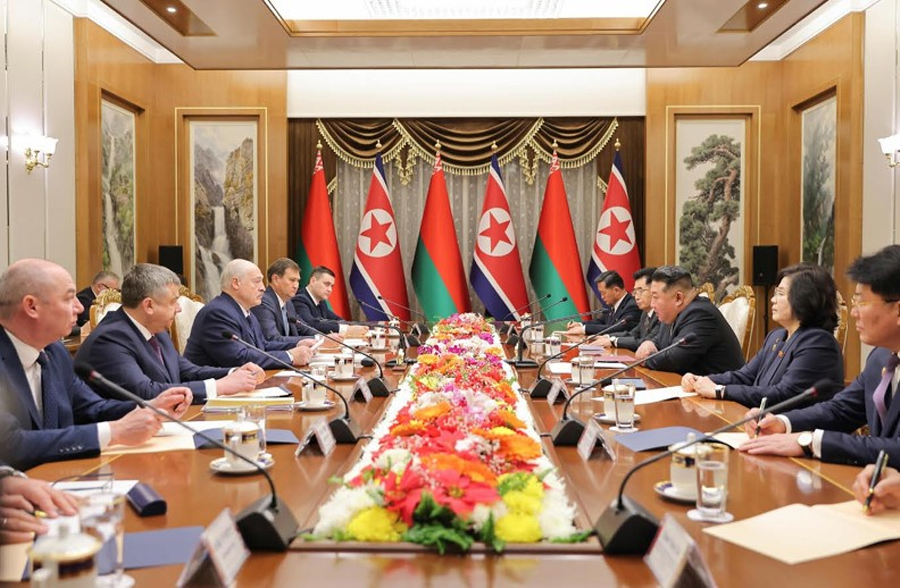
Looking ahead, North Korea is likely to expand its diplomatic engagement not only with traditional partners such as China and Russia, but also with countries in the Global South. Early indications of this trend include high-level exchanges such as the March 25 visit by Belarusian President Alexander Lukashenko.
These developments may also be connected to broader initiatives associated with a “new Eurasian security architecture,” as articulated by Russian President Vladimir Putin, including efforts such as the proposed “Eurasian Charter” involving North Korea, Russia, Belarus, Iran, and Myanmar.
By contrast, inter-Korean relations are expected to remain in a prolonged state of stalemate. North Korea’s current approach—characterized by strategic indifference rather than active escalation—suggests a continued freeze in bilateral engagement. While Pyongyang has left open the possibility of dialogue with the United States, the trajectory of U.S. policy—particularly in the context of ongoing Middle East tensions—will be a decisive factor. The key question remains whether Washington can present a proposal that North Korea deems sufficiently credible and advantageous to warrant engagement.
Challenges for Promoting Peace on the Korean Peninsula and Improving Inter-Korean Relations
Given that “hostility” and “two states” are not inherently synonymous, near- to medium-term policy toward North Korea should prioritize the mitigation of hostility. Effective crisis management between the two Koreas is essential, as even an inadvertent military clash would significantly impede any transition to dialogue.
Once hostility is reduced, attention should shift to clarifying South Korea’s policy posture and normative rationale regarding a “two-state” framework, alongside building a durable domestic consensus. Under the current constitutional framework, which remains oriented toward unification, a central question is whether the concept of unification can be broadened beyond territorial and institutional integration to encompass economic and cultural convergence.
Over the medium to long term, it will be critical to reassess approaches that place primary emphasis on resolving the “North Korean nuclear issue first” or on incremental nuclear reductions alone, both of which tend to reinforce the realist dynamics of inter-Korean relations.
Given the prevailing skepticism—not only in North Korea but also among regional stakeholders—regarding the feasibility of resolving the nuclear issue, insisting on prior denuclearization is likely to constrain any transition to dialogue. In the absence of effective external mechanisms to compel denuclearization, it is necessary to develop a strategy for managing the nuclear issue through a framework of “strategic stability.”
Leveraging a potential U.S.–China summit to catalyze the resumption of U.S.–North Korea dialogue—and subsequently extend that momentum to inter-Korean engagement—will be inherently challenging. Persuading third parties, particularly the United States and China, to bring North Korea to the negotiating table is difficult, and even if a U.S.–North Korea summit were convened, there remains a risk that it could prove largely symbolic or episodic.
To facilitate a substantive shift on the Korean Peninsula, it is first necessary to establish stability, peace, and denuclearization as shared regional objectives across Northeast Asia, including among North Korea’s key partners, China and Russia.
Accordingly, a central policy question is whether China and Russia—both of which play pivotal roles in North Korea’s external strategy—can be effectively engaged or, at a minimum, incentivized to maintain a neutral posture on Korean Peninsula issues. While South Korea’s capacity to directly influence Beijing and Moscow is inherently limited, it is nonetheless important to create conditions under which their positions do not actively constrain diplomatic progress.
Historically, North Korea has entered negotiations when it has assessed such engagement to be in its own strategic interest, rather than as a result of external inducement alone. In this regard, the ability to alter the current strategic calculus on the Korean Peninsula will be a decisive factor in determining whether a meaningful transition to dialogue can be achieved.
※ This article is a revised and reorganized version of the presentation “Analysis of North Korea’s Foreign Strategy and Measures for Improving Inter-Korean Relations,” delivered at the 77th Unification Strategy Forum hosted by the Institute for Far Eastern Studies at Kyungnam University.
-
PREV [Analysis of issues]
-
NEXT [Feature Article]