

-
 [ISSUE]
What is the “ghost disease” that North Korean defectors are talking about?In Gilju County of North Hamgyong Province, where North Korea's nuclear test site is located, local residents are haunted by a "ghost disease." Nuclear tests have caused abnormalities in the health of people living near the test site, but the exact cause is unknown. As many as six nuclear tests were conducted at the Punggye-ri test site between 2006 and 2017. The North Korean authorities have never warned or evacuated local residents in advance of these tests. Residents of Punggye-ri and the surrounding area have reported unexplained pain, vomiting, low white blood cells, nosebleeds, cancer, respiratory problems, and even death. “Radiation destroys the body's immune system, which is why it cannot be diagnosed in regular hospitals,” medical experts said. In fact, according to defectors, local North Koreans in Gilju often visit shamans because although they are in severe pain, doctors can not find the cause. “In Gilju, if you get sick, you go to a shaman who refers it to a ghost disease,” said a female defector who had lived through three nuclear tests before she left Gilju. "I was frustrating that although I had a pain all over my body as if it was poked with a knife and I suffered from insomnia, I couldn’t find out the cause from the hospital," said another North Korean defector from Gilju County who had lived through three nuclear tests. "When I was in Gilju, I heard doctors at the hospital saying that they didn’t know why there were so many liver and stomach cancer patients in Gilju," said a North Korean defector from Gilju who had lived through all six nuclear tests in the area before she defected from the country in 2019. "I, too, suffered from palpitations of the heart and headache and still take sleeping pills because I can't get sleep." North Korean soldiers who had served at the test site also testified that they were exposed to radiation. "When I was hospitalized in Gilju in 2014, a friend of mine, who was lying next to me, told me that his son-in-law had worked at the nuclear test site in Punggye-ri as a private first class and was given a special promotion to a second lieutenant and honorary military certificate upon discharging from the army, but he was not “able to leave his posterity.” "I suffer from depression, teary eyes, headache, bone pain, and pain in the chest. But, I can't be diagnosed with anything at the hospital," Kim Eul-jin from Gilju, who experienced up to the sixth nuclear test and defected in 2019, complained. In particular, some defectors testify that tuberculosis, which used to be called the ‘voracious disease’ because it was easily cured when one eats well, has led to death after the nuclear tests no matter how well one ate. "My son died of melted lungs due to tuberculosis in 2017 in Gilju," said Lee Young-ran. "I heard that several friends of his with the similar ages in Gilju also died of melted lungs," she said. "I also have gas in my stomach, and I am out of breath when I have a meal," she added. “I had a headache and took a blood test twice. My doctor was surprised to find out that my white blood cell count was so low.” Another native of Gilju who left North Korea in 2019 said, "Since 2013 when the third nuclear test was conducted, every one in two households in Gilju suffered from indigestion." "I felt bad for no reason, sometimes I had a headache, my heart fluttered, and I felt like being poked with needles," she added. "The same symptoms have continued even after I arrived in South Korea." One who was born in Punggye-ri and lived through the third nuclear test before defecting in 2014 said, "I have a headache to start with and my nose bleeds anytime." "Especially in the evening, I can't even lift a finger because I feel dead tired, and I collapse," he added.Kim Myungsung/SAND Secretary General
23.04.01 -
 [ISSUE]
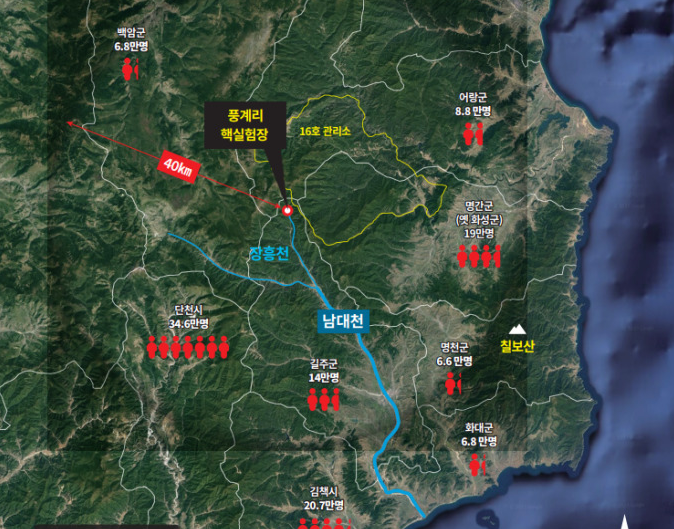
Measures against radioactive contamination needed at the nuclear test site in Punggye-ri There are growing concerns over radioactive contamination and exposure to radiation by local villagers close to the nuclear test site at Punggye-ri located on the northern tip of the Korean peninsula. SAND has long addressed this issue, and the Transitional Justice Working Group (TJWG) has conducted related researches and investigations for years. Our combined efforts have finally yielded results: the South Korean government announced that it will make a full investigation over North Korean defectors from the area. For more than a decade, people residing in the Gilju area in North Hamgyong province, where the Punggye-ri nuclear test site is located, are reported to suffer from lingering illness. They would break out in sweats and get headaches, but all that the villagers were able to hear from medical doctors at local hospitals was that no diagnosis could be made about the illness. The villagers were overcome with fear. After they have resettled in South Korea, North Korean defectors from this region were belatedly told that their illness might be related to radiation from the nuclear test site. There were six nuclear tests altogether at the site since the first one in October 2006, so the possibility of exposure to radiation and contamination of groundwater is hardly insignificant. In an investigation of 40 refugees who had lived in the Gilju area between 2017 and 2018, the South Korean government found abnormalities in nine people, but the findings were swept under the rug for unexplained reasons. Suspicions were raised that the Moon Jae-in administration covered up the case in the consideration of its relations with North Korea. TJWG, an organization that tracks and monitors human rights conditions in North Korea, however, said in a report last month that "540,000 people in the Punggye-ri area may have suffered direct or indirect radiation damages, and local agricultural products are also at risk of contamination." The group called for an examination for radiation be made on all 881 North Korean refugees who had lived in eight counties surrounding Punggye-ri before they left North Korea, and the results to be made public. The Punggye-ri test site, located at 2205 meters above sea level on Mantap Mountain, is built in a solid granite area. However, repeated nuclear tests accompanied by earthquakes that shake the ground are likely to have caused a tired mountain syndrome, according to Seo Kyun-ryeol, professor of nuclear engineering at Seoul National University. Namdaecheon, a stream that originates from Mantap Mountain, runs across the village of Gilju and flows into the East Sea passing the area between the city of Kimchaek and the county of Hwadae. The problem lies in that radiation emitted from the nuclear tests can be leaked into and spread through across the area by groundwater. Experts and international organizations express similar concerns. On March 1, a U.S. organization, the Union of Concerned Scientists, said, "Access to the geological and architectural details of the underground test sites is critical to understanding the possible pathways of radiation leakage through air and groundwater that could endanger lives of the local residents." The American scientists emphasized the role of the Comprehensive Nuclear-Test-Ban Treaty Organization (CTBTO) and similar agencies on this matter. The South Korean society is, however, lukewarm in their response to the issue. The risk arises from nuclear tests and radioactive contamination in the Korean peninsula, but South Koreans view it as if it were a problem for other countries. Their response to North Korean radiation is different from the sensitive response they showed to the release of radioactive contaminated water by Japan after an accident in Fukushima nuclear plants. The radiation leakage from North Korea is bound to be much more serious than that from Japan and the damage to be caused by contaminated water is inevitably greater, but South Koreans have applied different standards and responded complacently to the former. Radioactive contamination at North Korean test sites directly affects South Koreans’ lives as well. Mushrooms and other agricultural products from North Korea imported to the South under the guise of Chinese products are likely to pass lax customs procedures and end up on South Koreans’ plates. In fact, in 2015, the South Korean government revealed that more than nine times the allowed amount of radioactive cesium isotopes were detected in the mushrooms imported from North Korea under the guise of Chinese products. There are concerns that the smuggling and distributing mushrooms and other agricultural products and specialties from the contaminated regions could put not only North Koreans at risk, but also the people in the neighboring China, South Korea, and Japan. It is necessary to take measures, including thorough medical examination and treatment, for North Korean defectors from this region and convey to the North Korean authorities the danger of nuclear tests on the Korean peninsula and concerns of the South Korean and international community on it. The observation of Kim Jong-un fiddling with the button for his county’s seventh nuclear test calls for a more meticulous strategy for response.
23.04.01
News Letter
We are leading the global communication via Newsletter.
We will deliver the latest information and proven facts on Korean Peninsula status including North Korea situation.