

-
 [Kim Myongsung’s Inside North Korea]
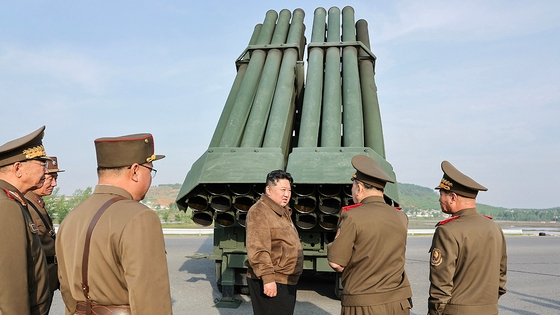
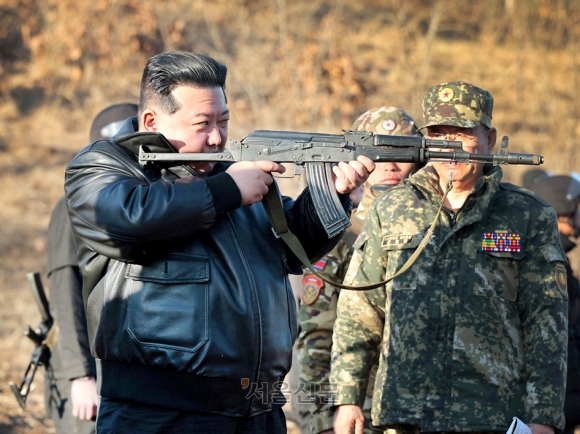
Kim Myongsung’s Inside North Korea· Kim Jong-un Test Fires Sniper Rifle and Multiple Rocket Launcher During Four-Day · Military Inspection· Kim Ki-nam, North Korea's Joseph Goebbels, Dies; Kim Jong-un Pays Tribute at Funeral· North Korea Moves to Control Jangmadang: Bans on Sale of Seafood Following FoodKim MyungsungSAND's Secretary General Editor for the SAND NewsletterKim Jong-un Test Fires Sniper Rifle and Multiple Rocket Launcher During Four-Day Military InspectionNorth Korean leader Kim Jong-un has intensively inspected the military sector over the past three days, starting from the 10th, promoting the sales of new weapons.On the 10th, Kim Jong-un was briefed by military officials about the new 240mm multiple rocket launcher. / Rodong SinmunAccording to Rodong Sinmun on the 13th, Kim Jong-un visited key defense industry enterprises under the Second Economic Committee on the 11th and 12th. During his inspection, he assessed the production status of advanced precision military goods, major sniper weapons, and the updated 240mm multiple rocket launcher.As reported by the Korean Central News Agency on the 11th, Kim Jong-un observed the updated 240mm multiple rocket launcher weapon system and witnessed the test firing of the guided projectiles on the 10th. North Korean media announced that the new guided 240mm multiple rocket launcher would be deployed to the military starting this year. The 240mm multiple rocket launcher has Seoul and the metropolitan area within its range.Kim stated, "An automatic firing command system has been introduced," and added that it will replace equipment in the Korean People's Army units from 2024 to 2026. He also drove the multiple rocket launcher vehicle himself.A photo released by the Korean Central News Agency shows the multiple rocket launcher being fired from a Transporter Erector Launcher (TEL) without anyone on board. However, cables connecting the vehicle to the outside were identified, suggesting that full automation has not yet been achieved. North Korea claims that eight multiple rocket launchers were fired, all hitting their targets.While the range of the existing 240mm multiple rocket launcher was estimated at 40-60 km, the range of the new 240mm multiple rocket launcher could extend up to 100 km. This means it could directly strike Seoul and the metropolitan area.On the 10th, Kim Jong-un personally drove the new 240mm multiple rocket launcher vehicle. / Rodong Sinmun North Korean media released photos on the 13th showing Kim Jong-un visiting a military factory and demonstrating firing a new sniper rifle. / Rodong SinmunSome observers point out that North Korea's actions, such as supplying obsolete multiple rocket launchers to Russia and deploying new ones to its military, indicate a move toward modernizing its conventional forces.The National Intelligence Service found evidence that North Korea supplied weapons, including 122mm multiple rocket launchers from the 1970s, to Russia. "We continue to monitor all aspects of military cooperation between Russia and North Korea," the agency stated.It has also been suggested that North Korea conducted test firings to export conventional weapons to friendly nations such as Russia and Iran.Kim Ki-nam, North Korea's Joseph Goebbels, Dies; Kim Jong-un Pays Tribute at FuneralOn the 9th, Kim Jong-un was seen at the grave of Kim Ki-nam, the Propaganda Minister of the ruling party, during his funeral. / Rodong SinmunThe Korean Central News Agency reported on the 10th that Kim Jong-un attended the wake and funeral of Kim Ki-nam, the Propaganda Minister of the ruling party, who died on the 7th, and accompanied the burial procession.Kim Ki-nam, who died at 94, had led the regime's propaganda efforts across three generations—Kim Il-sung, Kim Jong-il, and Kim Jong-un—earning him the nickname "North Korea's Paul Joseph Goebbels."Kim Jong-un reportedly attended the funeral at Pyongyang's Sojang Hall and expressed deep sorrow over the loss. He served as the chairman of the state funeral committee, overseeing the proceedings, and personally scattered dirt on the coffin at the Patriotic Martyrs' Cemetery in Sinmi-ri.The funeral procession of Kim Ki-nam, referred to as North Korea's Paul Joseph Goebbels, passing through Pyongyang on the 9th. / Korean Central News AgencyKim Jong-un praised Kim Ki-nam's contributions, stating, "Thanks to elder statesmen like Kim Ki-nam and their support, our state was able to continuously advance the Juche revolution despite the storms of history."Starting as Deputy Director of the Propaganda and Agitation Department of the WPK in the 1960s, Kim Ki-nam rose to Chief Propagandist, leading the idolization of the Kim family and justifying the hereditary succession, earning him the nickname "North Korea's Paul Joseph Goebbels."He visited Seoul in 2005 as the head of the North Korean delegation for the August 15th Grand National Festival, paying respects at the Seoul National Cemetery with 31 members. He also led the North Korean special envoy delegation to Seoul for former President Kim Dae-jung's funeral in August 2009.He maintained a close relationship with the Kim family, evidenced by a photo of him visiting Wonsan Agricultural College with Kim Jong-un, his older brother Kim Jong-chol, and younger sister Kim Yo-jong. The photo was later removed from North Korean media.North Korea Moves to Control Jangmadang: Bans on Sale of Seafood Following FoodIt has been reported that North Korean authorities are now controlling the sale of seafood in Jangmadang following the ban on food sales. They are also streamlining trade companies affiliated with various special agencies to reduce capitalist commercial elements and expand activities in the socialist state commercial sector.In November 2014, Kim Jong-un inspected Fishery Station No.18 under the Korean People's Army (KPA) Unit 567 / Rodong SinmunAccording to a source in Hyesan City, Ryanggang Province, an order to ban the sale of seafood in Jangmadang was issued and implemented at the end of April. Seafood sales to individual merchants at production sites have been banned, with supplies being directed exclusively to state commercial networks. Additionally, the sale of rice in Jangmadang has been banned in some areas of North Korea, including North Hamgyong Province and Ryanggang Province, to control rice supply and manage prices.This is the first time North Korea has banned the sale of seafood, aiming to weaken Jangmadang's capitalist elements and boost the state distribution network. At the 2021 8th Congress of the Workers' Party, developing a socialist commercial network was prioritized, likely to address financial difficulties by utilizing a network that can recoup funds anytime.Additionally, it has been pointed out that the reason North Korea banned the distribution of seafood in Jangmadang is to completely prevent residents from defecting by sea. A source from North Korea reported that after COVID-19, maritime defections by North Korean residents using fishing boats have increased, especially among those familiar with the sea from working on vessels linked to special agencies. The source stated, "Only boats with the national fishing plan can sail under armed supervision, thus preventing defections." If the government bans these vessels, it could also halt seafood distribution in the market. As a result, seafood distributors have reportedly switched to other businesses to sustain their livelihoods.
24.05.17 -
 [NK Focus]
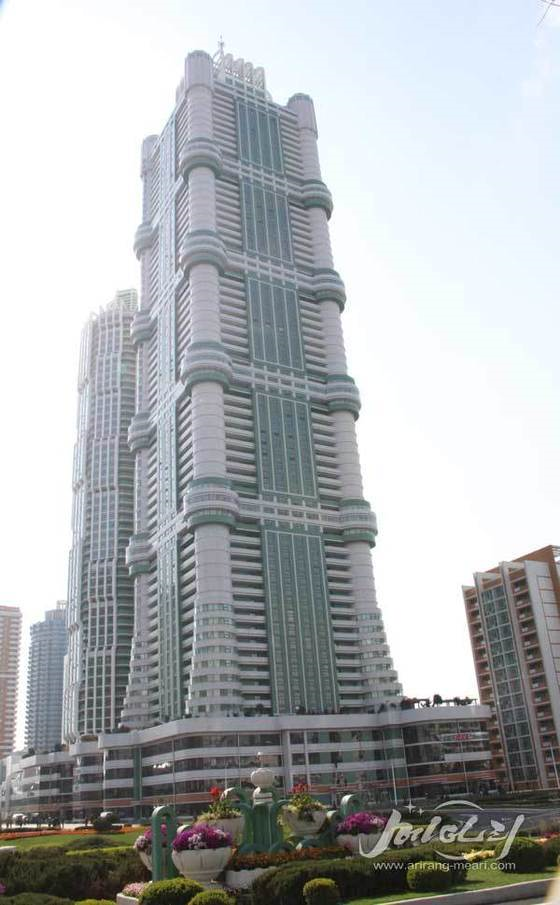
Why North Korean Residents are Reluctant to Livein Pyongyang's High-Rise New TownNorth Korea has been constructing a 'New Town' in Pyongyang, each with 10,000 homes annually for five years. However, the term 'high-rise,' previously emphasized by state media, has disappeared. Instead, the term 'building density' has emerged, indicating a change in Pyongyang's new town construction methods.The 70-floor apartment on Ryomyong Street in Pyongyang, completed in 2017 / MeariIn 2021, during the 8th Congress of the Workers' Party of Korea, North Korea announced a five-year economic development plan to build 50,000 homes in Pyongyang by 2025, at a rate of 10,000 households per year. As a result, Songhwa Street was completed in April 2022, 'Hwasong Street' for the first-stage construction project in April 2023, and 'Rimhung Street' for the second-stage construction project in April this year.The 80-floor apartment built on Songhwa Street in Pyongyang in April 2022 / Rodong SinmunSince 2013, North Korea has built apartments for scientists and educators near major universities in Pyongyang, starting with Unha Scientists Street, followed by Wisong Scientists Residential District (2014), Mirae Scientists Street (2015), and Ryomyong Street (2017). Mirae Scientists Street features a 53-floor high-rise building, and Ryomyong Street includes a 70-floor skyscraper.North Korean media often highlighted 'high-rises' while promoting Pyongyang's new towns. In May last year, 'DPRK Today' introduced the 53-floor apartment building on Mirae Scientists Street, the 70-floor building on Ryomyong Street, and the 80-floor building on Songhwa Street, noting the latter as "the tallest residential building in Pyongyang.“Last year, high-rise buildings were also introduced in the first-stage construction project in the Hwasong area. In North Korea, 'high-rise' typically refers to buildings with 50 floors or more, indicating a construction method that maximizes the floor area ratio by building tall structures.However, in the second-stage construction completed last month with 10,000 homes, the focus shifted to 'building density,' suggesting a new approach of densely packing several buildings to increase the building coverage ratio. As a result, the tallest building in the Hwasong Area's second-stage project is estimated to be under 50 floors.Photos of the Hwasong area's second-stage project released by North Korea show that buildings are predominantly around 20 to 30 floors high.Inauguration ceremony of the New Town in Pyongyang for the Hwasong area's second-stage project, April 2024 / Rodong SinmunThe change in construction methods for Pyongyang's new towns may be due to the chronic electricity shortage, which makes residents avoid high-rise apartments. Lee Eun-pyeong, a North Korean defector who participated in new town construction until 2016, explained that residents are reluctant to live in high-rises because elevators only operate during commuting hours due to electricity shortages. While solar installations have somewhat resolved lighting issues, they are insufficient for operating elevators.Additionally, during periods of high electricity demand, such as the farming season, power outages are common, often leaving elevators non-operational even during commuting hours. Water supply to high-rise buildings is also reported to be problematic. In Pyongyang, water is supplied every ten floors, but the pressure often drops after the fifth floor. Residents must carry water containers up and down stairs, and those on higher floors face such severe water shortages that even flushing toilets can be difficult.While wealthy residents may bribe elevator operators for usage, most people must carry essentials like food, coal, gas, and oil by foot.The rapid construction of high-rise buildings also raises safety concerns. North Korea's construction speed, such as completing an 80-story skyscraper in one year, is unimaginable in South Korea. While North Korea boasts about reducing construction time, experts point out the lack of discussion on essential infrastructure and building integrity. Instances of apartment collapses in Phyongsong in 2013 and Pyongyang in 2014, resulting in hundreds of casualties, raise concerns about the quality of construction.It is speculated that North Korean authorities might have shifted from building high-rises to increasing building density to mitigate potential safety hazards of hastily constructed high-rise buildings, which could pose safety risks later.
24.05.17 -
 [Issue Brief]
Evaluation of Chinese President Xi Jinping's Visit to France and Its Implications for North KoreaLee Dong-minProfessor of Political Science and International Relations at Dankook UniversityChinese President Xi Jinping began his European tour on May 7, visiting France first, followed by Hungary and Serbia. During his meeting with French President Emmanuel Macron, Xi stated that this visit would spread "stability and positive energy in a turbulent world" through deeper cooperation between France and China. Xi emphasized his aim to build new relations with France, strengthen cooperation with other European countries, and strive for world peace and stability. Notably, amid the ongoing intense conflict between Russia and Ukraine, China expressed its intention to engage in strategic communication with France, and France responded by emphasizing the importance of this dialogue.The implications of President Xi Jinping's visit to Europe should be examined from two perspectives. First, how will this tour, seen as a strategic readjustment of China's policy towards Europe, affect China-Europe relations, including China-France relations? Second, what are the implications of Xi's foreign activities for the Korean Peninsula, including North Korea? The first perspective involves extrapolating the macro-level international political implications, while the second assesses the impact on East Asia, particularly North Korea. This article will evaluate Xi's visit to France, highlighting China's policy towards Europe and inferring the implications for the Korean Peninsula, especially North Korea.Mr Macron hosted the president at the Elysee Palace on Monday morning. Pic: ReutersReview of China's Potential Policy Readjustment Towards EuropeAmid the intensifying strategic competition between the U.S. and China, China seems to be seeking to complete its Belt and Road Initiative (BRI) trade route by strengthening cooperation with France, a major European power. From China’s perspective, this effort reflects the tangible results of its long-pursued Go West policy and its intention to expand economic activities into Europe beyond its Eurasian integration with Russia. This strategy aims to disperse Western efforts to contain China. Particularly with restricted cooperation with the U.S. in high-tech fields under the Trump administration, China is looking for new opportunities through partnerships with technological powerhouses like France and Germany. Backed by substantial financial support from the Chinese government, Chinese companies are actively acquiring advanced technology firms in Europe to sustain their economic growth momentum through technological exchanges.This strategic approach by China aligns with France's interests. It bolsters France’s efforts to secure strategic autonomy, a priority since the mid-1990s, and reinforces the trend of maximizing European-centered autonomy, especially after the Russia-Ukraine war. Additionally, by solidifying economic cooperation with China, France can maximize its economic benefits. France is one of the top recipients of Chinese Foreign Direct Investment (FDI) in Europe, following the UK, Germany, and Italy. French investments in China are also steadily increasing, and China is expected to continue efforts to secure stable export markets for its companies and farmers in France.France's call for greater strategic autonomy in Europe reflects the understanding that European interests may differ from those of the United States, requiring a flexible approach. However, this does not mean increasing economic dependence on China. Instead, France aims to reduce reliance on overseas supply chains by enhancing its competitiveness through technological innovation, thereby expanding its strategic space internationally. In other words, Europe's foreign policy, including France's, should be seen as pragmatic and focused on national interests rather than pro-China.The recent actions of French leaders reflect the current situation in Europe. On April 25, President Emmanuel Macron, in a speech at Sorbonne University, warned that "the death of Europe" could become a reality due to the rapidly changing international order. He emphasized the urgency of addressing Europe's worsening poverty and strengthening industrial capabilities through investment in technological innovation and the discovery of new growth drivers based on technological independence.This suggests that France aims to enhance its internal capabilities and maximize national interests through economic cooperation, regardless of whether the partners are democratic or authoritarian states. Should the Russia-Ukraine war end early, Europe might restore cooperation with Russia. Countries like France and Germany, experiencing war fatigue, may find it hard to ignore the pro-Russia factions within their nations advocating for cooperation with Russia to secure cheap energy supplies essential for European economic growth. Interestingly, Xi Jinping's subsequent visits to Hungary and Serbia, both pro-Russia countries that maintain economic cooperation with Russia despite the war, raise concerns that strengthened cooperation between these countries and China could further consolidate China-Russia ties in Eastern Europe.These strategic positions of Europe are also linked to the potential readjustment of U.S. foreign policy. Europe’s actions may reflect considerations of a possible weakening of U.S. security commitments to Europe if domestic political instability in the U.S. increases. Albridge Colby, who oversaw the 2017 National Security Strategy (NSS) under the Trump administration, argued that the U.S. should shift its focus from actively ensuring European security to managing China's strategic rise, preventing changes in the status quo in the Taiwan Strait, and promoting an "Anti-Hegemonic Coalition" to strengthen cooperation with democratic states in East Asia.From this perspective, France’s pursuit of strategic autonomy should be seen not as a pro-China move, but as an effort to explore new foreign policy initiatives based on a solid European identity during times of international upheaval. President Emmanuel Macron maintains that protecting democratic systems is essential and expresses concerns about authoritarian regimes. However, he also acknowledges the practicality of strengthening economic cooperation with authoritarian states like China.Evaluation of Trends in Strengthening China-Europe Cooperation and Implications for North KoreaThe trend of strengthening China-Europe cooperation and expanding Europe's strategic autonomy is likely to solidify the China-Russia alliance, which is expected to have significant indirect impacts on the Korean Peninsula, particularly North Korea.Firstly, as Europe's strategic autonomy grows, the China-Russia alliance is expected to gain more momentum. The recent meeting between the leaders of China and France, shortly after German Chancellor Olaf Scholz's visit to China in April, reflects how Europe’s two key powers are competitively strengthening their relationships with China. In the future, countries like Hungary and Serbia are also expected to secure Chinese FDI, thereby increasing economic exchanges with China. The problem is that as cooperation between China and Russia in the economic, military, and energy sectors deepens, Europe’s closer ties with China will legitimize the China-Russia alliance. This could further tighten the relationship between the two countries, potentially weakening the effectiveness of the current international sanctions against Russia.Secondly, if China and Russia expand their cooperation to include European countries, North Korea might try to join this new economic bloc, similar to its ties with Eastern Bloc socialist countries centered around the Soviet Union during the Cold War. If major European countries like France and Germany shift from the value-based diplomacy promoted by the Biden administration, which advocated for a united front of democracies against authoritarian states, to a more pragmatic diplomacy focused on Europe’s economic growth, this could loosen the “democracy vs. authoritarianism” confrontation. This shift might weaken the democratic alliance, potentially leading to a relaxation of sanctions against North Korea, which would benefit Pyongyang. Consequently, North Korea might prioritize cooperation with China and Russia over improving relations with South Korea, Japan, or the United States. Thirdly, if China strengthens its ties with Europe and further solidifies its relationship with Russia, North Korea would welcome the reinforcement of the North Korea-China-Russia triangular alliance, helping it overcome international isolation. This situation could lead to North Korea becoming more dependent on China, thereby strengthening China’s strategic position. Conversely, the strengthened China-Russia alliance would provide North Korea with more strategic maneuvering space. The previously strained North Korea-China relationship, due to close North Korea-Russia ties, might stabilize. ① Economic: The deepening China-Russia relationship could help stabilize North Korea's economy. ② Diplomatic: Improvement in North Korea’s relations with South Korea, Japan, and the U.S. might become a lower priority. ③ Security: The visible North Korea-China-Russia triangular alliance could increase security instability in Northeast Asia.On May 16, Vladimir Putin's visit to China is likely to further elevate bilateral relations. North Korea is expected to actively seek to enhance its military and security capabilities, leveraging these changes in the external environment. If permanent members of the UNSC, such as China and Russia, fail to enforce economic sanctions imposed on North Korea for its development of Weapons of Mass Destruction (WMD) like nuclear and missile capabilities, North Korea will likely exploit this strategic breakthrough. The creation of economic revitalization opportunities and a favorable international environment will bolster the Kim Jong-un regime's confidence, potentially leading to a more aggressive stance towards South Korea and raising military tensions on the Korean Peninsula.As discussed, the growing cooperation between key European powers like France and Germany with China has significant implications. North Korea is likely to seize this opportunity to enhance its economic, diplomatic, and security position. Therefore, we must closely monitor changes in the security environment around us.
24.05.17 -
 [Political Terminology]
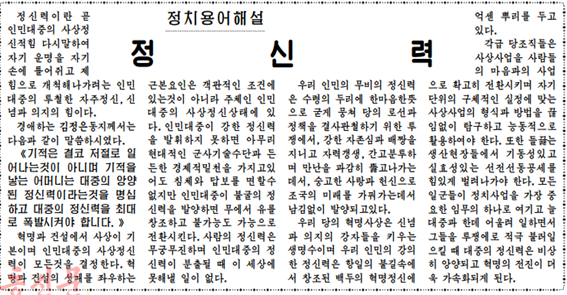
Introducing 'Spiritual Strength'—a North Korean political term that underscores the importance of mental fortitude over material wealth in sustaining the regime. It serves as a strategic tool to reinforce collective consciousness and de-emphasize individualism.[Political Terminology] Spiritual StrengthThe term "spiritual strength" refers to the ideological fortitude of our people, epitomizing their resolute self-reliance to shape their own destiny with unwavering determination and belief.(March 1, 2024, Page 2, Rodong SinmunOur esteemed leader, Comrade Kim Jong Un, once remarked:"Miracles don't happen on their own. The mother who gives birth to miracles must remember the solid spiritual strength of our people and unleash its full potential."In revolution and construction, ideology reigns supreme. The ideological vigor of our people dictates the outcome of everything. Success or failure isn't determined by objective conditions alone but by the ideological and spiritual state of our people. Without robust spiritual strength, even advanced military technology and a stable economic base can't prevent stagnation. Yet, when our people ignite their indomitable spirit, they can achieve the impossible. Human spiritual strength knows no bounds, and when our people's spirit surges, there's nothing beyond their reach.Our people's boundless spiritual strength shines through in their unwavering unity behind the leader's guidance, their steadfast adherence to the Party's directives, and their fearless resolve and dedication to overcome any obstacle for the country's future.The revolutionary ideology of our Party is the cornerstone for nurturing resolute individuals. The deep-rooted spiritual strength of our people stems from the revolutionary fervor of Baekdu, forged in the crucible of anti-Japanese struggle. Party organizations at all levels must integrate ideological work into people's minds and actions, constantly adapting methods to suit local conditions.Additionally, robust and effective propaganda efforts must be conducted vigorously in bustling production sites. When every worker views political work as paramount, uniting with the masses to spur them into action, the people's spiritual strength soars, propelling the revolution forward at an accelerated pace.
24.05.03 -
 [Kim Myongsung’s Inside North Korea]
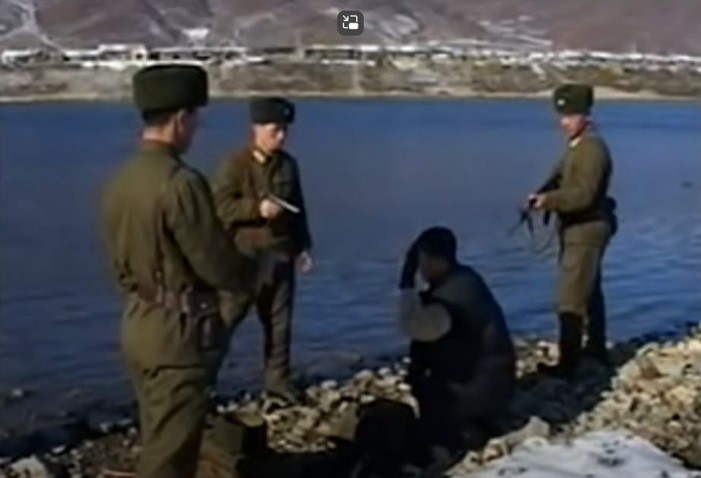
 Fifty North Korean Defectors Forcibly Repatriated from Changbai, Jilin Province, China in Late AprilFifty North Korean defectors, previously detained in a prison in Changbai, Jilin Province, China, were forcibly repatriated to North Korea on the 26th of last month.A North Korean propaganda video shows border guards arresting smugglers at the China border / Photo by SAND Institute English News TeamLocal sources in Changbai report that the day following North Korea's Partisan Foundation Day, April 26th, saw fifty detained North Korean defectors transported by two buses through customs to Hyesan City in Ryanggang Province. The Chinese police, to avoid attracting attention, reportedly had the defectors change into civilian clothes for the repatriation. These individuals were among those not repatriated during a major operation last October, staying in China until their sentences ended.Sources indicated Chinese authorities are thoroughly interrogating defectors, probing their escape timelines, accomplices, and any brokers who assisted them.Additionally, Chinese security forces targeted North Korean women trafficked into rural areas who had started families with Chinese spouses. In March and April, over twenty of these women in Jilin Province were detained and repatriated.China has reportedly supplied North Korea with surveillance gear to fully block border defections. Experts say this strengthens their ties, using defector repatriation as a diplomatic gesture to tighten border control.Footage Surfaces of Kim Jong-un's Security Using Japanese Toyota Vehicles, Flouting North Korea SanctionsNK News, a U.S.-based North Korean specialist outlet, reported on the 26th that Kim Jong-un's convoy was spotted with new Japanese Toyota SUVs.Kim Jong-un's convoy, featuring Japanese Toyota vehicles, was spotted during his visit to Kim Il Sung National Defense University on the 25th for Anti-Japanese Partisan Foundation Day / Photo by Korean Central Television / Yonhap News AgencyNK News analyzed footage from North Korean Central Television showing Kim Jong-un’s visit to the Kim Il Sung National Defense University. In the eighteen-vehicle convoy, they spotted six Toyota Land Cruiser 300s, with their logos removed and emergency lights installed. This discovery is the latest evidence that North Korea is circumventing United Nations sanctions, which have banned the transfer of transportation vehicles to the country since 2017. The Land Cruiser, part of Toyota's J300 series launched in 2021, starts at 110 million Korean won (about $80,000).These Toyotas were likely used to transport security personnel during Kim Jong-un’s visit to celebrate the 92nd anniversary of the Korean People's Army Foundation Day. NK News also noted the presence of two Mercedes-Benz Maybach GLS 600 SUVs, two Lexus LX SUVs, two Ford Transit vans, and five older Mercedes-Benz sedans.Earlier, in February, Kim Jong-un had received a luxury 'Aurus' car, known as the "Russian Rolls-Royce," from Russian President Vladimir Putin.NK News commented on the import of these foreign vehicles into North Korea, noting that while it is unclear how they were acquired, Kim Jong-un’s ability to sidestep international sanctions to import significant items indicates a potential for similar strategies in importing weapons and related manufacturing equipment.Rodong Sinmun Publishes Three Speeches Urging Strengthening of 'Anti-American Alliance' by Kim Yo-jong and the Ministry of Foreign AffairsLast month on the 24th, Rodong Sinmun released three speeches from Kim Yo-jong, a senior official from WPK, the Ministry of Foreign Affairs' director of external publicity, and vice foreign minister Im Chon-il, all calling for a stronger anti-American alliance.Kim Yo-jong, in her speech, sharply criticized the U.S., accusing it of hypocrisy by denouncing its “self-defensive” activities as violations of UNSC resolutions.Kim Yo-jong, Senior Official of the Workers' Party of Korea / Photo by Korean Central TelevisionThe criticisms seem to focus on recent U.S. objections to North Korea's military drills, such as the nuclear counterstrike simulation, which Pyongyang defends as rightful acts of self-defense, expressing strong discontent toward the U.S..The Director of External Publicity echoed this sentiment, stating, "Our nation will not tolerate the abnormal criminalization of legitimate defense enhancements, and will resolutely protect its sovereign rights and legal interests with more decisive and explicit actions."Im Chon-il, who oversees Russian affairs, referenced the U.S. House of Representatives' recent approval of a $60 billion military aid package to Ukraine, dismissing it as a "mere momentary illusion."The speeches, while reiterating familiar assertions, highlight efforts to weaken international sanctions through global anti-American solidarity. North Korea’s continued close ties with Russia, a leading anti-U.S. advocate, and its expanding diplomatic outreach to other anti-American nations like Iran and Belarus, align with this strategy.North Korea's plan to launch three reconnaissance satellites by year-end, viewed internationally as provocative, appears to be an attempt to shift blame for escalating tensions to South Korea and the U.S.
24.05.03 -
 [SAND Excousive]
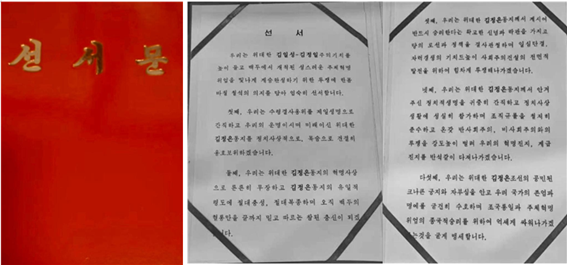
 Loyalty Oath on Kim Jong-un's 40th: Forging a New National Holiday Following Exclusion of Kim Il-sung and Kim Jong-il's Birthdays?In the midst of North Korea's decision to scrap the Day of the Sun and the Day of the Shining Star, recent confirmation reveals loyalty oath ceremonies took place on Kim Jong-un's 40th birthday, January 8th, across different institutions and businesses. This development hints at a push to establish Kim Jong-un's birthday as an official national holiday.Cover of the loyalty oath document used during the ceremony at a North Korean trade institution on Kim's 40th birthday, January 8th. / SAND Institute Newsletter Team The SAND Institute English Newsletter Team recently verified the loyalty oath document used at a North Korean trade institution on January 8th. Multiple institutions across regions confirmed administering the same oath.According to North Korean sources, on the morning of the 8th, the first working day after Kim Jong-un's birthday, all employees of a trade institution gathered in the main hall to hold a loyalty oath ceremony. This departure from convention, where loyalty oath ceremonies are typically held on national holidays such as the birthdays of Kim Il-sung and Kim Jong-il on the following day, underscores the significance of the event.Reports suggest that the loyalty oath ceremony held on Kim Jong-un's birthday, January 8th, is the first in 11 years since his inauguration in 2012. Notably, such ceremonies ceased after 2012 due to instructions against them, making their revival on Kim Jong-un's birthday after 12 years significant.Kim Jong-un, accompanied by his daughter, visits Kwangchon Poultry Farm on his 40th birthday. / Photo by Rodong SinmunThe oath, comprising five clauses, solemnly pledges to carry forward and complete the sacred revolutionary cause pioneered on Mount Paektu with the great Kim Il-Sung-Kim Jong-il idea.It emphasizes the signatories' commitment to politically and physically defending Kim Jong-un, adhering to his revolutionary ideology, showing absolute loyalty and obedience to his leadership, and believing and following only the Paektu bloodline to the end, becoming true loyalists.Furthermore, it includes commitments to maintaining belief in victory with Kim Jong-un, resolutely adhering to the party's line and policy, intensifying the struggle against all forms of anti-socialist and non-socialist forces, and striving for the ultimate victory of the country's reunification and the revolutionary cause of Juche.Sources state that "On his 40th birthday, Kim Jong-un did not have a ‘low key’ birthday but instead demonstrated his presence by holding a loyalty oath ceremony internally."Kim Jong-un's choice to host a loyalty oath ceremony on his 40th birthday, as he begins his 13th year in power, signals a shift towards political assertiveness, departing from his predecessors' approach.On January 8th, Rodong Sinmun reported that Kim Jong-un visited the Kwangchon Poultry Farm with his daughter, Kim Ju-ae, highlighting a parent's efforts to fulfill long-standing promises of providing 'meaty soup' and 'steamed rice' to the people, promises left unfulfilled for decades by previous generations and the Workers' Party of Korea.North Korea scaled back on using 'Day of the Sun,' once its top holiday for Kim Il-sung's birthday. The term vanished from state media for two months, surfacing only in one article last month on the 15th. Kim Jong-un skipped visiting Kumsusan Palace of the Sun on Kim Il-sung's birthday.Kim also requested name changes from external organizations. On the 25th, Koryo Tour, a North Korean tourism agency run by British nationals in Beijing, announced on its website the gradual phasing out of the term 'Day of the Sun,' following notification from their North Korean partners. Therefore, it's probable that North Korea will alter or remove expressions linked to the glorification of Kim Il-sung, like 'Day of the Sun.' With loyalty oath ceremonies set to resume on Kim Jong-un's 40th birthday, the country may adopt 'sun'-related titles once used for Kim Il-sung and Kim Jong-il to honor Kim Jong-un.The sources suggested Kim Jong-un's birthday might become an official commemorative day next year, eclipsing his predecessors' anniversaries.
24.05.03 -
 North Korea Initiates ‘Forgiveness Campaign’, Urges Crime Confessions in Pyongyang
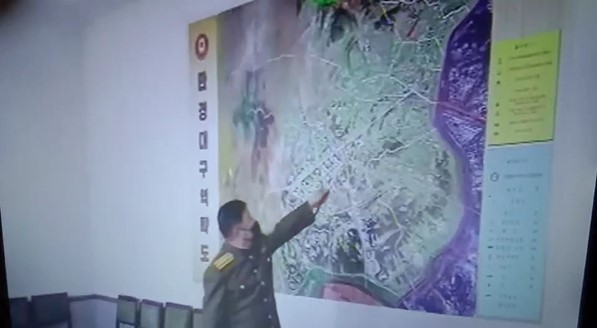
North Korea promotes self-reporting by integrating surveillance, punishment, and educational propaganda to curb the internal spread of Korean culture.A senior official from the Ministry of Social Security in the Mangyongdae District of Pyongyang City briefing on crimes against socialism in the region / SAND Institute English Newsletter Team Footage acquired by the SAND Institute reveals a campaign in Pyongyang City targeting the eradication of anti-socialist and unsocial behaviors. The footage, produced in the latter half of 2022, seems to have been aired within North Korea. It states that actions against socialism “erode unity, disrupt public order, and diminish the authority of the party and nation,” demanding their complete suppression and elimination. From early March to mid-June, Mangyongdae District saw intensified patrols, even in alleys, and through campaigns of legal education and civic political initiatives, uncovered 140 anti-socialist crimes. Similarly, in Sosong District, numerous propaganda brigades vigorously spread awareness among about 42,000 people regarding the dangers of anti-socialist and unsocial practices across hundreds of factories, workplaces, and two routes of the Pyongyang Trolleybus system.The campaign led to over a thousand residents and students reflecting on their past illegal acts, with around a hundred confessing to their deeds.Women propaganda agents from Sosong District in Pyongyang City conducting a campaign to eradicate anti-socialist behavior / SAND Institute English Newsletter TeamPropaganda efforts and strict enforcement in other parts of Pyongyang City, such as the Taedonggang and Hyongjesan Districts, have also resulted in the identification of numerous criminal activities.
24.04.19 -
 Kim Myongsung’s Inside North Korea
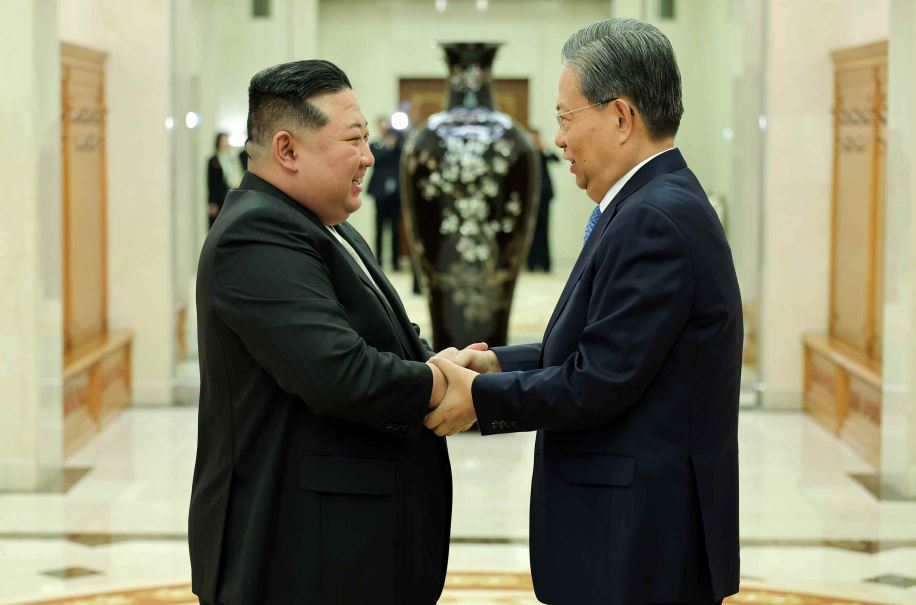
· Kim Jong-un Meets with Top Chinese Official: Discussing an Upcoming Visit to China?· Kim Jong-un says, "If the enemy opts for war, we will decisively use all means to defeat them."· North Korea Attempts to Jam GPS Signals Near Northern Limit Line in the West Sea Kim MyungsungSAND's Secretary General Editor for the SAND NewsletterKim Jong-un Meets with Top Chinese Official: Discussing an Upcoming Visit to China?North Korean leader Kim Jong-un met with China’s third-highest official, Zhao Leji, to discuss boosting bilateral cooperation. They likely also touched on Kim’s upcoming visit to China for the 75th anniversary of their diplomatic relations.Kim Jong-un greets Zhao Leji, chairman of the National People's Congress of China, with a handshake during their meeting on the 13th / Rodong SinmunKim Jong-un greets Zhao Leji, chairman of the National People's Congress of China, with a handshake during their meeting on the 13th / Rodong SinmunOn the 13th at the WPK Central Committee Office Building, Kim Jong-un met with Chairman Zhao Leji and emphasized the importance of the Chinese delegation's visit to Pyongyang. According to the Korean Central News Agency, he stated that this visit was crucial for demonstrating the unbreakable friendship between North Korea and China and for enhancing their longstanding friendly relations to align with today's needs. The KCNA further reported that both leaders had open discussions on key mutual interests, aiming to diversify and bolster their relations through dynamic exchanges and collaborations. On the same day, China’s Xinhua News Agency highlighted that Kim Jong-un remarked, “This year marks the 75th anniversary of North Korea-China diplomatic relations, heralding a new era for our bilateral relations.” While no explicit details were shared about Kim Jong-un’s visit or his potential summit with Chinese President Xi Jinping, it is likely that these topics were broached in some form during their discussions. As the 75th anniversary of North Korea-China diplomatic ties and the U.S. presidential election approach, analysts anticipate a summit to discuss economic cooperation and a joint strategy against the U.S. According to reports from North Korean and Chinese media, Kim Jong-un raised a toast for President Xi’s "longevity and health" at a luncheon with Zhao Leji. Video footage from China Central Television (CCTV) showed Kim and Zhao embracing warmly three times, signaling a strong bond. Additionally, a noteworthy gift was seen being offered to Kim Jong-un by the Chinese delegation—a statue of eight galloping horses.Kim Jong-un says, "If the enemy opts for war, we will decisively use all means to defeat them."Kim Jong-un asserted, "If the enemy opts for military confrontation with us, we will not hesitate to deploy all available means to decisively defeat them."During his 10th visit to the Kim Jong Il Political Military University, Kim Jong-un made these remarks, as reported by the Korean Central News Agency on the 11th.On the 10th, Kim Jong-un at the Kim Jong Il Political Military University for military officer training, taking a commemorative photo with the staff / Rodong SinmunKim emphasized the importance of being meticulously prepared for war, stating, "Now, more than ever, it is crucial to be thoroughly ready for war, not just any war, but one we must win decisively." He stressed the enduring principle of overcoming numerical and technological superiority with ideological and tactical superiority and commanded "absolute loyalty and obedience to the central leadership of the Party."In footage revealed by North Korea, Kim Jong-un was seen examining a detailed scale model of Seoul, with a backdrop labeled "Main Roads of Puppet Korea."North Korean media highlights the Kim Jong Il Political Military University as the top military education center, recognized during the Party's 75th Foundation Day parade in 2020.Since its founding on March 7, 1973, the Kim Jong Il Political Military University has been developing key military leaders for over 50 years, according to KCNA.North Korea Attempts to Jam GPS Signals Near Northern Limit Line in the West SeaNorth Korea attempted to jam GPS signals near the Northern Limit Line in the West Sea, just days before South Korea's 2024 elections. On the 10th, South Korea's Defense Ministry reported GPS disruptions on the 2nd and 7th near Yeonpyeong, Ganghwa, Paju, and Yeoncheon. There were 22 interference complaints at 1:23 PM on the 2nd and 46 at 2:13 PM on the 7th. The South Korean government and military, suspecting North Korean involvement in GPS disruptions, are assessing potential civilian damages. Coordination with various agencies aims to protect civilian ships and aircraft from adverse effects.GPS systems, which determine locations using satellite signals, can malfunction if disruption signals are sent. Such malfunctions could severely affect navigation systems on ships, aircraft, and even cars. North Korea's jamming signals, over 50 dBm from north of Yeonpyeong, mirrored the pre-2016 election tactics with 10-52 dBm signals affecting Haeju, Phyonggang, and Mount Kumgang, disrupting 1794 mobile bases, 1007 aircrafts, and 751 ships. During the 'Freedom Shield' joint military exercises in March, North Korea emitted weak GPS jamming signals near five West Sea islands—Baengnyeongdo, Daechongdo, Socheong, Yeonpyeong, and Small Yeonpyeongdo. Reports indicated that these signals caused no significant damage.
24.04.19 -
 Kim Jong-un and Officials Skip Memorial Visits on Kim Il-sung’s Birthday
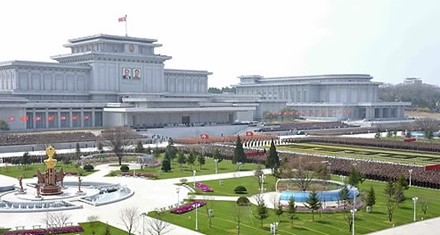
· Unprecedented in His 13 Years of Leadership · Focusing on His Own Birthday Over Previous Leaders'It has been reported that North Korean leader Kim Jong-un skipped visiting the Kumsusan Palace of the Sun on his grandfather Kim Il-sung's birthday (April 15) for the second year. This unusual move, mirrored by the absence of key officials at the commemoration, has sparked curiosity. In his 13th year of rule, Kim seems to be downplaying his predecessors' birthdays to emphasize his own, possibly to consolidate his power.The Kumsusan Palace of the Sun, resting place of Kim Il-sung and Kim Jong-il / Korean Central TelevisionThe Kumsusan Palace of the Sun holds the remains of Kim Il-sung and Kim Jong-il. Kim Jong-un has previously attended this site on major anniversaries. Since taking power, he had even declared the palace a sacred place by law in 2013, the year following his inauguration. North Korean media, including Korean Central Television, did not report any visits by Kim Jong-un or senior officials to the Palace up until the evening of April 16th, the day after Kim Il-sung's birthday. This delay in reporting suggests that if the visits had occurred, they would have been covered by now, indicating likely non-attendance. For the second consecutive year, Kim Jong-un did not visit the Palace on Kim Il-sung’s birthday, breaking a tradition maintained since his rise to power. This year, for the first time, key officials also skipped the visit, marking an unprecedented deviation from past practices. There is speculation that Kim Jong-un is intentionally avoiding memorial visits on the birthdays of Kim Il-sung and Kim Jong-il to diminish their historical significance. Interestingly, he skipped the visit on ‘Day of the Shining Star’ (Kim Jong-il’s birthday) two months ago but attended memorials on their death anniversaries last year. This suggests he is making strategic choices about the events he chooses to honor. Some analysts believe that Kim Jong-un’s decision to focus more on himself and less on idolizing North Korea's founding leaders might be a strategic move to subtly reduce their legacy, which traditionally justified the three-generation rule. Reflecting this shift, Kim Jong-un emphasized in a 2019 letter to the National Party Propaganda Workers' Contest, 'Mystifying the leader’s revolutionary activities and characteristics obscures the truth.' The new practice of not relying on ancestral fame could be seen as an expression of confidence from Kim Jong-un, now over 13 years into his rule. This aligns with the recent phrasing changes in state propaganda, which has started to downplay the traditional ‘Day of the Sun’ celebration in favor of more neutral terms like ‘April Holiday’ or ‘Spring Festival.’ Kim Jong-un has significantly cut back on his visits to the Kumsusan Palace of the Sun, a site he once regularly attended for important anniversaries. In 2022, he showed up only for New Year's Day, Kim Il-sung's 110th birthday, and the 28th anniversary of his death. Last year, his appearances were limited to a few select dates, and this year, he has not visited at all, missing even the New Year's Day and Kim Jong-il's birthday celebrations on February 16th. Initially, Kim Jong-un frequently visited the Kumsusan Palace to legitimize his leadership by honoring his lineage. However, having consolidated his power over more than a decade, he now makes fewer ceremonial visits, reflecting his increased confidence in his rule. Kim Jong-un’s recent departure from his predecessors' principles is evident in his actions. He notably ordered the removal of the 'Three-Point Charter for National Reunification' monument established by his father, Kim Jong-il, marking a significant policy shift.
24.04.19 -
 [Kim Myongsung’s Inside North Korea]
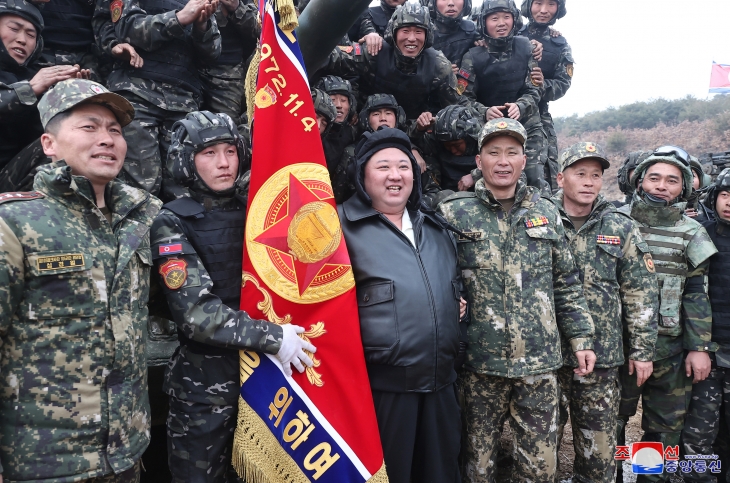
• March Sees 90% of Kim Jong-un's Public Engagements in Military, With Just a Single Nod to the Economy• North Korea Disclosed Russian Spy Chief’s Visit, Highlighting Strong Ties with Russia• North Korea Expresses Displeasure Over South Korea-Cuba Diplomatic Ties, Excludes Cuba from ‘April Spring Friendship Art Festival’ Guest ListMarch Sees 90% of Kim Jong-un's Public Engagements in Military, With Just a Single Nod to the EconomyIn March, 90% of North Korean Leader Kim Jong-un's activities emphasized military affairs, nearly doubling past figures. This surge, analysts suggest, might respond to growing tensions with South Korea, exacerbated by intensified US-South Korea drills.<Kim Jong-un oversees a major tank exercise on the 13th, unveiling new tanks in a show of readiness against South Korea. / Photo by Korean Central News Agency>North Korean media reports reveal Kim Jong-un participated in eight public activities in March, with seven, or 90%, focused on military endeavors.Kim Jong-un's military engagements in March included visits to a pivotal training base on the 6th, overseeing joint artillery training on the 7th, leading a significant tank drill on the 13th, directing aviation unit training on the 15th, supervising artillery shooting training on the 18th, guiding tests of solid-fuel boosters for new hypersonic missiles on the 20th, and inspecting the Seoul Ryu Kyong-su 105th Tank Division and the 1st Tank Armored Infantry Division on the 25th, among other activities.The increase in military-related public activities in March seems linked to the US-South Korea joint exercise 'Freedom Shield'. North Korea responded with public announcements on defense speeches and military training. Kim Jong-un emphasized military preparedness, bolstering capabilities, and advancing military industry during this period.Kim Jong-un's engagement in military-related public activities was similarly notable, with reports emerging eight times throughout January and February.This indicates Kim Jong-un's practical measures to enhance readiness for war, following the directive issued during the 9th Plenary Meeting of the 8th Central Committee of the WPK in December of the previous year.Their highlighting artillery, armor, and special forces underscores the importance of conventional weaponry and specialized units in prolonged conflicts, informed by recent analyses of conflicts like Ukraine-Russia and Israel-Hamas.North Korea Disclosed Russian Spy Chief’s Visit, Highlighting Strong Ties with RussiaA chief from the Russian Foreign Intelligence Service made a visit to North Korea to discuss various practical matters aimed at bolstering cooperation. The unusual step of disclosing such a visit, typically held in confidentiality, signals an intent to highlight the all-encompassing collaboration between North Korea and Russia.According to North Korea's Rodong Sinmun, Sergey Yevgenyevich Naryshkin, the Director of the Russian Foreign Intelligence Service, visited Pyongyang from March 25th to 27th.Throughout his stay, Director Naryshkin engaged in discussions with Ri Chang-dae, the North Korean Minister of State Security, alongside practical meetings. The report elaborated that the dialogues delved into the international and regional circumstances encircling the Korean Peninsula and Russia, addressing the need to enhance collaboration against the increasing espionage schemes by adversarial forces. This marks the first visit by the Russian Foreign Intelligence Service to North Korea in 13 years since May 2011, when the service met with Chairman Kim Jong-il. By publicly disclosing the visit, North Korea aims to demonstrate the depth of its relationship with Russia, spanning political, military, and economic collaborations.Reportedly, an economic delegation headed by Yun Jong-ho, North Korea's Minister of the Ministry of External Economic Relations, visited Russia on March 27th to explore opportunities for cooperation in economic and trade sectors.North Korea Expresses Displeasure Over South Korea-Cuba Diplomatic Ties, Excludes Cuba from ‘April Spring Friendship Art Festival’ Guest ListNorth Korea, in response to Cuba's recent diplomatic ties with South Korea, removed Cuba from the guest list of the April Spring Friendship Art Festival, which celebrates Kim Il-sung's birthday, known as the 'Day of the Sun,' signaling discontent with the new alliance.According to the Rodong Sinmun, the April Spring Friendship Art Festival is set to feature esteemed art, dance, and acrobatic groups from various nations, excluding the Cuban delegation. This contrasts with the previous November announcement on the festival's website, which listed participating countries such as Russia, Laos, and Cuba for the event scheduled from April 11th to 25th.Initially, the committee had listed Cuba as the third highlight in the "Invitation-related news" on their website, citing Cuban cultural entities' recommendations for various groups to participate, including the Unaccompanied Mixed Choir and the Contra Guitar Duo, among others. Following, Cuba's participation announcement was deleted from the festival's website. While posts one through twenty remain, the entry about Cuba's participation has been intentionally removed.The removal suggests North Korea's displeasure with Cuba for engaging diplomatically with South Korea. Since the announcement on the 14th, North Korea has omitted any mention of Cuba in state media.On the 18th, one month after the South Korea-Cuba diplomatic announcement, Rodong Sinmun covered a meeting between Ma Chol-su, North Korea's Ambassador to Cuba, and Cuban President Miguel Diaz-Canel. This suggests the possibility of blaming Ambassador Ma, and North Korea has not disclosed any appointment of a new ambassador to Cuba.
24.04.05 -
 [Issue Brief]
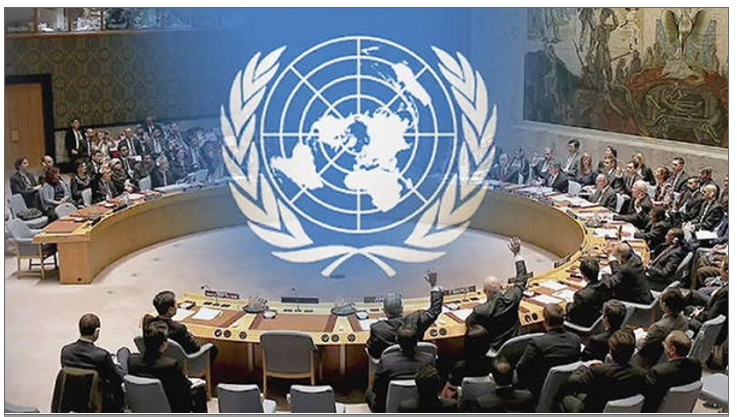
End of UN Panel of Experts on North Korean Sanctions and the Future Trajectory Jeong Jun-heeFormer Analysis Division Director at the Ministry of Unification,Ph.D. in Political ScienceDilution of the North Korean Sanctions Framework: A Growing ConcernThe Panel of Experts (PoE) for North Korea, established by the United Nations Security Council (UNSC) following North Korea's second nuclear test in 2009 under Resolution 1874 to oversee sanctions compliance, ceased its activities due to Russia's veto against renewing its mandate.The PoE had been key in impartially investigating and reporting on North Korea's breaches of sanctions, aiding the UNSC and member states in evaluating sanction adherence. The discontinuation of the panel represents a notable setback, undermining the sanctions regime's effectiveness against North Korea by removing a critical element of its monitoring framework.The United Nations Security Council (UNSC) distinguishes between comprehensive sanctions, targeting an entire nation, and targeted sanctions, aimed at particular individuals or entities responsible within that nation. North Korea initially was subject to targeted sanctions after its first nuclear test in 2006. Following its fourth nuclear test in 2016, the approach shifted to comprehensive sanctions with the adoption of UNSC Resolution 2270 in March 2016, which introduced trade sanctions aimed at maintaining US-China diplomatic relations.Between Kim Jong-un's nuclear completion announcement in November 2017 and the preceding 20 months, five UNSC resolutions expanded trade sanctions on North Korea. These now covered a range from gold, titanium ore, vanadium ore, and rare earths to iron ore, coal, seafood, textiles, and refined petroleum products affecting both WMD capabilities and civilian livelihoods, marking a significant shift from targeted to comprehensive sanctions.Impact of Sanctions on North KoreaThe efficacy of sanctions in altering North Korea's stance remains a contentious issue. Critics of the sanctions argue that they have been ineffective, suggesting that the North Korean leadership has demonstrated 'totalitarian resilience' by shifting the sanctions' burden onto the society and its citizens.During border lockdowns, North Korea managed to sustain itself by minimizing the import of consumer goods and engaging in state-level smuggling. It increased the state's food purchase to keep the low-wage system for city workers, and tightly controlled foreign currency usage to curb inflation and exchange rate spikes. Furthermore, with the shifting international dynamics, North Korea has been seen to bolster its ties with authoritarian forces like China and Russia, rendering the sanctions nearly ineffective. Even the 2023 Security Council reports indicated ongoing activities such as refined oil smuggling, potential arms dealings, and the expansion of sending workers abroad, suggesting the persistence of sanction evasion tactics.Despite North Korea's efforts to circumvent sanctions, there exists a significant viewpoint that argues for the continued effectiveness of these measures. Given the lack of concrete evidence to conclusively assess the impact of North Korean sanctions, it seems that both proponents and critics of the sanctions have valid points. The debate over the efficacy of sanctions, rather than being a matter of objective evidence, often reflects differing political perspectives and agendas.The Essential Continuation of North Korean Sanctions and Looking AheadDespite ongoing debates over their efficacy, it is crucial for the international community to remain vigilant in upholding sanctions against North Korea. While the ultimate aim of complete denuclearization may seem distant, sanctions play a crucial role in impeding North Korea's procurement of technology and vital components, thus preventing it from becoming a fully capable nuclear state. Additionally, easing sanctions without any shift in North Korea's stance could undermine the global disarmament framework, posing a threat to world peace and security, especially if nuclear arms proliferate and fall into the hands of terrorists.Furthermore, maintaining sanctions aligns with the interests of the five recognized nuclear states. Though North Korea's nuclear ambitions may offer short-term advantages to nations like China and Russia, sustaining the current non-proliferation framework bolsters their leadership in global politics over the long term.The cessation of the PoE on North Korea demands a comprehensive reevaluation of our sanctions approach, inviting us to reconsider both its aims and methods. Far from signaling the termination of sanctions, this development offers a unique opportunity to refine and strengthen our sanctions framework. This effort aims to more effectively stimulate behavioral changes within North Korea, emphasizing the need for strategic adjustments to encourage compliance and reform. Firstly, establishing international regimes to investigate sanction evasion, akin to the expert panel's work, is necessary. Given the difficulty of resuming such investigations under the UN's auspices, forming a multinational intelligence-sharing coalition like the Five Eyes to exchange and validate information on illicit activities could exert considerable pressure on North Korea and its allies. Especially, enhancing the effectiveness of third-party sanctions requires a robust mechanism for monitoring and evaluating compliance.Secondly, diplomatic efforts must be ramped up to keep global attention on North Korean sanctions high, encouraging broader international participation.Thirdly, a reevaluation of the sanctions' goals and limitations is necessary. We need to consider whether to continue targeting North Korea's complete denuclearization or to adjust the level of sanctions to incentivize policy changes within North Korea.Lastly, developing a 'Plan B' that emphasizes dialogue and cooperation could be beneficial for encouraging regime change in North Korea or achieving complete denuclearization. This strategy involves harnessing international cooperation. Recognizing China's crucial influence, due to its provision of essential goods to North Korea, is vital for devising effective sanctions strategies and realizing their ultimate objectives.
24.04.05 -
 [Issue Brief]
Prospects for North Korea-Japan Relations from Kim Yo-jong’s StatementLee Ki-taeDirector, Global Strategy Research Division at the Korea Institute for National UnificationOn February 15, 2024, Kim Yo-jong, a senior North Korean official, announced a conditional willingness for a North Korea-Japan summit, explicitly excluding the issue of Japanese abductions. Furthermore, on March 25, through a statement carried by the Korean Central News Agency, she said that Prime Minister Kishida Fumio had conveyed his intention to meet North Korean leader Kim Jong-un at the earliest convenience via various channels. In addition to this, she stipulated the non-mention of abductions and recognition of North Korea’s nuclear and missile development as the sovereign right for such a summit. Prime Minister Kishida, while acknowledging ongoing vements related to North Korea including contacts between the two nations, exhibited a cautious stance towards the prospect of a summit.<Kim Yo-jong, Deputy Director of the Workers' Party of Korea (WPK) / Korean Central Television>North Korea's revelation of its talks with Japan, as communicated by Kim Yo-jong, strategically aims to enhance its bargaining power in the ongoing dialogues, simultaneously underscoring Japan's strong interest in a bilateral summit. This announcement, however, signals stumbling blocks in the negotiation process, a contrast to the successful diplomacy in 2002 led by Prime Minister Junichiro Koizumi. Then, covert discussions facilitated by Hitoshi Tanaka with a key North Korean aide—referred to as 'Mr. X' and close to Kim Jong-un—culminated in Koizumi's landmark visit to North Korea. The fact that Kim Yo-jong has made such disclosures now hints at North Korea's attempt to assert its position and priorities early in the negotiation process. If talks were advancing smoothly, such a statement would likely not have been necessary, pointing to a tactical approach by North Korea to strengthen its hand in these critical discussions.What stands at the heart of the stalled North Korea-Japan talks? The abduction of Japanese citizens by North Korea remains a glaring point of contention. From the onset, this issue has set both nations at odds. During the 2002 summit, North Korea admitted abducting 13 of the 17 Japanese nationals, confirming the death of 8 and survival of 5, who were later returned to Japan. Since then, North Korea insists this matter was resolved following the summit, a stance Japan disputes.Japan refuses to accept the reported deaths of 8 abductees, believing they could still be alive in North Korea. Hence, Japan persists in its demand for a thorough investigation into the abductions, proposing their return as a fundamental condition for any future summit talks with North Korea.The initiative for a summit regained momentum under Prime Minister Shinzo Abe in 2018, amid a global push towards dialogue with North Korea and following a series of summits involving the US and South Korea. Breaking away from a policy of isolation, Abe, followed by Yoshihide Suga and Fumio Kishida, sought an "unconditional talk" with North Korea.Since the beginning of 2023, Prime Minister Fumio Kishida has escalated Japan's outreach to North Korea with notably more forward-looking communications. On May 27, he expressed a wish for “high-level” talks directly under his auspices to hasten a summit with Kim Jong-un. Following this, The Asahi Shimbun on September 29 reported two secretive interactions between the nations in March and May 2024 within key Southeast Asian cities. Kishida's May commentary, assumedly a nod to these discreet dialogues' positive outcomes, revealed no tangible progress signs. The minister's calls for "high-level prime ministerial talks" essentially hint at the deployment of a special envoy to North Korea, marking the crux of Japan's current diplomatic strategy towards North Korea.Yet, achieving a North Korea-Japan summit seems fraught with challenges for several reasons. Foremost, the contentious abduction issue remains unresolved, with uncertainty whether North Korea can provide findings that would satisfy the Japanese belief that all abductees, including Megumi Yokota, are alive. Furthermore, reaching a consensus on the extent to which Japan can relax its unilateral sanctions against North Korea in return for addressing the abductee issue proves difficult.Additionally, tackling North Korea's denuclearization remains a formidable task. The triad of Japan's concerns involves North Korea's nuclear and missile programs and the abductee issue. Despite the abduction matter currently taking center stage in dialogues, as Kim Yo-jong's statements suggest, North Korea seeks Japan's recognition of its nuclear activities as a sovereign right. This contrasts with Kishida who represents Hiroshima and consistently advocates for a nuclear-free world, underscoring a significant discord between the two nations on the issue of North Korea's denuclearization.Enhanced North Korea-Russia relations pose another hurdle. The ongoing Ukraine conflict and enduring sanctions against North Korea have spotlighted the deepening military and technological cooperation between Pyongyang and Moscow. This growing partnership further complicates Japan's position as a dialogue participant and challenges the feasibility of Kishida's proposition to dispatch a special envoy to North Korea, adding layers of complexity to the already strained negotiations.Furthermore, domestic politics in Japan significantly influence the feasibility of a North Korea-Japan summit. With Prime Minister Fumio Kishida's popularity at a record low, he views such a summit as crucial for his re-election in the September 2024 LDP leadership election. However, the focus of Japanese politics on reforms, such as addressing illegal funding and LDP factionalism, diminishes the immediate need for a summit. In addition, the decreasing public concern over the abduction issue casts doubt on the summit's potential effectiveness.For a North Korea-Japan summit to materialize, both nations must find common ground on the abduction issue. Japan may need to adjust expectations regarding abductee returns, and North Korea should admit to past actions, agreeing to repatriate survivors. A compromise, alongside sending Prime Minister Kishida's special envoy to North Korea, could set the stage for Kishida's landmark visit to Pyongyang, potentially heralding a significant diplomatic breakthrough.
24.04.05 -
 [Kim Myongsung’s Inside North Korea]
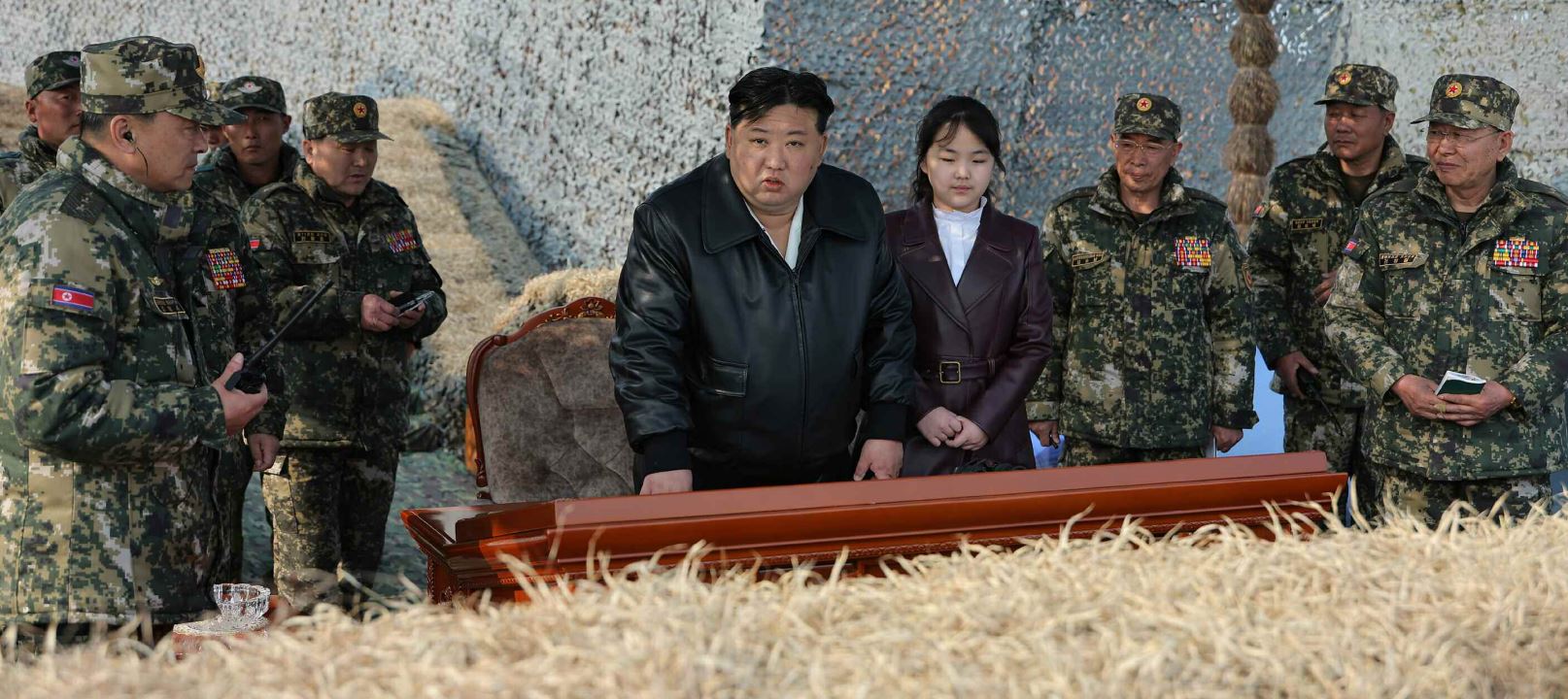
● Kim Jong-un and Daughter Tour Livelihood, Security Sites, Implying Kim Ju-ae's Leadership as 'Great Person of Guidance'● North Korean TV Used Official Name for South in Women's Football Match, Rodong Sinmun Calls South 'Puppet'● North Korea Resumes Missile Tests into the East Sea After 33 Days, Following Key Political Events in Russia and ChinaKim Jong-un and Daughter Tour Livelihood, Security Sites, Implying Kim Ju-ae's Leadership as 'Great Person of Guidance'North Korea's Korean Central News Agency (KCNA) announced that Kim Jong-un and his daughter, Kim Ju-ae, attended the opening of the Kangdong Greenhouse near Pyongyang, honored as "great persons of guidance."<State media on the 16th showcased Supreme Leader Kim Jong-un overseeing North Korean Airborne forces' exercises, accompanied by his daughter Kim Ju-ae. / Photo by Rodong Sinmun>The term "guidance," often used in North Korea for the supreme leader or the Workers' Party of Korea (WPK), unusually includes Kim Ju-ae this time, suggesting a potential leadership role for her.The same day, KCNA reports highlighted the term "guidance" three times while discussing the pair's actions, specifically praising "Our Respected Comrade Kim Jong-un as a beacon of leadership and innovation," celebrating the "Party's Central Committee's distinguished guidance," and hailing them as "The great persons of guidance." Such wording intentionally places Kim Ju-ae within the realm of leadership.However, it's interesting to note that this phrasing was specifically chosen for KCNA's international audience. Domestically, Rodong Sinmun referred to Kim Ju-ae more tenderly as "the beloved daughter."<North Korean Leader Kim Jong-un and daughter Kim Ju-ae are seen engaging with officials at the newly inaugurated Kangdong Comprehensive Greenhouse / Photo by Rodong Sinmun>On the day the training guidance of the Airborne forces by the Kim duo was reported, state media also revealed photographs where Kim Ju-ae stood ahead of Kim Jong-un, peering through binoculars at the troops below. This unusual spotlighting in North Korean press, typically reserved for Kim Jong-un alone, along with Kim Ju-ae's active participation, fuels speculation regarding her grooming as his successor.The frequency with which Kim Jong-un includes Kim Ju-ae in public appearances, across both economic and security contexts, is drawing attention. This strategy, possibly aimed at tempering any potential backlash to a female successor amidst the country's traditional views, suggests a calculated effort to familiarize the populace with Kim Ju-ae's presence in varied official settings. Critics argue that this might also reflect a rush to solidify her image as a potential heir amidst internal uncertainties.During the greenhouse visit, Kim Jong-un arrived in an "Aurus," a luxury armored vehicle gifted by Russian President Putin, receiving a grand escort. A Korean Central Television broadcast showed the Aurus, flanked by security vehicles, moving along empty roads. Upon arrival, Kim Jong-un and his daughter, Kim Ju-ae, were seen alighting from the Aurus.Additionally, on the 16th, Kim Yo-jong, Kim Jong-un's sister and Deputy Director of the Workers' Party of Korea (WPK), announced through the Korean Central News Agency, "Our respected Comrade Kim Jong-un first used the car, a gift from Russian President Vladimir Putin, during a public event on the 15th."While Kim Jong-un emphasizes strong ties with Russia, a notable shift is seen in North Korea's relations with Cuba. Reports on the 16th highlighted North Korean Ambassador Ma Chol-su's meeting with Cuban President Miguel Díaz-Canel, just before Ma's return to North Korea. Serving since 2018, Ma's recall, soon after the diplomatic outreach between South Korea and Cuba, suggests it might be the cause.North Korean TV Used Official Name for South in Women's Football Match, Rodong Sinmun Calls South 'Puppet'<The broadcast, contrasting with Rodong Sinmun's reference to the South Korean team as 'puppet' on the 14th, opted for subtitles reading 'Chosun vs. ROK and made no mention of ‘ROK' or 'puppet' in its commentary. Remarkably, the South Korean flag was also displayed in full, without any censorship, marking a significant shift from previous practices./Photo by Korean Central Television, Yonhap News Agency>North Korean television caught viewers' attention by referring to South Korea as "ROK" during a women's football match broadcast between the North and South, a notable departure from its usual 'puppet' label.On the 17th, North Korea's Korean Central Television showcased the semi-final battle between the North and South Korean teams in the U-20 Women's Asian Cup, held in Uzbekistan.On the 17th, the Korean Central Television aired the thrilling semi-final match from the 13th, labeling South Korea as ‘ROK’ and North Korea as 'Chosun'.<North Korea's Rodong Sinmun labeled South Korea as 'puppet’ while covering the semi-final match between North and South Korea in the U-20 Women's Asian Cup, which took place in Uzbekistan on the 14th / Photo by Rodong Sinmun>While Rodong Sinmun previously used the term 'puppet’ in its coverage of the match on the 14th, the televised match presented the South Korean flag in its entirety, a notable change from the 2022 Qatar World Cup broadcasts where the flag was blurred out.Aside from the subtitles, the broadcast conspicuously avoided any direct references to South Korea, focusing its narrative solely around 'our team', North Korea, without giving South Korea any mention.This latest media approach, frequently adopting terms like 'puppet' and 'puppet Korea' for the South since last year, reflects the North Korean leader Kim Jong-un's stance on treating South Korea as an adversary.In a notable turn of events during the semi-finals, North Korea dominated South Korea with a 3-0 victory, later defeating Japan 2-1 in the finals to claim their first U-20 Women's Asian Cup title in 17 years.North Korea Resumes Missile Tests into the East Sea After 33 Days, Following Key Political Events in Russia and China<On February 14th, North Korean outlets reported the test-firing of the 'Padasuri-6' ground-to-sea missile, supervised by Kim Jong-un / Photo by Rodong Sinmun>On March 18th, North Korea launched multiple ballistic missiles into the East Sea, restarting its provocative actions 33 days after its last cruise missile deployment, as confirmed by South Korea's Joint Chiefs of Staff.The recent launches are notably the second instance of ballistic missile tests this year, following a 64-day hiatus since a hypersonic intermediate-range ballistic missile (IRBM) test on January 14th.In the early hours of the morning, at approximately 7:44 AM, suspected short-range ballistic missiles were detected originating from Sangwon County in North Hwanghae Province, heading towards the East Sea.They added, "Our military is ramping up surveillance and coordination with the US and Japan, preparing for any further launches and ensuring we're fully ready to respond."The South Korean military is currently assessing the specifics of the missile launches, including their trajectory and speed. Meanwhile, the Japan Coast Guard reported that the missiles landed outside Japan's Exclusive Economic Zone (EEZ) shortly after launch.North Korea's resumption of provocations after a month of silence, notably during the U.S.-South Korea "Freedom Shield (FS)" exercise from March 4th to 14th, has elicited various interpretations.Experts believe North Korea avoided provocations during key political events in China and Russia, strategically timing their resumption after these events concluded.Russia, maintaining close ties with North Korea, especially after the Ukraine conflict, witnessed the re-election of President Vladimir Putin for a fifth term on March 17th. China also concluded its ‘Two Sessions’, a major political gathering, from March 4th to 11th.The military stays alert for more provocations by North Korea, particularly around the South Korean elections, Kim Il-sung's birthday (April 15), and the Korean People's Army Foundation Day (April 25). North Korea also plans to launch three reconnaissance satellites by year-end, confirmed at last year's WPK Plenary Meeting.
24.03.22 -
 [North Korean Terminology]
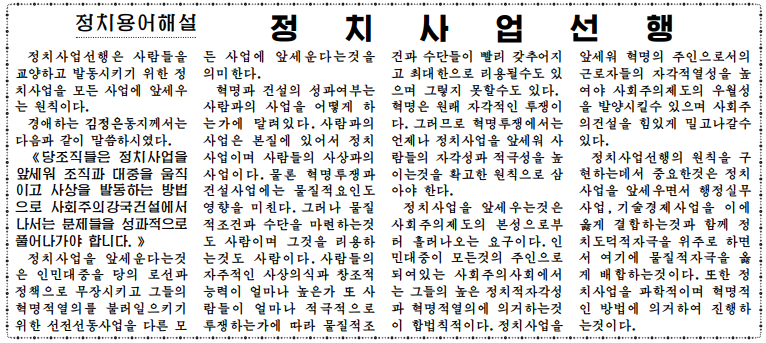
North Korea is seen as lagging significantly in meeting its citizens' fundamental needs, with politics viewed more as a means of maintaining ruler obedience than serving the public good. Despite worsening conditions for its people, the emphasis remains on control. On March 20, 2024, the Rodong Sinmun highlighted 'Political Precedence,' underscoring this focus.[Political Terminology]Political PrecedencePolitical Precedence is a principle that places political work, aimed at educating and mobilizing the populace, ahead of all other tasks. The esteemed Comrade Kim Jong-un has articulated it as follows: "Party organizations must take the lead in political work, mobilizing the organization and the masses, and by doing so, effectively resolve the issues arising in the construction of a socialist powerhouse."To prioritize political work means to elevate the role of propaganda and agitation that arms the people with the Party's ideology and policies, and sparks their revolutionary fervor, above all other tasks. The outcome of revolutionary and construction efforts hinges on the manner in which people are engaged and tasks are managed. At its core, this engagement is political, focusing on people's ideologies. While material factors play a role in revolutionary struggles and construction efforts, it is ultimately people who provide and utilize these material resources. The speed at which material conditions and resources are secured and utilized to their maximum potential is contingent upon the level of people's autonomous ideological consciousness and their creative capabilities, as well as their willingness to actively engage in struggle. Revolution is fundamentally an act of conscious struggle, thus making it imperative to always prioritize political work to enhance the consciousness and activism of the populace.Emphasizing political work is inherent to socialism, where the masses, as the system's core, drive actions with their political consciousness and revolutionary zeal. Prioritizing political efforts to boost the workers' awareness and enthusiasm is essential for reinforcing socialism's merits and effectively promoting its development.A key aspect of realizing the principle of Political Precedence is the appropriate integration of political work with administrative and technical-economic tasks, alongside a focus on political and moral stimulation, properly complemented by material incentives. Furthermore, political work must be conducted based on scientific and revolutionary methods.
24.03.22 -
 [NK Focus]
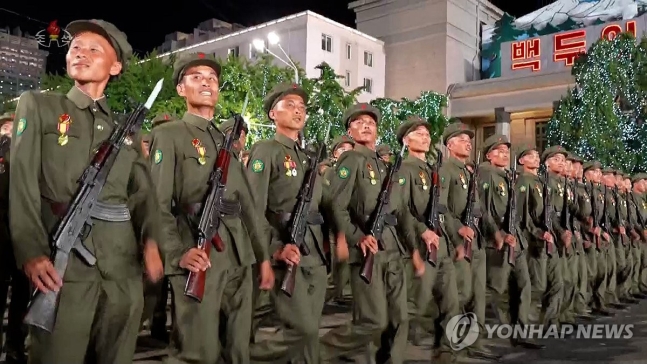
Responding to US-South Korea Joint Drills, North Korea Implements Resident Movement Controls and Conducts Outdoor ExercisesDuring the US-South Korea "Freedom Shield" drills (April 4-14), North Korea reportedly enforced movement controls and performed blackout and evacuation exercises, elevating internal tension. Amidst this, North Korea appeared to adopt a quieter approach, possibly due to major events like China's Two Sessions and Russia's presidential election, while internally intensifying its security measures. <On the 9th, Korean Central Television aired a noon recording of the Civil Defense Military Parade in Pyongyang's Kim Il Sung Square, celebrating the 75th founding anniversary of North Korea / Photo by Korean Central Television, Yonhap News Agency>On the 15th, sources from North Hamgyong Province reported that North Korea, during the US-South Korea drills, conducted blackout and anti-aircraft exercises with civilian participation on the 12th and 13th. A Ministry of National Defense statement on the 5th criticized the joint drills, revealing the organization of internal emergency evacuations and sheltering exercises.The sources further disclosed that on the 11th, North Korean authorities carried out blackout drills, instructing residents to cover windows and prevent light leakage upon hearing sirens.The morning of the 12th saw the mobilization of the Worker-Peasant Red Guards and Red Youth Guards, simulating enemy air raids, fully outfitted and taking strategic positions, while the elderly, women, and children equipped with essential supplies organized a climb into the mountains.These residents endured the night outdoors, engaging in evacuation drills, descending only after the air raid alert was lifted at 3:30 p.m. on the 13th.Reports indicate that North Korea imposed a lockdown, barring residents from leaving their homes as the US-South Korea military drills started on the 4th, citing rising tensions. This abrupt mandate forced those away to swiftly return. The unexpected restriction, especially for those out for business or official reasons, led to considerable disarray.This sudden order caused significant disruptions, especially for those out on business or official duties, leading to temporary paralysis in transportation, distribution, and market supply, eliciting public dissatisfaction towards the unannounced movement restrictions.North Korea also showed a militaristically sensitive response to the "Freedom Shield" drills, with heightened internal controls. The day following the onset of the US-South Korea drills, on the 5th, the Ministry of National Defense spokesperson vehemently criticized the "reckless military exercises" by the US and South Korea. The statement highlighted, "We face severe consequences due to the security instability from their wrong choices, as they escalate their open threats and invasion attempts against a sovereign state." <On March 14, 2024, North Korean leader Kim Jong-un joined troops in training exercises on a new model tank / Photo by Rodong Sinmun>State media, including the Korean Central News Agency and Rodong Sinmun, reported on the 14th that Kim Jong-un unveiled new tanks, reinforcing the resolve for war against the South, and escalating wartime rhetoric. Additionally, North Korea launched several ballistic missiles into the East Sea on the 18th, three days after the drills concluded, escalating military tensions on the Korean Peninsula.
24.03.22 -
 [Kim Myungsung’s Inside North Korea]
● Kim Jong-un Ramps Up Military Exercises in March, Stirring Tensions on Korean Peninsula● Testimony from a North Korean Defector: “I Fled as I Heard I'd be Sent to Nuclear Bases for Labor”● North Korea Steps Up Actions to Dismantle Unification Efforts, Designating the DMZ as Its BorderKim Jong-un Ramps Up Military Exercises in March, Stirring Tensions on Korean PeninsulaNorth Korean leader Kim Jong-un has been making headlines with his consecutive visits to military firing ranges and strategic training bases since March. With each visit, accompanied by vivid imagery of Kim Jong-un personally handling firearms and overseeing artillery drills, tensions in the region have heightened. This surge in military activity is widely seen as a direct response to the ongoing joint military exercise 'Freedom Shield', conducted by the United States and South Korea since the 4th of this month.<North Korean leader Kim Jong-un holds a rifle and assumes shooting positions during his visit to a strategic training base in the western region of North Korea on the 6th. /Photo by Korean Central News Agency>On the 7th, North Korea further intensified its military maneuvers by conducting firing exercises featuring multiple launch rocket systems and self-propelled artillery (SPA) in the vicinity of Nampho City. According to reports from the South Korean Joint Chiefs of Staff, these exercises targeted maritime locations, underscoring the seriousness of North Korea's military posture.The Rodong Sinmun detailed Kim's personal supervision of these exercises, particularly highlighting the involvement of joint units at the corps level. The newspaper stated, "The training began with a demonstration of power shooting by long-range artillery units near the border line, tasked with a significant military mission to deter war by putting the enemy's capital within striking distance."The Rodong Sinmun also documented Kim Jong-un's satisfaction with the preparedness and combat readiness displayed by the artillery units involved in the exercises. <North Korean leader Kim Jong-un supervises joint units' firing exercises as reported by the Korean Central News Agency on the 8th /photo by Korean Central News Agency, Yonhap News Agency>Kim Jong-un articulated the strategic objectives behind these exercises, emphasizing the importance of setting realistic training goals to empower artillery units to seize initiative swiftly and decisively in potential conflicts. He underscored the need for dynamic and effective training to bolster North Korea's military capabilities and maintain the efficacy of its fundamental nuclear deterrent — its artillery.Earlier in the month, on the 6th, Kim Jong-un made a visit to a significant operational training base located in North Korea's western region. As reported by Rodong Sinmun, Kim Jong-un emphasized the importance of enhancing practical training to significantly bolster combat capabilities.He further stressed the importance of vigorously ushering in a new era of strengthening 'war readiness', aligning it with the evolving strategic landscape.Rodong Sinmun's coverage included images of Kim Jong-un engaging in shooting exercises, followed by depictions of soldiers participating in training activities and commemorative photographs.North Korea has persistently opposed joint US-South Korean military exercises, denouncing them as "war rehearsals" and reacting strongly, often by launching missiles during exercise periods.The Republic of Korea Joint Chiefs of Staff affirmed their commitment to combined defense, closely monitoring North Korea's actions during ongoing exercises. They pledged a swift, strong, and definitive response to any provocation.Testimony from a North Korean Defector: “I Fled as I Heard I'd be Sent to Nuclear Bases for Labor”A North Korean defector revealed that political prisoners are sent to work in nuclear facilities, facing high radiation risks, rather than typical camps.Research from the Korea Institute for National Unification (KINU), detailed in "North Korean Residents' Domestic Lives," reveals a woman in her 40s from Pyongyang, identified as A, disclosed that North Korea forces political prisoners to work at nuclear sites. <Nyongbyon Nuclear Scientific Research Center /Photo by 38 North>North Korean military-run nuclear bases, feared for radiation risks, often see young people dodging conscription despite offered privileges. The woman likened these bases to prisons, noting the universal avoidance due to the harmful effects of radiation on health.She added that despite parents' reluctance to send their children to such bases, serving five years there—compared to ten in a regular unit—offers university admission and Communist Party membership. However, it's rumored that service leads to death within three years.The woman, once a doctor leading a stable life in North Korea, chose defection to protect her daughter from being sent to a nuclear base. Following her husband's defection, she and her two daughters faced intense surveillance and after a while, there was the tragic loss of the eldest daughter in an accident. Threatened with her daughter's conscription into the base's harsh conditions, she saw defection as the only way to save her.In October, the US NGO Human Rights in North Korea (HRNK) indicated that political prisoners might be forced into building and maintaining nuclear test sites. They highlighted satellite images of a 5.2 km dirt road connecting Punggye-ri Nuclear Test Site in Kilju County to Myonggan 16th Concentration Camp as supporting evidence.HRNK posited that given the sensitive nature of the nuclear test site and the 16th Camp, which held over 20,000 detainees, North Korea may have employed political prisoners for tunnel construction due to their controllability. They further analyzed that the road might serve dual purposes: transporting forced laborers to the site or moving observation equipment there.North Korea Steps Up Actions to Dismantle Unification Efforts, Designating the DMZ as Its BorderOn the 4th, it was confirmed that North Korea, which labels South Korea as its "principal adversary" and the DMZ as the border, has removed articles mentioning unification from its state media, indicating a shift in stance.The Korean Central News Agency (KCNA) of North Korea removed articles featuring terms like "peaceful unification," "national unification," and "ethnic unity" from its website. Despite being considered taboo now, numerous articles under each term were once accessible.A report by Kim Yo-jong criticizing President Yoon Suk-yeol’s New Year's address, particularly calling "peaceful unification" a fantasy, was removed from North Korean media.Articles on the WPK Central Committee's Enlarged Plenary Meeting in December, which mentioned "national unification," disappeared. Previously searchable, their recent deletion this month is evident.The removal of unification articles follows Kim Jong-un's pivot to hostility towards South Korea, declaring "Unification can never be achieved with South Korea." <Kim Jong-un, addressing the 14th Supreme People's Assembly on January 15th, 2024, in Pyongyang, emphasizes the need for education that views South Korea as the ultimate foe, suggesting possible constitutional changes. /photo by Photo by Korean Central Television>During the WPK Plenary Meeting at the close of last year, Kim Jong-un emphatically declared "unification impossible," articulating that the dynamics between North and South Korea have evolved from familial ties to adversarial relations, positioning them as nations at war with each other.In his January Supreme People's Assembly speech, he advised against referring to the North and South as kin.Since then, North Korea has been actively "erasing unification." Searches on the KCNA’s website yield few articles on "unification," some quoting Kim Jong-un's directive to "completely remove the concepts of unification, reconciliation, and kinship" from the Supreme People's Assembly.Recently, a section detailing the North Korean Constitution on the state media's website was made private, following Kim Jong-un's announcement at last month's Supreme People's Assembly to remove unification-related terms from the constitution.
24.03.14
News Letter
We are leading the global communication via Newsletter.
We will deliver the latest information and proven facts on Korean Peninsula status including North Korea situation.