

-
 [Feature Article]
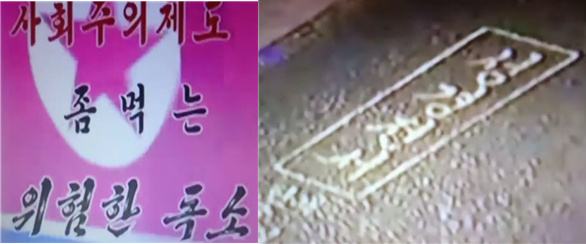
North Korean Authorities Accuse Anti-Regime Movement, Involving Educators, Doctors, and Intellectuals, in Pursuit of Liberal Democracy Party… 사회주의 제도 좀먹는 위험한 독소’라는 제하의 학습제강 영상자료에 성경전서를 퍼뜨린 사실도 성토하고 있다. (사진: SAND연구소가 입수한 영상자료 캡처) North Korean organizations involved in anti-regime activities within North Korea have come to light through official North Korean documents. Recent video materials obtained by SAND from North Korean security authorities reveal that educators, doctors, and intellectuals in North Korea have recognized the irrationality and contradictions inherent in the North Korean regime through exposure to South Korean radio, movies, and TV shows. In response, they have spontaneously formed an anti-regime revolutionary organization, and astonishingly, some even claim to have established a political party with the vision of creating a liberal democracy system. The emergence of such organizations within North Korea, aiming to adopt South Korea's liberal democracy ideology and aspiring to transform their own society, is believed to be a first-time occurrence. The materials recently acquired by SAND consist of videos created by North Koreans for internal educational purposes. These videos were carefully selected from crackdowns and arrests that occurred in Pyongyang and various provinces during the first half of the previous year, following North Korea's enactment of the Reactionary Ideology and Culture Rejection Law in December 2020. This law marked the beginning of an extensive nationwide campaign to suppress South Korean culture, with severe penalties, including the death penalty, imposed on those involved in distributing South Korean videos. The video material provides detailed insights into anti-regime activities within North Korea, shedding light on key individuals involved. One prominent figure is Shin Tae-su, who worked as a middle school teacher in a county. His transformation from a typical educator to an anti-regime advocate began as he immersed himself in South Korean broadcasts and recordings. Ultimately, Shin declared the formation of an anti-regime political party, marking a pivotal moment in his life and in the broader landscape of North Korean dissent. 북한이 2022년 하반기에 조직별 학습제강인 영상자료에 등장하는 반체제 인물들. 왼쪽 신태수는 중앙대학 졸업, 학교교원으로 새로운 당을 창건, 새 정부를 세우기 위해 국가전복음모를 시도하여 적발, 오른쪽 병원의사로 재직하던 최모씨는 종교를 전도하면서 북한제도에 반기를 들었다는 죄명으로 처단(사진: 샌드연구소가 입수한 영상자료 캡처) The video material states about Shin Tae-su, "The dissident Shin graduated from a central university with the Party's support and worked as a middle school teacher. However, he gradually became ideologically corrupted during the process of exposing himself to evil content such as South Korean TV programs. Eventually, he developed resentment towards our nation's system." Furthermore, it was mentioned that "Shin always complained that the nation did not treat him well, and in the end, he claimed to have established a new party under the so-called liberal democracy system and formed a new government through the process of watching impure South Korean materials. He, along with more than ten dissidents he got to know through exposure to impure materials, conspired to overthrow our nation and went on a rampage, only to face the stern judgment of the nation." This indicates that more than ten people, through exposure to South Korean cultural materials like TV shows, underwent ideological changes and formed a collective sympathy to engage in anti-regime activities. It illustrates how deeply South Korean cultural influence has penetrated North Korean society and the extent of its impact. The fact that they faced the stern judgment of the nation implies that they were either executed or sent to Political Prison Camps. The video also reveals excerpts from a notebook containing the principles and regulations of the party he established, along with a partial list of its members. Article 1 of the party regulations stated, 'Our goal is to establish a new party under the liberal democracy system,' while Article 2 emphasized, 'Within our newly organized party, there will be no discrimination between upper and lower ranks.' 신태수가 작성한 새로운 당 강령과 조직원칙 (사진: SAND연구소 입수자료 캡처) In the confidentially regulated party principles, Article 1 stated, 'Anyone who desired freedom can join our organization,' and Article 2 specified, 'Our party represents intellectuals, farmers, and others.' It is noteworthy that their organization, which aimed to build a liberal democratic political party in North Korea, prioritized the representation of intellectuals and farmers, rather than the core class of the Workers' Party of Korea (WPK). They sought to incorporate the intellectual class, known for rational and reasoned thinking, as well as the disgruntled peasant masses, who were bound by hunger and feudalistic servitude under the cooperative farm system, into the vanguard of the revolution to achieve fundamental regime transformation in North Korean society." Ri Young-chol, Cha Ryong-sun, Park Sang-geun, and more were on the list, and North Korea's public disclosure of these names of individuals involved in anti-regime activities serves as a stark warning, not just to those named but also to their families, effectively marking them all as dissidents. The video discusses a North Korean doctor who turned to religion after reading the Bible. Exposure to South Korean videos triggered significant ideological shifts, ultimately leading him to participate in anti-regime activities. Additionally, the video accuses individuals of accepting money in exchange for sharing military secrets, educational materials, and sensitive military information with South Korean authorities. It also unveils how party members monitored Kim Jong-un's movements through surveillance and eavesdropped on military facilities. The video material reports, "These dissidents conspired not only against our system but also to harm their own leader, devising counter-revolutionary plans. However, they were apprehended and arrested following reports from our loyal people." The video depicts party members as "alarming foes of the revolution, enticed by impure propaganda, and engaged in actions against our leader." Additionally, the video condemns South Korean broadcasts and videos as "malicious counter-revolutionary toxins that penetrate the hearts of our people and erode the absolute authority of our leader”. In the 1980s, there were individuals in South Korea known as the Juche Faction. They were deeply committed to Kim Il-sung's Juche ideology, considering it their guiding principle and the basis for their actions. They played a prominent role in stirring up mass anti-American protests and advocating for North Korea's "National Liberation People's Democracy Revolution (NLPDR)." In fact, the Juche faction managed to exert significant influence over the student activist movement during the late 1980s and early 1990s and even made inroads into South Korean politics. However, today, we are witnessing a new phenomenon: the emergence of revolutionary parties in North Korea working towards achieving liberal democracy. Moreover, more people are being exposed to South Korean cultural materials, such as TV shows, which signifies a significant development. If North Korea clings to the Juche ideology and its regime system, even as it faces international criticism, these new vanguards will seek fundamental changes. North Korea's enactment of the "Reactionary Ideology and Culture Rejection Law" in December 2020, which includes the death penalty for distributing South Korean content, underscores the significant influence of South Korean content within North Korea, as the regime perceives it as a substantial threat. Despite the tight control exerted by North Korean authorities, it appears that South Korean content, continue to gain traction within North Korea. A survey conducted by the Unification Media Center in October of the previous year revealed an increasing demand for South Korean content among North Korean youth, despite the reinforced penalties for consuming such materials. Although anti-regime organizations in North Korea face dissolution and heightened suppression by the authorities, as long as the Kim family regime remains in power and restricts human freedoms, the struggle of North Korean revolutionary forces striving for a liberal democratic system akin to South Korea is likely to persist in the future. <To be continued in the next newsletter> .bbs-view-content {font-size: 14pt; text-align: justify;} .bbs-view-content table {width: 100%; border: 1px solid #333333; border-collapse: collapse;} .bbs-view-content table td {border: 1px solid #333333; padding: 5px;text-align: center; font-size: 12pt;} .bbs-view-content .note {border: 1px solid #333333; padding: 15px; text-align: left; font-size: 12pt;} @media (max-width: 800px) {.bbs-view-content {text-align: left;}}
23.11.17 -
 [North Korean culture]
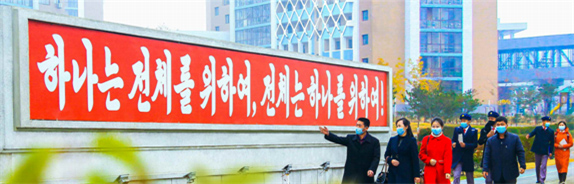
One for All and All for One! The slogan ‘All For One, One For All’ is prevalent in North Korean society, highlighting the nation's emphasis on collectivism. (Photo: Rodong Sinmun) Editor's Note: Article 63 of the Socialist Constitution of the Democratic People's Republic of Korea states the collectivist principle of "one for all, all for one." This slogan first appeared in North Korea in the late 1950s during the Chollima Work Team Movement, a mass movement for increased production, and continues to be used as an important means of governance and a representation of social culture. North Korea, based on the collectivist (Groupist) principle at the core of this slogan, demands the blockade of external information and the voluntary and obligatory submission of its members. Below, we introduce stories of collectivism encouraged socio-culturally in North Korea. With Brotherly Love Not long ago, some people visited the house of Han Un Ok residing in Neighborhood Unit 34 of Sangbisok-dong, Hanggu District in Nampho Municipality. They were Ri Myong Il, section chief of the Nampho Municipality General Hospital, and other medical workers who devoted their sincerity to the husband of Han Un Ok for a hundred and scores of days. In last May Han’s husband was unexpectedly carried to the hospital when he was at a crisis. The hospital immediately held a consultative meeting and buckled down to the cure for recovering the patient. The doctor in charge of the patient and other medical workers of the hospital sincerely cured him and officials of the hospital frequently called on the patient to encourage him. Thanks to their great efforts, Han’s husband left the hospital after several months’ cure. However, medical workers have continued to visit his house with brotherly love. Looking at those medical workers, he expressed his will to work more for the benevolent system where the whole society forms a great harmonious family to the last moment of his life. Story of Three New Wells It was when soldier-builders of Yu Jang Chol-led unit of the Korean People’s Army participating in the construction of the Kangdong Greenhouse Farm were making bricks necessary for the dwelling house construction near a river. The soldier-builders often saw people coming to the well near the worksite to bring water from a neighboring village. They say that the water from the well is very good for health. But, the road to the well was steep. So the soldier-builders leveled the road evenly. Not satisfying with it, they newly made three wells in suroundings of the original one. The new three wells reflect deep love and affection of our soldier-builders who are willing to do more good things for the people. Six Hours after Leaving Worksite One day in the end of August, workers of the Work-team No. 4 of the Moranbong District Water Supply and Drainage System Management Station, finished their task in Kaeson-dong and Inhung-dong No. 1 when the closing time passed far. After a while, the head of the work-team left the resting room. Then his work-team members Kang Hun, Hwang Tae Il and Pyon Jong Hwan waited for him outside. They suggested him helping the Work-team No. 1 which was remodeling a pumping station and a water tank in Kinmaul-dong Nos. 1 and 2 as its task was large and it wanted hands. So they worked together with those of the Work-team No. 1 until over two o’clock next day. The work results for six hours for helping the other work-team were not recorded in the journal of work. However, the process of the work helping the other work-team is kept in their minds as a beautiful retrospect. Rodong Sinmun .bbs-view-content {font-size: 14pt; text-align: justify;} .bbs-view-content table {width: 100%; border: 1px solid #333333; border-collapse: collapse;} .bbs-view-content table td {border: 1px solid #333333; padding: 5px;text-align: center; font-size: 12pt;} .bbs-view-content .note {border: 1px solid #333333; padding: 15px; text-align: left; font-size: 12pt;} @media (max-width: 800px) {.bbs-view-content {text-align: left;}}
23.11.03 -
 [North Korean Terminology]
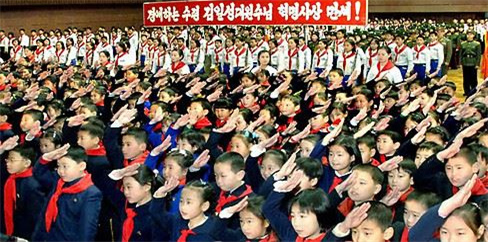
Groupism It is an ideology actively utilized as a means of consolidating the system, emphasizing the way of life that all residents must sacrifice and submit themselves for the organization and the group, and that society and the group are more important and should take precedence over the individual. Throughout North Korea, one can see the collectivist slogan, "one for all, all for one." In North Korea, a person is regarded not as an individual but as a member of society and the group, and the extent to which one dedicates themselves to society and the group serves as a measure of value and a principle of action. Therefore, individualism is thoroughly excluded, and only a collectivist view of life is paradoxically preached as the true creed that communists should possess. Additionally, North Korea has been raising the consciousness of its residents by connecting the collectivist view of life to the so-called "theory of socio-political life," stating that the socio-political life of the group is more precious than the physical life of the individual. North Korea's Korean Central Television is promoting the slogan "one for all, all for one" through video editing materials. (Source: Korean Central Television) Accordingly, all political and social systems in North Korea are based on collectivism, and the group method is applied to every nook and cranny of individual and social life. After a day's work, North Korean residents participate in a "Life Review Session," which is one form of collectivist lifestyle. Agriculture through cooperative farms, competitive labor movements, mass rallies, etc., are also typical phenomena caused by collectivism. In learning activities, the methods of "collective learning" and "collective discussion" are implemented, emphasizing "collective guidance". North Korea claims that collective guidance is "the most scientific method of leadership that can eliminate individual subjectivity and arbitrariness in the activities of the party committee." In literary and artistic creation, collectivism is reflected in the method of "collective work." Since the 1960s, "leader image works" have been mass-produced as idolized literary works, and various types of collective works are being created. The greatness of the leader is justified by the logic that it cannot be created by the power of a single individual, and therefore the strength and talent of multiple creators must be gathered. Statues of Kim Il-sung and Kim Jong-il established on Mansudae Hill in Pyongyang City / Photo by Korean Central News Agency North Korea's collectivism has thus been deeply ingrained in social structure and residents' consciousness, functioning as a mechanism to maintain the regime. However, North Korean society is also changing over time, just as North Korea itself has said it is a single living entity, and accordingly, the principles of collectivism are being eroded. The national distribution system has disappeared due to continuous economic difficulties, and private economic activities through the Jangmadang (marketplace) economy are increasing, as residents need to solve their own food, clothing, and shelter issues. Furthermore, the influx of external information is spreading individualism among North Korean residents, showing a tendency to weaken the existing ideology-centric and collectivist consciousness. .bbs-view-content {font-size: 14pt; text-align: justify;} .bbs-view-content table {width: 100%; border: 1px solid #333333; border-collapse: collapse;} .bbs-view-content table td {border: 1px solid #333333; padding: 5px;text-align: center; font-size: 12pt;} .bbs-view-content .note {border: 1px solid #333333; padding: 15px; text-align: left; font-size: 12pt;} @media (max-width: 800px) {.bbs-view-content {text-align: left;}}
23.11.03 -
 [SAND Research Report]
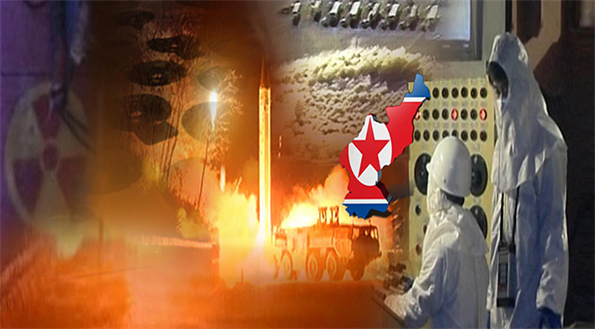
A Study on North Korea's Nuclear Economic Policy: Focusing on Correlation(2) Editorial Note: This research is a joint endeavor from the 2019 initiative aiming to lay the groundwork for reunification. This initiative was spearheaded by the SAND Research Institute in partnership with the Institute of Economic Research at Seoul National University. Within, we provide an up-to-date analysis examining the frequency, significance, co-occurrence, and implications of the terms "nuclear" and "economy" in various contexts. (Continued from Issue No. 13) 5. Analysis of the Characteristics of the Occurrence of "Nuclear" and "Economy" In order to understand the North Korean authorities' perception of nuclear issues and the economy, an analysis was conducted on the trend of the simultaneous occurrence ratio of "nuclear" and "economy." This was based on analytical documents, as well as the frequency of each word group's appearance in documents where both "nuclear" and "economy" were present. 1) Results of the Simultaneous Occurrence Ratio Analysis of "Nuclear" and "Economy" According to Table 4 below, the number of documents in which economic terms appeared (Column 2) was significantly higher than the number of documents in which nuclear terms appeared (Column 3). The number of documents in which nuclear and economic terms appeared separately (Column 6) was significantly higher than the number of documents in which nuclear and economic terms appeared simultaneously (Column 5). The ratio of documents in which economy appeared alongside nuclear terms (Column 5) out of the documents in which nuclear terms appeared (Column 3) was quite high. On the other hand, the ratio of documents in which nuclear appeared alongside economic terms (Column 5) out of the documents in which economic terms appeared (Column 2) was low. The ratio (Column 7) of the documents in which nuclear and economy appeared together (Column 5) out of all documents in which nuclear and economy appeared (Column 4) ranged from a minimum of 0% to a maximum of about 15%, which is not high. Comparing the trend of the number of documents in which nuclear and economy appeared separately with the number of documents in which they appeared simultaneously (Figure 3), it is found that the number of documents in which nuclear and economy appeared separately had a relatively small fluctuation range. On the other hand, the number of documents in which nuclear and economy appeared simultaneously saw a significant increase starting from the third quarter of 2016, decreased after peaking in the third quarter of 2017, but increased again in the third quarter of 2018. <Table 4> Results of Simultaneous Occurrence Ratio Analysis of Nuclear and Economy 구분 (1) (2) (3) (4) (5) (6) (7) Total Documents Documents with Economy Documents with Nuclear Documents with Both Nuclear and Economy Documents with Concurrent Occurrences Documents with Separate Occurrences (5)/(4) 2013.1 112 86 6 87 5 82 0.05747 2013.2 112 75 10 76 9 67 0.11842 2013.3 107 83 11 84 10 74 0.11905 2013.4 86 55 4 56 3 53 0.05357 2014.1 105 82 5 84 3 81 0.03571 2014.2 87 55 2 57 0 57 0.00000 2014.3 103 77 6 78 5 73 0.06410 2014.4 109 86 9 88 7 81 0.07955 2015.1 112 80 5 84 1 83 0.01190 2015.2 110 77 3 79 1 78 0.01266 2015.3 122 80 6 81 5 76 0.06173 2015.4 125 92 8 93 7 86 0.07527 2016.1 132 91 6 92 5 87 0.05435 2016.2 119 89 7 91 5 86 0.05495 2016.3 159 114 11 118 7 111 0.05932 2016.4 138 95 15 97 13 84 0.13402 2017.1 127 90 15 95 10 85 0.10526 2017.2 117 84 9 85 8 77 0.09412 2017.3 114 85 14 86 13 73 0.15116 2017.4 128 90 14 94 10 84 0.10638 2018.1 108 78 7 79 6 73 0.07595 2018.2 109 80 1 80 1 79 0.01250 2018.3 109 82 5 82 5 77 0.06098 <Figure 3> Quarterly Trend of the Proportion of Documents with Concurrent Occurrence of "Nuclear" and "Economy"(Based on the Number of Documents) ㅡSeparate Occurrences of Nuclear and Economy --Concurrent Occurrences of Nuclear and Economy 2) Analysis Results on the Relevance of the Occurrence of "Nuclear" and "Economy" According to <Table 5>, it is confirmed that the rank of economic terms within the group of nuclear-related words is significantly higher than the rank of nuclear terms within the group of economy-related words in the previous quarter. While nuclear terms are often ranked beyond 1000th in the group of economy-related words, economic terms are ranked as high as 178th at the lowest within the group of nuclear-related words, indicating a significant difference between the two cases. <Table 5> Positions of Nuclear- and Economy-Related Words in Each Other’s Contexts Year-Quarter Economy-Related Terms in Nuclear Context Nuclear-Related Terms in Economy Context 2013.1 6 608 2013.2 9 854 2013.3 29 710 2013.4 173 1628 2014.1 20 1716 2014.2 107 1911 2014.3 85 1804 2014.4 45 1938 2015.1 76 2491 2015.2 16 1566 2015.3 148 2522 2015.4 28 900 2016.1 81 2306 2016.2 178 1529 2016.3 65 1495 2016.4 1 637 2017.1 52 808 2017.2 31 1291 2017.3 15 894 2017.4 20 875 2018.1 61 1279 2018.2 31 1723 2018.3 2 1204 ※ Note: The ranking is based on the sum of the matrix multiplication results, not on the absolute frequency of each word, when the co-occurrence word matrix is derived. 3) Implications From the results in <Table 4>, the number of documents in which the economy appears is greater than the number of documents in which nuclear appears. This seems to be partly due to the inclusion of economic academic journals in the analysis target, and the characteristics of academic journals compared to popular magazines. While it’s comparatively straightforward to delve into economic topics in academic discourse, nuclear subjects often lend themselves more readily to political discussions. Consequently, considering that the study’s dataset is heavily academic, the prevalence of "economy" in comparison to "nuclear" is an important factor to take into account. From the results in <Table 4>, comparing the number of documents in which nuclear and economy appear separately with the number of documents in which they appear together, it is analyzed that the number of documents in which the two words appear separately is significantly greater. This suggests that the parallel advancement of nuclear and economic development is more likely to assert the legitimacy and utility of each, rather than being connected by a logical link between nuclear and economy. According to <Table 5>, while the economy is actively utilized to explain nuclear, it is rare to use nuclear to explain the economy. This result can be interpreted as recognizing the utility value of the economy over nuclear for North Korean citizens, even in academic journals. In other words, it is inferred that while the economy needs to be emphasized along with nuclear for the survival of North Korean citizens, when explaining the economy, nuclear is either deemed unnecessary or there is a failure to find an intrinsic connection between the two. 6. Analysis of the Co-occurring Word Groups of "Nuclear" and "Economy" By examining word groups that tend to appear together with "nuclear" and "economy," we aim to grasp the concepts and meanings that authorities associate with these terms. 1) Analysis Results According to <Table 6>, the analysis of co-occurring word groups reveals that, with the exception of 8 words, the top 25 related words for "nuclear" and "economy" differ significantly. For "nuclear," the associated words mainly include technology, war, energy, weapons, world, country, powerhouse, and imperialists. Meanwhile, the "economy" is frequently described alongside words like development, socialism, people, country, management, construction, state, and production. There are 8 words in total that appear in both economy-related and nuclear-related word groups. These words are development, socialism, people, country, construction, powerhouse, science and technology, and technology. Among them, development, socialism, people, country, construction, and powerhouse seem to be interconnected, highlighting the results of nuclear development and economic progress. Science and technology, as well as technology, are perceived as common tools applicable to both the nuclear sector and economic development. However, a clear logical link connecting nuclear and economic development remains elusive. Despite the presence of 8 common related words, their rankings vary noticeably between the economy-related and nuclear-related word groups. According to <Table 7>, in the economy-related word group, words such as development, socialism, and people, which rank 1st, 2nd, and 3rd, respectively, record relatively low rankings of 21st, 16th, and 11th in the nuclear-related word group. On the other hand, "technology," ranking first in the nuclear-related group, falls to the 17th position in the economy-related group. Hence, words highly ranked in the nuclear context tend to appear lower in the economic context, and vice versa. Moreover, other high-ranking words in the nuclear-related word group are absent from the economy-related word group. <Table 6> Words Related to Nuclear and Economy Words Related to Economy Words Related to Nuclear ※ Note: The ranking is not based on the absolute frequency of each word. Instead, it is derived from a co-occurrence word matrix. The rankings are determined by the sum resulting from matrix multiplication, with words included in both the economy-related and nuclear-related word groups highlighted. <Table 7> Common Related Word Rankings for Economy and Nuclear-Related Words Common Related Words Rank in Economy-Related Word Group Rank in Nuclear-Related Word Group 발전 Development 1st 21st 사회주의 Socialism 2nd 16th 인민 People 3rd 11th 나라 Country 4th 6th 건설 Construction 6th 19th 강국 Strong Nation 11th 7th 과학기술 Science and Technology 16th 15th 기술 Technology 17th 1st 2) Implications The ranking results convey a clear message; only 8 out of the 25 related word groups have made their way into both the nuclear and economic domains, underscoring the distinct nature of the two terms. The pronounced disparities in the rankings of shared words between the nuclear and economic word groups reinforce the notion that nuclear and economy are perceived as separate entities. Examining the nature of the words in each related word group, nuclear-related words include terms like technology, war, weapons, strong nation, and science and technology, mainly composed of technology-related words and reasons for nuclear development claimed by North Korea. On the other hand, economic-related words are mainly composed of terms related to economic development, such as development, socialism, people, construction, production, and development. In summary, nuclear is often explained as a means to protect the people from international political threats, such as the threat of war from the United States. In contrast, economy is described in terms of the elements necessary for economic development, suggesting a fundamental dissimilarity between the two words. Furthermore, there is no internal link presented that connects these two words. .bbs-view-content {font-size: 14pt; text-align: justify;} .bbs-view-content table {width: 100%; border: 1px solid #333333; border-collapse: collapse;} .bbs-view-content table td {border: 1px solid #333333; padding: 5px;text-align: center; font-size: 12pt;} .bbs-view-content .note {border: 1px solid #333333; padding: 15px; text-align: left; font-size: 12pt;} @media (max-width: 800px) {.bbs-view-content {text-align: left;}}
23.11.03 -
 [Opinion]
Exploring the Potential for a North Korean Attack on South Korea, Drawing Parallels with Hamas Kim Yeoul-soo Director of Security Strategy at the Korea Institute for Military Affairs The militant group Hamas, based in the Gaza Strip, recently launched a startling and brutal attack against Israel, displaying a complete disregard for human life, including the lives of children and the elderly. Their methods encompassed indiscriminate acts of violence and hostage-taking, targeting individuals regardless of their gender or social status. Palestinian armed forces gathered around an Israeli military vehicle transported from Israel to the Gaza Strip on the 7th (local time). (Photo: Yonhap News Agency) The group’s tactics can be broadly categorized into incursion, hostage-taking, and psychological warfare. Considering North Korea’s historical ties with Hamas, there is a possibility that North Korea is now analyzing these acts of terrorism to assess their potential applicability for future operations against South Korea. With this context in mind, let's delve into a comparative analysis across five key areas. First, Hamas strategically harnessed the element of surprise in terms of timing for their attack. They identified a vulnerable moment for Israel, amidst the looming threat from potential normalization of relations with Saudi Arabia. This, combined with internal unrest and societal divisions in Israel, especially during the Prime Minister's attempts to consolidate power, provided Hamas with an opportune window to strike. They launched their attack on October 7th, coinciding with the start of Sukkot, a festival period when the country was in a celebratory mood and many soldiers were on leave. In a parallel strategy, North Korea might look to exploit times of national unrest within South Korea, aiming to time their assault to maximize its impact. Second, Hamas employed a diversified and unexpected arsenal in their attack, utilizing a blend of civilian and military equipment that included drones, paragliders, motorcycles, trucks, and boats. The use of powered paragliders stood out as particularly unforeseen, highlighting their innovative approach to warfare. Similarly, North Korean state media aired a training session in December 2016, where special forces practiced an attack on the Blue House in South Korea, employing paragliders for infiltration. In a potential confrontation, it’s conceivable that North Korea could mobilize its special forces, utilizing an array of approximately 300 Antonov An-2 aircraft alongside paragliders. This tactic underscores the importance of preparedness and vigilance in anticipating unconventional methods of attack. Image of Special operation forces paratroopers released by North Korea's Rodong Sinmun. (Photo: Rodong Sinmun) The third element of surprise in Hamas’s method of attack was multifaceted, encompassing three distinct fronts: land, sea, and air. For the first time, Hamas orchestrated a complex assault, seamlessly integrating attacks from all three domains. They unleashed a staggering barrage of 5,000 Qassam rockets, effectively overwhelming the defensive capabilities of Israel’s Iron Dome and inflicting substantial damage. North Korea’s long-range artillery is much more precise compared to Qassam rockets. Especially, North Korea has positioned 340 artillery pieces, including 170mm self-propelled guns and 240mm multiple rocket launchers, targeting the metropolitan area. These can fire 16,000 shells per hour toward the metropolitan area. South Korea would respond by deploying its air force's KGGB bombs, the army's K9 self-propelled howitzers, and KTSSM (Korea Tactical Surface-to-Surface Missile) with a caliber of 600mm to destroy North Korea’s long-range artillery. However, there are no means to intercept any surviving long-range artillery shells heading toward the metropolitan area. The planned Low Altitude Missile Defense (LAMD) system, set to be operational by 2029, presents a window of opportunity for North Korea, should they choose to act before its implementation. Moreover, inspired by Hamas’s strategic use of tunnels in Gaza, the prospect of North Korea expanding its network of attack tunnels towards South Korea is a tangible threat. The North Korean military is capable of moving 30,000 troops per hour through these tunnels, suggesting that abandoning such a strategic asset is unlikely, and highlighting the need for South Korea to maintain a state of readiness against unconventional attack methods. Hamas armed group members inside a Gaza Strip tunnel on August 18, 2014, showcasing it to Reuters to counter Israel's claim of having destroyed all infiltration tunnels. (Photo: Reuters) The fourth aspect of analysis delves into cognitive warfare, an advanced form of psychological warfare designed to influence the decision-making processes of the enemy’s leadership and population through misinformation. Over the past two years, Hamas effectively misled Israel by signaling a shift in focus towards economic issues, which resulted in a strategic miscalculation and provided a perfect cover for their unexpected attack. Additionally, Hamas engaged in a disinformation campaign, spreading false narratives about the Israeli army bombing hospitals in Gaza, resulting in hundreds of casualties. This tactic aimed to vilify Israel on the international stage. Drawing parallels, it is plausible that North Korea could adopt similar strategies, exploiting South Korea’s widespread communication networks and social media platforms to disseminate misinformation, create confusion, and manipulate public opinion to its advantage. Such tactics underline the importance of robust information verification systems and public awareness to counteract the effects of cognitive warfare. The fifth and final point of consideration is the strategic use of hostages. In its recent assault, Hamas captured around 220 individuals, effectively using them as a significant bargaining tool. This move put considerable pressure on both the U.S. and Israel, complicating their tactical responses and delaying the initiation of ground operations. In a comparable situation, it is plausible to imagine that North Korea might seize strategic locations such as Yeonpyeong Island near the Northern Limit Line. In doing so, North Korea could aim to use the territory as a negotiating chip, potentially demanding concessions such as the withdrawal of United States Forces Korea (USFK), all while maintaining the looming threat of nuclear escalation. In conclusion, there is a tangible risk that North Korea could find inspiration in Hamas's tactics, learning from their approach to surprise attacks, cognitive warfare, and hostage-taking. A thorough understanding and analysis of these strategies are imperative to ensure robust defenses are in place and regional stability is maintained. .bbs-view-content {font-size: 14pt; text-align: justify;} .bbs-view-content table {width: 100%; border: 1px solid #333333; border-collapse: collapse;} .bbs-view-content table td {border: 1px solid #333333; padding: 5px;text-align: center; font-size: 12pt;} .bbs-view-content .note {border: 1px solid #333333; padding: 15px; text-align: left; font-size: 12pt;} @media (max-width: 800px) {.bbs-view-content {text-align: left;}}
23.11.03 -
 [Feature Article]
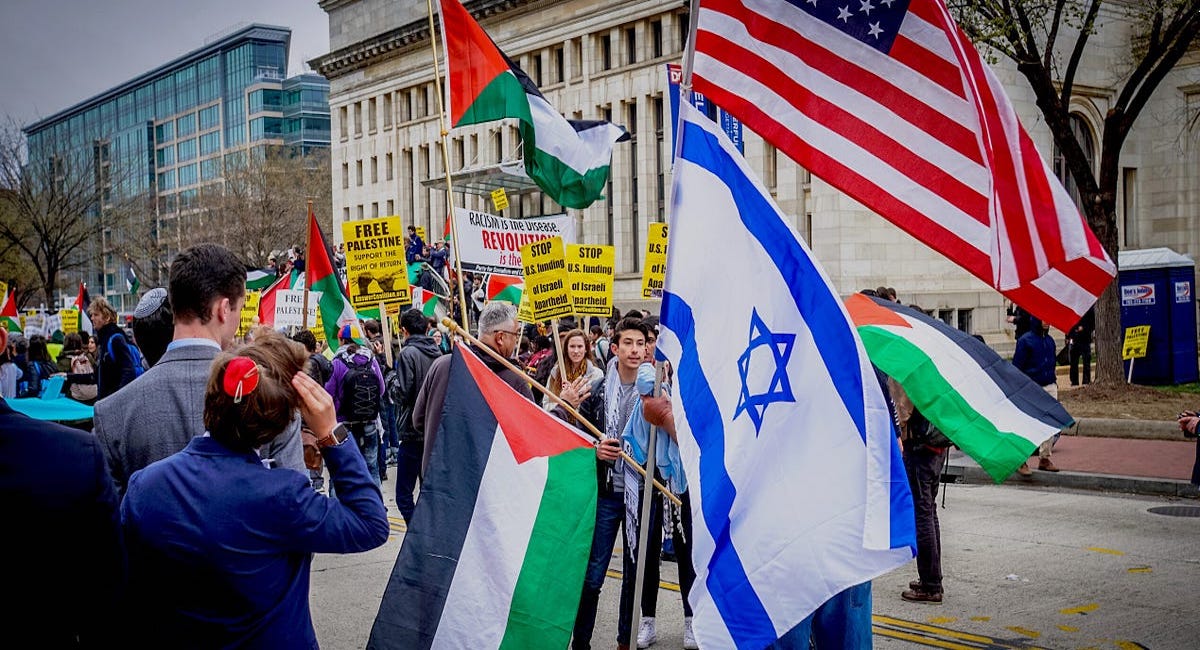
2023 Israel-Hamas War from a Korean Perspective Park Hyondo Professor, the Sogang Euro-MENA Institute, Sogang University in Seoul Palestine and Israel The British planned to withdraw their troops and end the Mandate in Palestine at midnight on May 14, 1948. At 4 p.m., while Palestine was still under British Mandate rule, Israeli Zionists secretly gathered in a Tel Aviv museum, and Ben Gurion declared Israel's independence. Israel was founded based on the partition plan for Palestine passed by the United Nations General Assembly on November 29, 1947, with 33 votes in favor, 13 against, 10 abstentions, and one absentee (Thailand). The Palestinian Arabs rejected the UN partition plan but did not prevent it from being presented to the UN General Assembly and passed. Unable to recognize Israel's independence, seven Arab states, led by Egypt and including Jordan, Syria, Iraq, Lebanon, Saudi Arabia, and Yemen, unsuccessfully attempted to cripple Israel by launching the First Arab-Israeli War on May 15. About 700,000 Palestinian Arabs were displaced from their homes. The war is known in Arabic as al-Nakba, or Great Catastrophe, because it created a significant number of refugees. While the refugees still hold the keys to their homes, Israel has never allowed them to return. While the First War was a catastrophe for the Arabs, the Third War, known as the Six-Day War, was a setback in which Israel launched surprise attacks on June 5, 1967. The Arabs were devastated. At 7:45 a.m., an Israeli airstrike destroyed 391 Egyptian airplanes before they could even take off. The war ended in a complete Israeli victory: Israel captured the Sinai Peninsula and Gaza from Egypt, the West Bank of the Jordan River from Jordan, and the Golan Heights from Syria. After a surprise attack by Egypt in 1973 led to a fourth war, Israel signed a peace treaty with Egypt in 1979, returning the Sinai Peninsula to Egypt while retaining control of Gaza. In 1994, Israel also made peace with Jordan but did not return the West Bank. Israel is willing to trade the Golan Heights for a peace deal, but Syria has consistently refused, demanding an unconditional return. The territories currently inseparable from the Palestinian issue are the Gaza Strip and the West Bank of the Jordan River. According to the Palestinian National Bureau of Statistics, as of 2022, there were 5.35 million Palestinians (2.72 million men and 2.63 million women), with 3.19 million living in the West Bank (1.62 million men and 1.57 million women) and 2.17 million in Gaza (1.1 million men and 1.07 million women). The West Bank covers an area of 5,655km2, more than 15 times larger than Gaza (365km2). Palestine Liberation Organization (PLO) and Hamas The Palestine Liberation Organization (PLO) was formed at the First Arab Summit in 1964, but with Egypt acting as its guardian, the Palestinian independence movement’s autonomy was significantly reduced. However, after suffering a humiliating defeat in the 1967 Six-Day War, the PLO realized the importance of its own movement and began to expand its radius of action without relying on its Arab brothers. It was only then that the Arabs living in Palestine realized that they had to create their own state. In fact, even before Israel’s independence in 1948, the Palestinian problem was complicated by the lack of strong Palestinian nationalism. There was more of an Arab nationalist view of Palestine as a part of Syria than a nationalist view of Palestine as my homeland, defending it and making it my country. In 1919, the Palestinian delegation to the Paris Peace Conference resolved that Palestine was part of Syria. In 1937, before the British Royal Commission, Arab leader Auni Abdul Hadi argued that Palestine was a word coined by Jewish Zionists and that there was never a country called Palestine; it was part of Syria. In 1946, opposing the partition of Palestine at the Anglo-American Council, Arab historian Philip Hitti, a professor at Princeton University, argued that a country called Palestine had never existed in history. In a May 1947 statement to the UN General Assembly, the Arab League representative argued that Palestine was part of Syria and that Palestinian Arabs were not independent enough to form an independent political entity. Ahmad Shuqairi, the first chairman of the PLO, stated that it was customary to view Palestine as a southern province of Syria. The PLO realized in hindsight that it needed to create its own state, but the road ahead was not smooth. In Jordan, where Palestinian refugees make up the majority, the PLO was labeled as a subversive force and ousted, and it was not welcomed in Lebanon or any other Arab country. At the 1976 Munich Olympics, the PLO’s “Black September” group kidnapped and murdered Israeli athletes, drawing international condemnation. The vicious cycle of terror, isolation, and marginalization continued. Palestinians raised the flag of resistance against the Israeli government in 1987. The first popular uprising (intifada) began. Hardliners traveling abroad grew increasingly resentful of the PLO, which had been leading the Palestinian independence movement. In response to the PLO's incompetence, Hamas emerged as an Islamist resistance movement. Founded in 1928 as the Palestinian branch of the Muslim Brotherhood, an Islamist movement founded by seven young men in their 20s in Ismailiya, Egypt, near the Suez Canal, to restore the glory of Islam, Hamas, unlike the secular PLO, emphasized Islam and led the Palestinian independence movement. Amid fierce resistance from Palestinians, Israel and the PLO recognized each other’s existence in 1993 and signed a peace agreement. Israelis and Palestinians laid down their arms, marking a historic reconciliation of peaceful coexistence. In recognition of this, in 1994 the Nobel Prize Committee jointly awarded the Nobel Peace Prize to PLO Chairman Arafat, Israeli Prime Minister Yitzhak Rabin, and Israeli Foreign Minister Shimon Peres for turning war and hatred into peace and cooperation. But on November 4, 1995, Rabin was assassinated by Yigal Amiran, an Israeli far-right extremist. In Israel, the political forces that most strongly reject peaceful coexistence with the Palestinians are led by far-right conservatives, such as the Jewish Home, Netanyahu’s current coalition partner. National Security Minister Ben Gvir is a prime example. Netanyahu, of course, is a staunch opponent of Rabin’s two-state solution. In Palestine, Hamas refuses to coexist with Israel. Hamas does not recognize Israel. In its 1988 charter, Hamas’s Palestinian homeland includes what is now Israel, meaning that an independent Islamic state of Palestine would be created by destroying Israel and reclaiming Palestine as its own. As Article 8 of Hamas' charter states, “Allah is the goal, the Prophet is the model, and the Quran is the constitution. Jihad is the way, and death for Allah is the noblest desire.” In 1979, the Iranian Islamic Revolution marked a significant turning point. If the Muslim Brotherhood in 1928 marked the beginning of the anti-Western and anti-secularist movement of Sunni Muslims in the Middle East, it was in Shi‘i Muslim-majority Iran that Islamic Revolution replaced a pro-American secular monarchy in 1979 with a republic that was neither East (Soviet communism) nor West (Western capitalism) but solely Islamic. It was the first Islamist revolutionary state to integrate Islam into a political system. In 1973, Muslims in the Middle East regained their confidence when they startled the West with the oil crisis after the 1973 War, demonstrating Muslim power to the West for the first time since Napoleon’s invasion of Alexandria in 1798. The Iranian Revolution served as an example of how to live the Muslim way in the midst of such a massive historical shift. Although Iran is a Shiite country, the Iranian Islamic Revolution was not a Shiite revolution, but an Islamic revolution as envisioned by the Sunni Islamist thinker Mawdudi. After toppling an oppressive monarchy with the slogan of liberating the oppressed, Iran’s Islamic Revolutionary leadership turned its attention to Palestine, which became a battleground between Arab nationalists and Zionists. To liberate Palestine, Iran founded the anti-Israeli militant organization Hezbollah, or the Party of Allah, in Lebanon’s Shiite heartland in 1982 and has supported it ever since. Hezbollah is the jewel in crown for Iran. Iran does not recognize Israel. Unlike Iran and Hezbollah, which are Shiite, Hamas is Sunni, but sectarian differences are irrelevant when it comes to the cause of destroying Zionist Israel. Iran, like Hezbollah, has consistently supported Hamas. In 2011, when the “Arab Spring” popular protests swept across the Middle East, Hamas and Iran feuded over support for the Syrian government. Iran wanted Hamas to support the Syrian government, but Hamas refused, which led to a falling out. After the Egyptian Muslim Brotherhood lost power and the Iranian-backed Syrian government gained ground in the Syrian civil war, the isolated Hamas reconciled with Iran, and Iranian support for Hamas resumed in late 2014. So is Iran Behind the Hamas Attacks? Logically, Iran, Hamas, and Hezbollah are allies in the struggle against Israel, but the relationship between Iran and Hamas is different from that between Iran and Hezbollah. Hamas does not do everything Iran wants it to do. It is not a master-servant relationship. There is a strong suspicion, but no proof, that Iran is behind Hamas attacks, as the United States puts it. Iranian Supreme Leader Ali Khamenei has emphasized that Iran has nothing to do with the Hamas attacks. The reason the U.S. believes Iran is behind this is not solely due to Iran’s normal relationship with Hamas. The attack occurred at a time when Israel’s relationship with Saudi Arabia was moving towards normalization. Ayatollah Khamenei stated that normalizing relations with Israel is akin to “betting on a losing horse.” Israel hopes that by engaging with Saudi Arabia, the entire Arab world will not only normalize relations with Israel but also contain Iran, which seeks its destruction. Despite the resumption of ambassadorial-level diplomacy after a seven-year hiatus, Saudi Arabia remains concerned about Iran. As the U.S. is preoccupied with containing China, it encourages Israel and Saudi Arabia to work together to restrain Iran. Hamas is well aware that Saudi Arabia’s condition for diplomatic relations with Israel would marginalize it, leaving it out of important discussions in the Palestinian issue. Consequently, it is likely that Hamas carried out this attack to strain relations between the two countries. While there are various theories, including the involvement of Iranian masterminds and Hamas acting independently, one thing is certain: there will be no peace in the Middle East until the Palestinian issue is resolved. Let us refrain from the distressing practice of tallying precious lives as casualties. May the souls of the victims rest in peace. .bbs-view-content {font-size: 14pt; text-align: justify;} .bbs-view-content table {width: 100%; border: 1px solid #333333; border-collapse: collapse;} .bbs-view-content table td {border: 1px solid #333333; padding: 5px;text-align: center; font-size: 12pt;} .bbs-view-content .note {border: 1px solid #333333; padding: 15px; text-align: left; font-size: 12pt;} @media (max-width: 800px) {.bbs-view-content {text-align: left;}}
23.11.03 -
 [North Korean Terminology]
Life Review SessionA Life Review Session refers to a gathering where North Korean residents reflect on their work and personal/professional lives in their affiliated party, institution, or labor group on a weekly, monthly, quarterly, and annual basis, and mutually critique each other.In its early days, the Life Review Session was held once a month, and participation was not strictly enforced. However, after the onset of the sole regime in 1967, the Life Review Session became more stringent. North Korea strengthened internal control in opposition to the establishment of a monolithic ideological system and the detente atmosphere in the international community. As a part of this, the party's organizational life system was restructured, intensifying the Life Review Session. The most significant change in this process was the institutionalization of the party life review. Kim Jong-il's established "New System for Life Review Session" was much more stringent and strict compared to the early days.In the "New System for Life Review Session", Life Review Sessions were meticulously organized, grouping 10 to 15 people together, similar to a party cell. Every North Korean resident was obliged to participate in the Life Review Session. Though the Life Review Session may seem trivial and routine, it became a means to thoroughly control and dominate the daily lives of North Korean citizens. In April 1974, one of the "Ten Principles for the Establishment of a Monolithic Ideological System" explicitly stated active participation in the Life Review Session.From the second grade of elementary school, one must mandatorily join a political organization, and thereafter, everyone, regardless of age or gender, must participate in the Life Review Session. Party members participate in their respective party cells, while non-party youths join the 'Socialist Patriotic Youth League', younger members join the youth organization, women join the Socialist Women's Union of Korea, workers join the General Federation of Trade Unions of Korea, and farmers join the Union of Agricultural Workers of Korea.North Korean diplomats and students abroad are also obliged to participate in the Life Review Session. Each embassy and trade representative office has temporary party cells or league organizations, so any North Korean abroad must partake in these sessions. The Life Review Session involves self-criticism and mutual criticism, where individuals reflect on and criticize their mistakes. Whether it's a party organization or a labor group, the nature and method are the same.Kim Il-sung emphasized that excelling in self-criticism and mutual criticism is the best weapon to elevate party character and repeatedly stressed the importance of criticism. Kim Jong-il institutionalized the Life Review Session in the context of establishing a succession system. Through this, the Life Review Session was used as a powerful control mechanism to fully entangle residents ideologically within the organization.The current Life Review Session in North Korea, due to the cracks in the collectivist society, is more ceremonial compared to the past, and its authenticity has faded. However, considering that North Korean residents are forced to participate in organizational activities, including the Life Review Session, throughout their lives, the significance of the Life Review Session in North Korean society remains valid and is still utilized as a means to control the entire population.
23.10.20 -
 [Insights from within North Korea]
DIU Formed by President Kim Il Sung in His TeensEditorial Note: October 17, 2023 marks the 97th anniversary of Kim Il-sung's establishment of the Down-with-Imperialism Union (DIU) when he was just 10 years old. While this narrative plays a pivotal role in North Korea's education system, it's important to note that it contains unverified objective facts and serves to legitimize the country's hereditary regime. The following is content as presented by North Korea.Today marks the 97th anniversary of the formation of the Down-with-Imperialism Union (DIU), a genuine communist revolutionary organization, under the leadership of President Kim Il Sung.North Korea asserts that in 1926, at age 14, Kim Il-sung formed an organization to challenge Japanese imperialism and free Korea. (Photo: Rodong Sinmun)On the occasion of this meaningful day, our people recollect with deep emotion the undying feats of the President who gave birth to the origin of new type of the revolutionary Party building by forming the DIU.The DIU was the first revolutionary youth organization in our country as it was organized with youths of the new generation aspiring after socialism and communism to achieve the national liberation and the class emancipation with the ideal of anti-imperialism, independence and sovereignty.The President, who embarked on the revolutionary road in his early years, made his effort to find a new way for liberating the country from Japan’s colonial rule during his revolutionary activities at Hwasong Uisuk School in the mid-1920s.1986 North Korean stamps commemorating the 60th anniversary of the DIU's inceptionFirst of all, He explored the genuine path of the Korean revolution, the road of independent development, provided the hard core for it and pushed ahead with the work to form a vanguard organization of the revolution.He told the young core members sharing the intention with him:We must open up a long and thorny path in order to liberate the country and build a society in which the working people can live happily; if we build up our ranks and fight tenaciously at the cost of our blood, we shall emerge victorious; after forming an organization we should rally the masses behind it and arouse them to liberate the country by relying on their own efforts.Later, he discussed the name of the organization and its character, fighting programme and norms of activities with them.Under such detailed preparations, the President formed the DIU, a vanguard organization of the revolution, with young communists of the new generation on October 17, Juche 15 (1926).North Korea asserts that in 1926, at age 14, Kim Il-sung formed an organization to challenge Japanese imperialism and free Korea. (Photo: Rodong Sinmun)At that time, the President was in his teens.At its inaugural meeting, the President said that the formation of the DIU is a proclamation of the decisive battle for overthrowing Japanese imperialism with arms and a declaration of showdown with all imperialism throughout the world.In North Korea, the DIU is seen as the foundation of their national identity, often termed 'Kim Il-sung's North Korea.' (Photo: Rodong Sinmun)The immediate task of the DIU was to defeat Japanese imperialism and achieve the liberation and independence of Korea, and its final objective was to build socialism and communism in Korea and, further, destroy all imperialism and build communism throughout the world.Indeed, the formation of the DIU was a historic declaration heralding the new start of the Korean revolution and since then, the Korean revolution has advanced along the road of independent development with definite fighting target and strategy.
23.10.20 -
 [SAND Research Report]
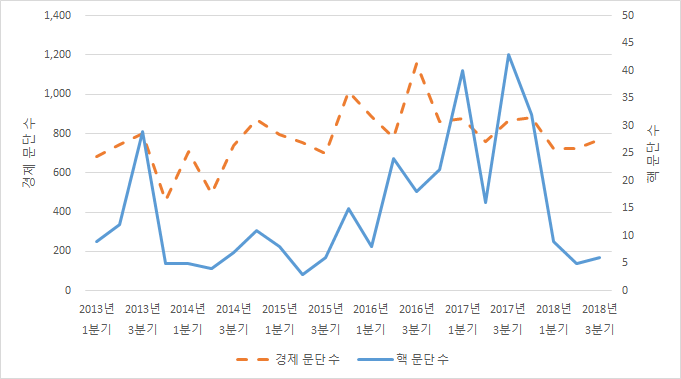
A Study on North Korea's Nuclear Economic Policy: Focusing on Correlation Editorial Note: This research is a joint endeavor from the 2019 initiative aiming to lay the groundwork for reunification. This initiative was spearheaded by the SAND Research Institute in partnership with the Institute of Economic Research at Seoul National University. Within, we provide an up-to-date analysis examining the frequency, significance, co-occurrence, and implications of the terms "nuclear" and "economy" in various contexts. 1. Background and Purpose One of the most significant questions in North Korea's denuclearization negotiations concerns the North Korean regime's will to denuclearize. Specifically, whether North Korea is willing to abandon its nuclear program for economic development remains a matter of debate. Some argue that Kim Jong-un has a strong intention to denuclearize for economic growth, depending on the conditions presented in the negotiations. On the other hand, others believe that Kim Jong-un has no intention to give up nuclear weapons and that his goal in denuclearization talks is to become a legitimate nuclear state. While providing a definitive answer to this crucial question is challenging, one approach is to examine the relationship from North Korea's perspective. This study aims to analyze how North Korean intellectuals, experts, or official propaganda understand the relationship between the nuclear program and the economy using text mining techniques on North Korean data. More specifically, three possible relationships exist: a positive correlation (complementary goods), an independent relationship (independent goods), and a negative correlation (substitute goods). If many of the related terms for nuclear and economy overlap and reinforce each other's meanings, and there's a high correlation in their frequency of appearance, then North Korea may view their relationship as complementary. Conversely, if there's little overlap in terms but a negative impact on each other's meaning, they can be understood as substitutes. Through this analysis, this study aims to determine why North Korea shifted from its 2013 "Byungjin policy (parallel development)" to focusing on economic development in 2018. The study also seeks to derive implications for North Korea's national development strategy and future nuclear and economic development plans. In this study, we mainly analyze the leading North Korean journals, namely "Economic Research", "Political Legal Research", and "Kim Il Sung University Journal: Philosophy, Economy". These journals are significant representatives in their respective fields and provide valuable insights into the logical structure and evolution of the nuclear and economic discourse. 2. Analytical Methodology and Application In information retrieval theory, documents are represented as sets of word arrays for search and access. The Document-Term Matrix (DTM) and Term-Document Matrix (TDM) allow the extraction of word frequency per document. These methodologies are applied to extract related terms and their frequencies concerning nuclear and economy from "Economic Research", "Political Legal Research", and the “University Journal (Philosophy, Economy). Beyond the traditional approach, this study forms word matrices based on sentences and paragraphs to grasp the context-centric meaning. Association analysis employs the multiplication of the aforementioned TDM (Term-Document Matrix) and DTM (Document-Term Matrix) to depict a relative association scale for individual words. This method facilitates the extraction of terms that hold substantial relevance to "nuclear" and "economy" from the data analyzed in journals such as "Economic Research", "Political Legal Research", and "University Journal (Philosophy, Economy)". Correlation analysis evaluates the model based on correlation coefficients and adjusted coefficients of determination. This method ascertains the statistical significance of each variable using the P-value. Within the pages of the "Economic Research", "Political Legal Research", and "University Journal (Philosophy, Economy)", we have designated the quarterly frequency (or ratio) of the term "nuclear" as variable 1 (X1), and that of "economy" as variable 2 (X2). Subsequent statistical analysis is conducted to determine the correlation between these variables over distinct periods. 3. Principal Findings: Quarterly Frequency Analysis of "Nuclear" and "Economy" Terms Within the scholarly contexts of 'Economic Research', 'Political and Legal Studies', and the 'Academic Journal (Philosophy, Politics)', we systematically extracted and quantified the quarterly occurrences of the terms “nuclear” and “economy” as well as the frequency of paragraphs wherein these terms appeared. The goal of this extraction process was twofold: firstly, to evaluate the relative emphasis or importance placed on these terms over time, and secondly, to discern evolving patterns or dynamics between their respective usages. Upon thorough analysis, distinct patterns emerged concerning the trends of the terms 'economy' and 'nuclear'—both in terms of isolated word frequency and broader paragraph occurrence. As delineated in <Figure 1> and <Figure 2>, the term 'economy', both in its isolated occurrences and within paragraph contexts, maintained relative stability from the first quarter of 2013 through the third quarter of 2018. Contrarily, the term 'nuclear' exhibited notable fluctuations, with a pronounced surge in its frequency from the initial quarter of 2016 extending to the final quarter of 2017. To refine our understanding and provide a more nuanced interpretation, correlation coefficients were derived between the datasets, pertaining to these terms. Recognizing a possible inflection point around Q3 2016, the analysis was bifurcated to evaluate periods before and post this quarter. The ensuing results, encapsulated within <Table 3>, denote a correlation coefficient of 0.4198 across the entire timeline, which, notably, achieves statistical significance at a 5% confidence threshold. Post the third quarter of 2016, the correlation coefficient amplified to a noteworthy 0.8212, remaining statistically significant at the 5% level. Yet, precluding this period, the coefficient stood at a modest 0.3345—indicating a positive yet comparatively subdued correlation, with diminished statistical significance. Interestingly, patterns discerned from paragraph-based analyses were in alignment with those derived from isolated word counts. To encapsulate, our frequency-based assessment from Q1 2013 to Q3 2018 illuminated a prevailing positive correlation between the terms 'nuclear' and 'economy'. A segmented analysis of this timeline revealed that from Q1 2013 to Q2 2016, the terms operated more as Independent Goods, while the span from Q3 2016 to Q3 2018 saw them functioning more symbiotically as Complementary Goods. Table 1: Quarterly Frequency of the Terms 'Nuclear' and 'Economy' (Based on Word Count) 분기 Quarter 총 단어 수 Total Words 핵 단어 수 Occurrences of 'Nuclear' 경제 단어 수 Occurrences of 'Economy' 핵 단어 비율 Percentage of 'Nuclear' Usage 경제 단어 비율 Percentage of 'Economy' Usage 2013.1 80,766 9 1,181 0.00011 0.015 2013.2 84,016 14 1,301 0.00017 0.015 2013.3 79,196 39 1,423 0.00049 0.018 2013.4 61,574 8 792 0.00013 0.013 2014.1 73,416 5 1,388 0.00007 0.019 2014.2 61,764 2 951 0.00003 0.015 2014.3 74,515 8 1,319 0.00011 0.018 2014.4 79,744 12 1,678 0.00015 0.021 2015.1 80,431 6 1,569 0.00007 0.020 2015.2 82,818 3 1,381 0.00004 0.017 2015.3 82,715 7 1,172 0.00008 0.014 2015.4 89,421 32 1,915 0.00036 0.021 2016.1 89,199 9 1,541 0.00010 0.017 2016.2 81,019 48 1,334 0.00059 0.016 2016.3 113,017 22 1,836 0.00019 0.016 2016.4 87,326 21 1,409 0.00024 0.016 2017.1 83,759 70 1,576 0.00084 0.019 2017.2 82,246 22 1,430 0.00027 0.017 2017.3 85,003 62 1,648 0.00073 0.019 2017.4 91,246 40 1,468 0.00044 0.016 2018.1 75,671 15 1,232 0.00020 0.016 2018.2 82,918 6 1,235 0.00007 0.015 2018.3 82,896 7 1,453 0.00008 0.018 Figure 1: Quarterly Trends in the Frequency of 'Nuclear' and 'Economy' Terms (Based on Word Count) Table 2: Quarterly Frequency and Proportion of the Terms 'Nuclear' and 'Economy' (Based on Paragraph Count) 구분 Quarter 총 문단 수 Total Paragraphs 핵 문단 수 Paragraphs with 'Nuclear' 경제 문단 수 Paragraphs with 'Economy' 핵 문단 비율 Percentage of 'Nuclear' Paragraphs 경제 문단 비율 Percentage of 'Economy' Paragraphs 2013.1 3,656 9 683 0.00246 0.187 2013.2 3,858 12 745 0.00311 0.193 2013.3 3,468 29 799 0.00836 0.230 2013.4 3,076 5 459 0.00163 0.149 2014.1 3,222 5 711 0.00155 0.221 2014.2 2,848 4 494 0.00140 0.173 2014.3 3,383 7 738 0.00207 0.218 2014.4 3,534 11 871 0.00311 0.246 2015.1 3,579 8 794 0.00224 0.222 2015.2 3,529 3 754 0.00085 0.214 2015.3 3,918 6 700 0.00153 0.179 2015.4 4,082 15 1,013 0.00367 0.248 2016.1 3,782 8 889 0.00212 0.235 2016.2 3,675 24 778 0.00653 0.212 2016.3 5,245 18 1,158 0.00343 0.221 2016.4 4,062 22 860 0.00542 0.212 2017.1 3,909 40 879 0.01023 0.225 2017.2 3,574 16 757 0.00448 0.212 2017.3 3,940 43 865 0.01091 0.220 2017.4 4,181 32 884 0.00765 0.211 2018.1 3,453 9 725 0.00261 0.210 2018.2 3,620 5 726 0.00138 0.201 2018.3 3,721 6 771 0.00161 0.207 Figure 2: Quarterly Trends in the Frequency of 'Nuclear' and 'Economy' Terms (Based on Paragraph Count) Table 3: Correlation between the Frequencies of 'Nuclear' and 'Economy' Terms by Time Period 기준 분류 Classification 전 기간 Overall Period 2016년 3분기 이전 Prior to Q3 2016 2016년 3분기 이후 Post Q3 2016 상관계수 (p-값) Correlation Coefficient (p-value) 단어 수 Word Count 0.4198* (0.0461) 0.3345 (0.2424) 0.8212* (0.0124) 문단 수 Paragraph Count 0.4637* (0.0259) 0.4144 (0.1407) 0.8874* (0.0033) Note: The (*) symbol indicates statistical significance at the 5% confidence level. 4. Implications The words "nuclear" and "economy," as well as paragraphs containing these terms, display a positive correlation in their frequency, and the overall trend showcases a parallel trajectory. Considering North Korea's practice of scrutinizing all publications, it can be inferred that after North Korea declared its simultaneous nuclear and economic development policy (also known as Byungjin policy or parallel development) in 2013, the country's leading academic journals have reflected this fundamental policy direction of the party. However, the fact that the correlation coefficient between "nuclear" and "economy" significantly increased post-Q3 2016, achieving statistical significance, can be interpreted as being related to North Korea's series of military provocations from the start of 2016 to the end of 2017. This includes nuclear tests and the testing of Intercontinental Ballistic Missiles (ICBMs), and the global community's response to such actions. As military and political tensions escalate, North Korea, facing international criticism, appears to have intensified its domestic justification for nuclear development. One manifestation of this emphasis is evident in the increased frequency of terms like "nuclear" and "economy", especially "nuclear", in academic journals and other publications. (To be continued in the next issue) .bbs-view-content p { font-size: 14pt; text-align: justify; } .bbs-view-content table { width: 100%; border: 1px solid #333333; border-collapse:collapse; } .bbs-view-content td { border: 1px solid #333333; padding: 5px; } .bbs-view-content td p { text-align: center; font-size: 12pt; }
23.10.20 -
 [2023 Unification Perception Survey]
2023 Unification Perception Survey by the Institute for Peace and Unification Studies at Seoul National UniversitySouth Korean Sentiments toward North Korea: A Rising Tide of Distrust and Vigilance Not Seen Since 2007The current global tensions, akin to a new Cold War, coupled with North Korea's aggressive military actions, have notably altered South Korean views. Our 2023 survey shows an unprecedented wariness towards North Korea since 2007. Concurrently, there's a rising recognition of the alliance between South Korea, the US, and Japan, even as threats from North Korea, China, and Russia intensify.Last week, Seoul National University's Institute for Peace and Unification Studies, led by President Kim Bum-soo, presented their '2023 Unification Perception Survey' at the Hoam Faculty House. The data revealed a rise in negative views towards North Korea: those seeing it as adversarial increased to 18.6% from 13.6%, caution grew from 17.7% to 24%, and overall negative sentiment reached a record 42.6% since 2007.Survey Results: What do South Koreans think about North Korea? (Data from a 2022 survey conducted by the Institute for Peace and Unification Studies at Seoul National University)The data shows that individuals in their 20s have a deep distrust towards North Korea at 49.3%. In contrast, those in their 50s, though more trusting of North Korea, also see a greater likelihood of its military aggressions.The numbers further unveil that 64.8% of respondents now believe in North Korea's likelihood to resort to military provocations, a slight increase from the previous year’s 60.9%. Contrarily, the spirit of collaboration has taken a hit, plummeting from 47.9% to 37.7% — a steep decline of over 10%.The Institute opined, "Considering North Korea's anticipated missile initiatives, it's improbable that the prevailing negative sentiments will dissipate anytime soon." Furthermore, they project continued divides in opinion, stemming from generational, regional, and ideological differences.The Institute speculates, "Post-COVID-19, if the global media were to highlight positive changes in North Korea, especially in sectors like tourism, education, and international cultural exchanges, we could potentially witness a shift in perceptions."Another pivotal revelation from the survey was the declining sentiment for unification. Only 43.8% now believe in its necessity, the lowest since 2007. Conversely, those skeptical of unification have risen to an all-time high of 29.8%. The Institute stresses, "To foster a positive sentiment for unification, both external diplomatic maneuvers to mitigate geopolitical threats and internal strategies to address socio-economic challenges are imperative."Survey Response Rate on the Topic of Korean Unification among South Koreans (Data from a 2022 survey conducted by the Institute for Peace and Unification Studies at Seoul National University)South Koreans seem to appreciate the firm stance of the Yoon Suk-yeol administration towards North Korea, evident from the increasing satisfaction rate, which now stands at 54.3%. The present sentiment of heightened distrust and caution towards North Korea likely amplifies this approval.Public Satisfaction Survey Results Regarding the Current Government's Policy on North Korea.(Data from a 2022 survey conducted by the Institute for Peace and Unification Studies at Seoul National University)On the nuclear front, even though support for South Korea's nuclear armament has marginally dipped to 52.3%, it remains significant. Interestingly, 49.3% endorse the idea of indigenous nuclear development, while 23.6% advocate for the deployment of US tactical nuclear weaponry.Survey Results on Public Opinions Regarding South Korea's Nuclear Armament. (Data from a 2022 survey conducted by the Institute for Peace and Unification Studies at Seoul National University)Perceptions about threats from neighboring countries also emerged prominently. North Korea unsurprisingly tops the list with 45.8%, followed closely by China at 36.8%. Japan, Russia, and the US follow in succession with 8.3%, 4.6%, and 4.5% respectively.Survey on Relations and Perceptions of Neighboring Countries. (Data from a 2022 survey conducted by the Institute for Peace and Unification Studies at Seoul National University)Lastly, an endearing revelation: South Koreans’ affinity for the United States has been on a steady climb. A heartening 81.5% now feel a closeness to the US, up from 53% in 2007. The emotional connection with North Korea, however, has dwindled dramatically from 24% in 2007 to a mere 7% in 2023. Japan, China, and Russia follow, with 5.3%, 2.8%, and 0.6% respectively indicating a sense of proximity.
23.10.06 -
 [North Korean Terminology]
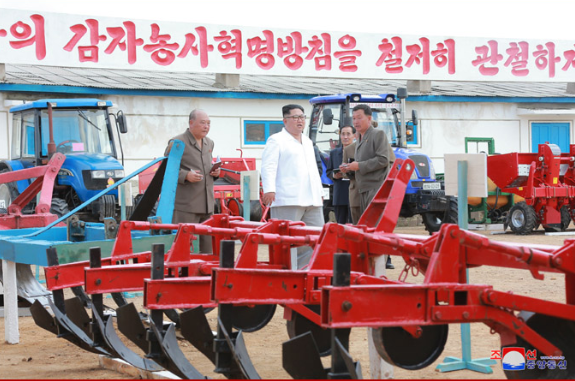
North Korea's Potato RevolutionChairman Kim Jong-un is seen giving directives to increase the level of mechanization in potato farming at the Jungheung Farm in Samjiyon City. (Photo by Rodong Sinmun)In the face of persistent food shortages, North Korea has embarked on a mission to address the hunger issue of its people by prioritizing potatoes as a staple crop. The regime is actively promoting potato cultivation and an increase in production, with a particular focus on the Ryanggang Province, centered around Taehongdan County. North Korea aims to instigate a significant boost in potato production, akin to a potato farming revolution.During the mid-1990s, a period known as the "Arduous March," North Korea witnessed a surge in malnutrition cases, underscoring the pressing need for increased agricultural production. In response, in October 1998, Kim Jong-il, during his visit to Taehongdan County, directed the replacement of corn, previously regarded as the king of crops, with potatoes. This decision marked the beginning of the "Potato Farming Revolution," highlighting a transformative shift towards potato cultivation.In January 1999, Ryanggang Province was designated as the "Potato Province," and in July 2000, North Korea established the "Potato-Producing Nation" for its agricultural sector. The regime also forcibly relocated thousands of soldiers to Samjiyon City and Taehongdan County in Ryanggang Province to intensify potato cultivation. North Korean authorities have pursued policies aimed at making potatoes a staple food source to address food shortages.A propaganda poster released in celebration of the 65th anniversary of the founding of the WPK, featuring the slogan "Let's bring unprecedented prosperity to our potato fields!"North Korea explains, "There are two methods to increase agricultural production: raising the yield per unit of land and expanding cultivation areas." The Potato Farming Revolution aims to achieve a dramatic increase in potato production through these two approaches. The goal is to produce an average of 60-70 tons per hectare in designated regions. Potatoes thrive in cooler conditions, making them suitable for North Korea's average temperatures and elevations. They also have the advantage of being cultivable in areas where rice and corn struggle to grow, making expanded cultivation a promising avenue for increased potato production.Taehongdan County in Ryanggang Province stands out as a prime potato-producing region and is renowned for its modernized and scientific agricultural practices referred to as the "Taehongdan-style Scientific Farming Methods." It has achieved comprehensive mechanization in potato farming, a key feature of its success.Kim Jong-un is personally overseeing Taehongdan County in Ryanggang Province, North Korea's most prominent potato production area. (Photo by Rodong Sinmun)As of October 2020, the major potato-producing region of Ryanggang Province had completed its potato harvest. In particular, Samjiyon City, a large-scale production area, reported exceeding this year's potato production plan, boasting the involvement of 18 multiple harvest teams and hundreds of workers. These harvested potatoes undergo secondary processing for enhanced shelf life at Samjiyon Potato Flour Production Factory and Taehongdan Potato Processing Factory. Despite being a crucial component of North Korea's agricultural policy alongside rice and corn, potato farming still faces challenges. To achieve substantial expansion in potato production, securing adequate supplies of fertilizers, energy, plastic, and agricultural machinery remains the most critical factor, and this is where North Korean authorities face their biggest hurdles in achieving the promised revolutionary transformation.
23.10.06 -
 [40th Anniversary of the Rangoon Bombing]
North Korean Attack: 17 South Korean Officials Killed in International TerrorKim MyungsungSAND's SecretaryGeneral Editor for the SAND NewsletterOn October 9, 1983, a tragic incident unfolded at the Martyrs' Mausoleum in Burma (now Myanmar), where 17 South Korean dignitaries, including the Deputy Prime Minister, tragically lost their lives in a North Korean terrorist bombing. This North Korean bombing, carried out with the intention of assassinating the South Korean President four decades ago, sent shockwaves not only through Korean society but reverberated across the globe. Even though the apprehended terrorists admitted to acting on North Korean authorities' orders, North Korea not only refused to apologize for this unprecedented act of terrorism but also accused the South Korean government of orchestrating the event. While I was in North Korea (I defected in 2002), I happened to learn about the Rangoon Bombing incident from a relative who had been involved. On October 9, 1983, at Myanmar's Rangoon Aung San Cemetery, South Korean government officials were awaiting President Chun Doo-hwan. This photograph captures their final moments seconds before the terror attack. (Photo by SBS 'Kkokkomu')At that time, my uncle served as an ambassador at the North Korean embassy in Myanmar. One day, I overheard a conversation he had with other family members. It was revealed that three North Korean operatives had sought refuge in the home of a North Korean diplomat located in Rangoon, Myanmar, for two weeks while preparing for their terrorist mission. Here's a summary of what I quietly gleaned from that conversation:The North Korean agents stayed on the embassy's second floor, and one evening, they engaged in a conversation with the ambassador over a meal. After becoming intoxicated, the North Korean ambassador and diplomats fell asleep on the first floor. However, one of the operatives couldn't sleep and was pacing around. When the ambassador asked why he couldn't sleep, the operative replied, "I can't stop thinking about my mother back home." The ambassador advised him to complete his mission and reunite with his mother upon returning.A few days later, the North Korean agents carried out a bombing attempt aimed at assassinating President Chun Doo-hwan at the Aung San Mausoleum. After the terrorists were apprehended and their connection to North Korea was exposed, the Burmese government expelled North Korean diplomats. The North Korean ambassador hastily departed for Moscow on a Soviet plane within 48 hours, expressing regret over the belongings he couldn't take with him. Upon returning to North Korea, he even served as the chairman of the Red Cross Society of the DPR Korea. This is the extent of what I learned about the Rangoon Bombing during my time in North Korea.October 9, 1983, North Korean terrorists detonated a pre-installed bomb, causing the building to collapse and resulting in the deaths of 17 South Korean government officials. (Photo by SBS)After defecting to South Korea and gaining access to the full details of the Rangoon Bombing through the internet and media outlets, I was astonished. Although the explosion occurred just before President Chun Doo-hwan's arrival at the mausoleum, averting a crisis, it resulted in the tragic deaths of 17 high-ranking South Korean officials, including the Deputy Prime Minister and the Foreign Minister, with over ten others sustaining serious injuries.The Donggun Patriot, the ship that carried North Korean terrorists and docked at Rangoon Harbor. (Photo by SBS)The Rangoon Bombing, orchestrated with the aim of removing the President of South Korea, was directed by North Korea's second-in-command at the time, Kim Jong-il, with the approval of Kim Il-sung. It was carried out under the command of Major Kang Chang-soo, a unit leader within North Korea's Reconnaissance General Bureau. Kang Chang-soo was the son of Kang Kon, the former Chief of the General Staff of the North Korean Army who perished during the Korean War on June 25. The leader of the three-member team responsible for explosives was Jin Seon-soo from Sariwon City in North Hwanghae Province, while the team members included Kang Min-chul from Thongchon County in Gangwon State and Shin Gi-cheol from Hamgyeong Province. The building of the North Korean embassy in Myanmar where the North Korean terrorists hid. The address was 154/A, Tiri 2nd Street, Ahlone, Rangoon. (Photo by SBS screen capture)The North Korean "Donggun Patriot, the ship" transporting the three terrorists and the necessary equipment, set sail from Ongjin Port in Hwanghae Province on the night of September 9, 1983, and arrived at Rangoon Port in Myanmar on the afternoon of September 17, just eight days later. Upon disembarking, the three terrorists received guidance from Ambassador Jeon Chang-hwi, who was the chief diplomat at the North Korean embassy. Their residence was located at 154/A Tiri 2nd Street, Ahlone, Rangoon. Although Jeon Chang-hwi held the position of chief diplomat, he was, in reality, a member of the Workers' Party's Liaison Department, serving as a North Korean overseas espionage coordinator. The local North Korean embassy played the role of their covert base of operations and provided support for their terrorist activities.To transport the necessary equipment and agents for the terrorist act, they utilized official embassy vehicles with diplomatic plates, which granted them immunity. The three North Korean terrorists stayed in the embassy's second floor for two weeks, where they devised their plan and received training. Explosives and detonation devices were smuggled in using diplomatic backpacks.On October 6, the three North Korean terrorists left their residence and, guided by Ambassador Jeon, conducted reconnaissance of the Aung San Mausoleum. The following morning, they climbed onto the roof of the mausoleum building and planted explosives (three bombs) on the ceiling. While Kang Min-chul and Shin Gi-cheol installed the explosives on the ceiling, Jin Seon-soo watched from below. These explosives were designed to be remotely detonated within a range of 1 to 2 kilometers, with an effective lethal radius of 80 meters. The three operatives spent the next two days camping in the surrounding woods.North Korean terrorists who were either arrested or killed while attempting to escape after the attack. From left to right: Captured Jin Mo, Killed senior operative Shin Gi-cheol, Captured and confessed senior operative Kang Min-chul. (Photo by SBS)On the morning of October 9, three terrorists detonated a bomb and scattered to make their escape to the harbor, with plans to return to North Korea aboard a ship. The leader, Jin Mo, attempted to swim across the river toward the sea on the evening of October 10 but was discovered, leading to a tightening dragnet. He detonated a grenade but survived. Kang Min-chul and Shin Gi-cheol attempted to flee on a fishing boat on the 11th but engaged in a shootout with the police. Shin Gi-cheol was killed, and Kang Min-chul managed to escape but later, on the 12th, detonated a grenade before being captured by soldiers. His left forearm was severed, but he survived. According to my uncle's account, the suicide grenades they carried, provided by North Korean authorities, were designed to explode immediately upon removing the safety pin. The operatives were unaware of this, resulting in their disfigurement and disabilities.North Korean terrorist Kang Min-chul, who spent 25 years in detention, eventually met his end in Myanmar's Insane Prison. (Photo by SBS)North Korea vehemently denied any involvement in this incident. However, on November 22, the suspects, who were arrested by Myanmar's prosecution authorities, confessed to their crimes. Subsequently, on December 9, the Rangoon People's Court's Special Tribunal issued a death sentence for the two terrorists. Jin, who remained silent until the end, was executed in April 1985, while Kang Min-chul, declared insane, served time in a Myanmar prison until his death on May 18, 2008, at the age of 53.The 17 individuals who tragically lost their lives in North Korea's bomb attack on October 9, 1983.North Korea's motive for the terrorist act was to induce social chaos and regime overthrow through the assassination of the president. The 1970s and 1980s were a period of intense Third World diplomacy between South Korea and North Korea. President Chun Doo-hwan's state visit to Myanmar, a country that shared socialist ideology with North Korea, had the potential to undermine North Korea's leadership in Third World diplomacy, leading to this act.The opening ceremony of the South Korean Martyrs Memorial Monument at Aung San Cemetery in Myanmar, held on June 6, 2013. (Photo by Yonhap News)High-ranking North Korean defector and Unification Minister Go Young-hwan remarked, "North Korea attempted to assassinate President Chun Doo-hwan in Africa in 1982 but canceled the mission under Kim Il-sung's orders, stating that Africa was not suitable. It seems they relocated the assassination attempt to Myanmar." This incident shook the international community's opinion, leading to South Korea asserting its dominance in relations with the Third World through South-South cooperation.The Myanmar government reported the Rangoon Bombing as an act of North Korea to the United Nations and sent a delegation to apologize to the South Korean government. Additionally, 69 countries, including the United States and Japan, issued a joint statement condemning the North Korean regime. Despite diplomatic isolation, North Korea continued its acts of terror against South Korea and the international community. Incidents like the 1987 Korean Air Flight 858 bombing, the 2010 sinking of the ROKS Cheonan, the 1997 assassination of Kim Jong-il's half-nephew, Yi Han-yong, and the 2017 assassination of Kim Jong-nam show that North Korea's acts of terror persist. The international community must unite in condemning North Korea's barbaric acts of terrorism and ensure that they are not repeated.
23.10.06 -
 [North Korean Terminology]
Inminban (People's Units)The People's Units, or Inminban, are the smallest administrative units in North Korea. Comparable to the 'dong' and 'ban' levels of administrative organization in South Korea, they mainly consist of full-time homemakers and retired workers.Titled "Harmonious Inminban," this article was featured in the Rodong Sinmun on May 12, 2022, highlighting the formation and management of Inminban in the same residential area. / Photo by Rodong SinmunThe origin of North Korea's Inminban can be traced back to 1946, at the onset of land reforms when they were organized nationwide as social cooperation units under the People's Committee of North Korea. During this period, land area statistics were aggregated based on Inminban, village, Ri (administrative division), and Myeon (administrative division).Following the immediate aftermath of Korea's liberation from Japanese rule, North Korea established the 'Inminban' as the smallest administrative control organization to effectively manage its citizens. This organization is led by a head, known as the banjang, who is nominated at the city or county (district) people's committee office based on recommendations from residents. Typically, women from loyal and reputable families are selected for this role. Other members of the Inminban include the household head, sanitation head, and propagandists. Originally composed of 20-30 households, urbanization and the rise of apartment buildings led to a restructuring in 1994, expanding the Inminban to encompass 20-40 households.North Korea defines the Inminban as "an organization comprising a specific number of households, established to uphold the policies of the Party and the state, execute state-social tasks, and prudently manage daily life." Operating as a system that addresses local concerns, such as childcare, sanitation mobilization, and maintaining public order, the Inminban relies on processes like general meetings.In June 22, 2021 issue, Rodong Sinmun showcased residents viewing 'film documentation' of the 3rd plenary session of the 8th Central Committee of WPK, including a photo of a family from an Inminban in Songphyong District, Chongjin City. / Photo by Rodong SinmunAfter the 'Arduous March,' a period characterized by economic crisis and famine in North Korea, the regime aimed to tighten control over its citizens by strengthening the Inminban system. In addition to the Inminban leader, there is also a household head. While the Inminban leader supervises the overall activities of the group, the household head specifically oversees the husbands of families. Especially in Pyongyang since the mid-1970s, these household heads have the authority to organize meetings, mobilize members, give lectures, and most importantly, monitor and report the activities of residents after work hours. This role establishes them as influential figures within the community.People working in general administrative agencies often avoid living in agency apartments to escape the surveillance of the local Inminban. Moreover, as the state distribution system becomes inadequate and markets expand, organizational solidarity is waning, resulting in a decline in the vibrancy and role of the Inminban compared to the past.
23.09.22 -
 [Feature Article]
North Korea’s Violation of the 9.19 Inter-Korean Military Agreement and Our Response StrategyMoon Seong-mookDirector, Center for Korean Unification StrategyKorea Research Institute for National StrategyOn the morning of September 19, 2018, at Pyongyang's Paekhwawon State Guest House, former South Korean President Moon Jae-in and North Korean leader Kim Jong-un observed the signing and exchange of a military agreement for the Panmunjom Declaration's implementation. Former South Korean Defense Minister Song Young-moo and former North Korean Minister of People's Armed Forces No Kwang-chol conducted the signing. / Photo by Pyongyang Joint Press CorpsIt's been five years since the 9.19 Inter-Korean Military Agreement, often referred to as the 9.19 Agreement, was finalized. Initially, North Korea showed some willingness to comply with the terms of the agreement. However, after the inconclusive outcome of the Hanoi summit in 2019, Kim Jong-un took a more direct and blatant approach in violating the agreement. According to the 2022 Defense White Paper, there have been 17 documented instances of North Korea's violations of the agreement since 2019. However, this number only includes major violations, and the actual count would be much higher if we consider other unrecorded cases. The 9.19 Agreement explicitly prohibits any hostile actions against the other party. North Korea's various provocations against South Korea are clearly hostile acts and thus constitute violations of the agreement. If we define "violation of agreement" as engaging in prohibited actions or failing to fulfill obligations, then North Korea is in violation of most of the agreement's provisions. Furthermore, North Korea has consistently used the agreement as a tool to threaten South Korea, even going as far as threatening to discard it.Korean Central News Agency reported that on November 25, 2019, North Korean leader Kim Jong-un inspected the Changrin Island Defense Force, located on the western front. / Photo by Korean Central News AgencySo, how should we respond to this situation? Firstly, while we continue to encourage North Korea to uphold the 9.19 Agreement, we must also maintain a strong military readiness. If North Korea fails to adhere to the agreement's terms, we shouldn't feel obligated to fulfill our part either. Secondly, in the event that North Korea violates the agreement and provokes us, we must respond with determination. It's essential to make them understand that provocations come with significant consequences. Thirdly, if North Korea persists in ignoring the 9.19 Agreement, as it currently does, we need to make a serious decision. As the president has previously warned, if North Korea engages in extreme provocative actions such as territorial incursions or additional nuclear tests, we should promptly consider suspending the implementation of the Inter-Korean Agreement. We should also be prepared to take all necessary subsequent measures, including the immediate reactivation of the Voice Of Freedom (VOF) directed at North Korea.1) In 2019, Kim Jong-un made a visit to Changrin Island in the West Sea and ordered shooting, despite it being designated as a no-fire zone.2) As per the 2022 Defense White Paper on page 353, under General Appendix 12, there are documented major violations of the 9.19 Military Agreement by North Korea.3) Article 1 of the 9.19 Agreement explicitly states, "Both South and North Korea have agreed to cease all hostile actions against each other across all domains, including land, sea, and air, that contribute to military tensions and conflicts."Keywords:hostile actions, violation of the agreement, military readiness
23.09.22 -
 [Feature Article]
Paradigm Shift and Search for a New Unification StrategyJinwook Choi Center for Strategic and Cultural Strategies⦁ Crisis of Liberal World Order⦁ From Peace to Security⦁ Search for a new Unification StrategyKorean unification has been pursued on the principle of engagement and peaceful means since the end of the cold war. Such chances become less feasible, however, as the US-China strategic competition and the North Korea’s nuclear weapons pauses unprecedented security crisis to the Korean Peninsula. It is time for South Korea to search for a new unification strategy. 1. Crisis of Liberal World OrderToday, the liberal world order led by the United States is faced with the crisis, which is closely related to the rise of China. The threat awareness remains controversial and the US response was not in time. The U.S. misjudged that there was a lot of hope for positive change in China. China was expected to be democratic and contribute to liberal international order as a G2 partner.The U.S. skepticism about China's democratization began with Xi Jinping's third consecutive term as chairman in 2023, following the suppression of the pro-democracy movement triggered by the promotion of the Hong Kong repatriation law in 2019. This could not avoid being evaluated as a Chinese-style political system beyond the Chinese-style economic system. Expectations for the G2 partnership of U.S.-China and China's political change that the U.S. wants have not been realized, but there has been no trick to promote China's transition to the system other than increasing interdependence. Strictly speaking, China was not included in the US sphere of influence, so control over China was limited.It turned out that China was the biggest beneficiary of globalization over time. The U.S.-led liberal world order, which began to decline due to the war on terror, was faced with outright challenges from China in the wake of the 2008 global financial crisis. The so-called realist strategists harshly criticized the U.S. liberal hegemony strategy, which pushed NATO's eastward movement and the war on terror, as a high-cost naive strategy without actively responding to China's challenge to the U.S.It was not until President Trump announced China the biggest security threat to the United States that the US policy towards China made a dramatic turnaround. President Trump criticized, "The U.S. has become a pushover that takes the lead in global agendas and is responsible for the security of other countries." The U.S.-China relationship is no longer an ambiguous relationship between competition and cooperation. The U.S.would reduce overseas overcommitment and extended deterrence and focus on balancing its power over China. President Trump defined globalization as a failure and declared de-globalization and "America First." The withdrawal from the Paris Climate Agreement symbolically showed a change in American interest and responsibility for leadership in the international order.G. John Ikenberry, a professor at Princeton University and an international liberal, argues that the nature of the liberal world order crisis is that the liberal world order expanded around the world with the end of the Cold War (rather than optimistic expectations of China's rise or regime change). In other words, the crisis began when the disparate countries tied to the Soviet sphere of influence were released. With the joining of a large number of disparate countries such as Russia and China, awareness of the security community has weakened, and a crisis of governance and goal consciousness has emerged. As a result, the globalized liberal world order, which is the result of the Cold War victory, did not grow soundly as an order in name and reality. Although it was a half-world order during the Cold War, the U.S.-led liberal world order was able to grow healthy because homogeneous countries in the liberal order shared values and maintained hierarchies by thoroughly blocking expansion instead of recognizing the Soviet sphere of influence.The Biden administration strategically conceptualized globalization based on dual vision by dividing the world in the two groups of countries: one is those who can share the vision and the other is those who cannot share the vision. There is no motivation to talk with those countries like North Korea and China. who do not share the vision. 미중 무역분쟁은 변수가 아닌 상수. “미중 무역분쟁 장기화 대비한 G2 통상전략 짜야” (사진/연합뉴스, 자료/ 무협제공)2. From Peace to SecurityThe unification strategy has been more of a political confrontation than efficiency or feasibility. The key to the so-called confrontation between conservatives and progressives was to expand the support base, and the "unification strategy" was a tool for this, characterized by a rosy vision of the future rather than the efficiency or reality of the strategy.Unification strategies have been established around unification scenarios. and packaging is more important than content. Political slogans or rosy visions may be mobilized to make wishful thinking look more realistic. In fact, the unification by absorption was not the government's official policy, but it was no wonder that North Korea expected to follow in the footsteps of Eastern socialist countries in the 1990s and had to prepare for it. Rather, in the early 1990s, there were many concerns that South Korea might not be prepared for the possibility of collapse of the North, and the cost of unification or the risk of war were not an issue. However, in the face of China's aid to North Korea and the U.S. soft landing policy, the scenario of unification by absorption failed to find momentum. Meanwhile, the gradual unification scenario was based on optimism about North Korea's change, but failed to ignore the truth that large-scale inter-Korean economic cooperation is impossible without North Korea's denuclearization. Peaceful coexistence was paved with gradual unification, but North Korea's rigid system and nuclear weapons caused power loss and only security instability.ROK’s Constitution is clear regarding what unification means: the South and the North are integrated into one system and one ideology under one government. Therefore, regardless of whether unification takes place gradually or suddenly, or whether the process of unification is short-term or long-term, unification is based on a liberal democratic order and led by the Republic of Korea. Despite this clear concept of unification, "de facto unification" in contrast to "legal unification," "peaceful coexistence without war" in contrast to "unification," and "gradual unification" in contrast to "immediate unification" are technically misuse of the concept.Leaders should always be prepared to answer what the core interests of the country are, what external forces threaten the core interests, and what they can do to defend the core interests from external threats. Sometimes they awaken threat awareness by exaggerating potential threats or raising target standard of goals. As threat awareness increases, the need for new strategies to overcome them increases, and energy to achieve goals is charged, strengthening the adaptability and durability of the system.Without threat awareness, the need for a strategy would not be urgent. However, in Korea's security field, there is a phenomenon of reducing or avoiding threat awareness. In particular, Korea's unification discourse presents a rosy vision of unification, but it is not very interested in how to overcome obstacles in the process of achieving its goals. The main issue of the unification discourse is to reduce concerns about ' astronomical unification cost after sudden collapse of North Korea'. The progressive camp has put "immediate unification," on the taboo at all, and presented an optimistic prospect of establishing an economic community through large-scale economic cooperation. However, the "Korean Peninsula Peace Process" did not provide a realistic method for denuclearization.3. Search for a new Unification StrategyKorean unification has been based on rosy scenarios regardless of reality. Few people believe that Korean unification are likely to materialize.and trust unification strategies are realistic. It is always difficult to implement unification policies. Now Koreans need to tackle substantial issues rather than discussing ambiguous plans. First, the unification strategy must include an active response to North Korea's nuclear weapons development. North Korea's nuclear weapons program is not only a security issue that threatens the survival of South Korea, but also a problem directly related to the framework and agenda of Korean unification. Negotiations on North Korea's nuclear weapons program have already been conducted between the U.S. and North Korea, and South Korea have been ruled out. Moreover, lifting economic sanctions, suspending South Korea-U.S. military drills and declaring an end to the war at a time when North Korea has dozens of nuclear weapons is an option that cannot be chosen without giving up security and hoping for a miracle of unification.Second, just as the division of the Korean Peninsula is a product of great power politics, unification will inevitably be affected by great power politics. Based on an objective analysis of this, overcoming obstacles and creating a friendly unification environment is an important part of the unification strategy. In particular, the recent Korean Peninsula issue and changes in the order of Northeast Asia have been increasingly closely related. South Korea often wonders which countries are friendly to inter-Korean unification and which are unfriendly. In a 1994 poll after the end of the Cold War, Koreans chose Japan (69 percent) as the most unfavorable country for reunification, while China accounted for only 5 percent. Now China (48%) is the most unfriendly country. Third, unification awareness is not necessarily limited to the framework of 'costs and benefits', but is often a matter of values and beliefs. In particular, the view of unification of the MZ generation is more realistic than emotional. They are concerned about North Korea's nuclear weapons and support the strengthening of the Korea-U.S. alliance for South Korea's security. They have some skepticisms of neighboring countries for their support for Korean unification, and do not trust North Korea. Dialogue and negotiations with North Korea are meaningless, and Korean unification is not so feasible. Therefore, the MZ generation is not active in unification. Fourth, state-centered unification and security-centered Republic of Korea are more important than the view of national unification today. It is important for South Korea to keep its identity as an independent country, rather than sharing a sense of community with North Korea. Unlike the past, Korean nationalism is not a strong motivation for pursuing unification. However, the Republic of Korea will not hesitate to absorb North Korea just in case and make a unified Korea more eagerly than any other country. This is duality of national identity. Therefore, how nationalism affects Korean unification is truly a puzzle.4. Concluding remarksThe unification strategy should be focused on solving imminent problems and overcoming obstacles rather than making a vague vision. However, while pursuing a strategy unrelated to feasibility for a specific unification scenario, the strategy clearly fails. Various views should be allowed to be expressed with regard to national security, but responsible authorities and experts should establish and implement strategies based on an objective and thorough analysis of the situation, and take responsibility for their analysis.key words:unificatio strategy, South-South conflict, lack of a strategic thinking
23.09.22 -
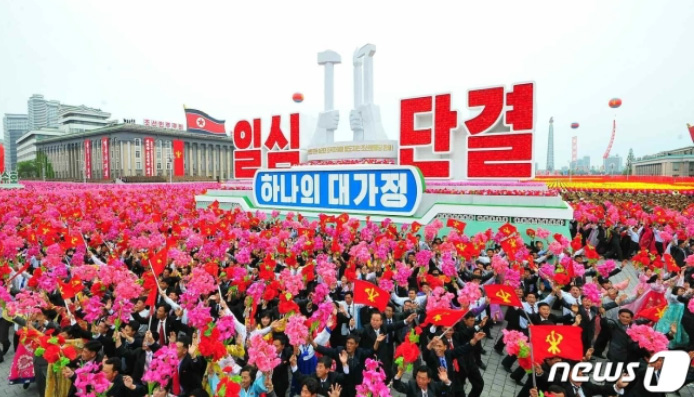 [North Korean Terminology]
Socialist Big FamilyThe concept of 'Socialist Big Family' views the entire North Korean society as a single-family unit, and perceives the relationship among the leader, party, and people similar to that between parents and their children. Rooted in this concept, North Korea highlights that showing loyalty and filial piety towards the leader is a natural response to benevolence.North Korean citizens waving the Workers' Party flag under the slogan "Unified heart, one family" (Photo by News1)In his New Year's speech in 1962, Kim Il-sung stressed the need for the masses to demonstrate their patriotic dedication and heroic public spirit to transform society into a harmonious and united big family. This was aimed at consolidating the entire population into a unified big family through a collectivist spirit. Emerging in the 1960s, the Big Family concept has since evolved into discourses like the 'Red Big Family', 'Revolutionary Big Family', and 'Communist Big Family', solidifying its influential position in maintaining the socialist regime.The Socialist Big Family concept essentially enlarges the image of the state to that of a family. By grafting the secondary group, 'the state', onto the primary group, 'the family', North Korea intends to argue that the Suryong, the supreme leader of the revolution, plays a more pivotal role than the biological parents in every household. Through the "domestication of the state", North Korea accentuates the love and trust between the Suryong and the masses, and the loyalty and filial piety of the masses towards the Suryong. This perspective is embedded in the education system, especially targeting children and teenagers, emphasizing them to grow up as 'loyal' and 'filial' to the Suryong. This is evident in the practice of reverently displaying pictures of Kim Il-sung and Kim Jong-il in the most prominent spots in households, acknowledging the Suryong as the 'true parents'. This fosters a state characterized by a patriarchal and organic nature, built upon the trinity relationship of 'Suryong-Party-People'.The entire society promotes unity under the "General's Guidance" within a single big family (Photo by Rodong Sinmun)The emphasis on the Socialist Big Family ideology became pronounced in the 1990s. Faced with internal and external challenges, North Korea underscored the 'Socialist Big Family' concept that binds 'Suryong-Party-People' together, aiming to bolster its waning collectivism. By expanding the traditional family's social significance, the regime sought to solidify its legitimacy and stability. The idea behind the Socialist Big Family was to consolidate society with the Suryong at its pinnacle, especially during challenging times like the death of Kim Il-sung in the mid-1990s. This perspective also shapes a societal structure where party officials, executing directives from Kim Il-sung, Kim Jong-il, and Kim Jong-un, naturally dominate the masses. Under the recent Kim Jong-un regime, the emphasis on the Socialist Big Family concept has been revived.
23.09.08
News Letter
We are leading the global communication via Newsletter.
We will deliver the latest information and proven facts on Korean Peninsula status including North Korea situation.